Swing Trading Earnings Season: When to Hold, Cut, or Enter
Stocks in the top decile of earnings surprises continued to outperform the market for weeks after the announcement (Skinner and Sloan, Review of Accounting Studies, 2002), and Bernard and Thomas (Journal of Accounting and Economics, 1989) showed the post-earnings drift persists for 60 trading days after the report. The return is real — but it reaches only those who enter correctly, at the right stage, with the right position size.
Earnings season introduces a binary overnight risk into every existing swing position. The decision framework covers three choices: cut marginal setups before the report, hold A+/A-grade setups with a gain cushion, and screen for fresh post-earnings entries once the chart stabilizes. Each section below works through the criteria.
Earnings Are Binary — Position Size Must Reflect That
Binary risk means the stock can gap 5–30% in either direction overnight, and no stop loss protects against an overnight gap. A position sized at 1% portfolio risk with a $2 stop can still lose 8–12% of its position value if the stock gaps down $10 on a miss — turning a manageable risk into a multi-R loss from a single event.
The options market prices the expected move for each earnings report. The expected move is the implied straddle price divided by the stock price — a rough consensus on how much the stock could move in either direction. For a $50 stock with a straddle priced at $3, the market implies a ±6% move. The swing trader's job is to compare that expected move to the current gain cushion and position size, not to guess which way the stock moves.
Mark Minervini addresses this directly in Trade Like a Stock Market Wizard (2013): positions with a gain cushion smaller than the expected move should be reduced or closed before the report. If you are up 4% on a position and the expected move is 8%, a miss erases your gain and puts you underwater on the position. If you are up 15% and the expected move is 8%, you can hold with less anxiety — a miss is painful but not catastrophic.
The one-R rule applied to earnings: if holding through the report would risk more than 1R, reduce the position to where the expected downside move equals at most 1R. Half-sizing before earnings is a simple implementation for most setups.
Three Decisions Before Every Earnings Report
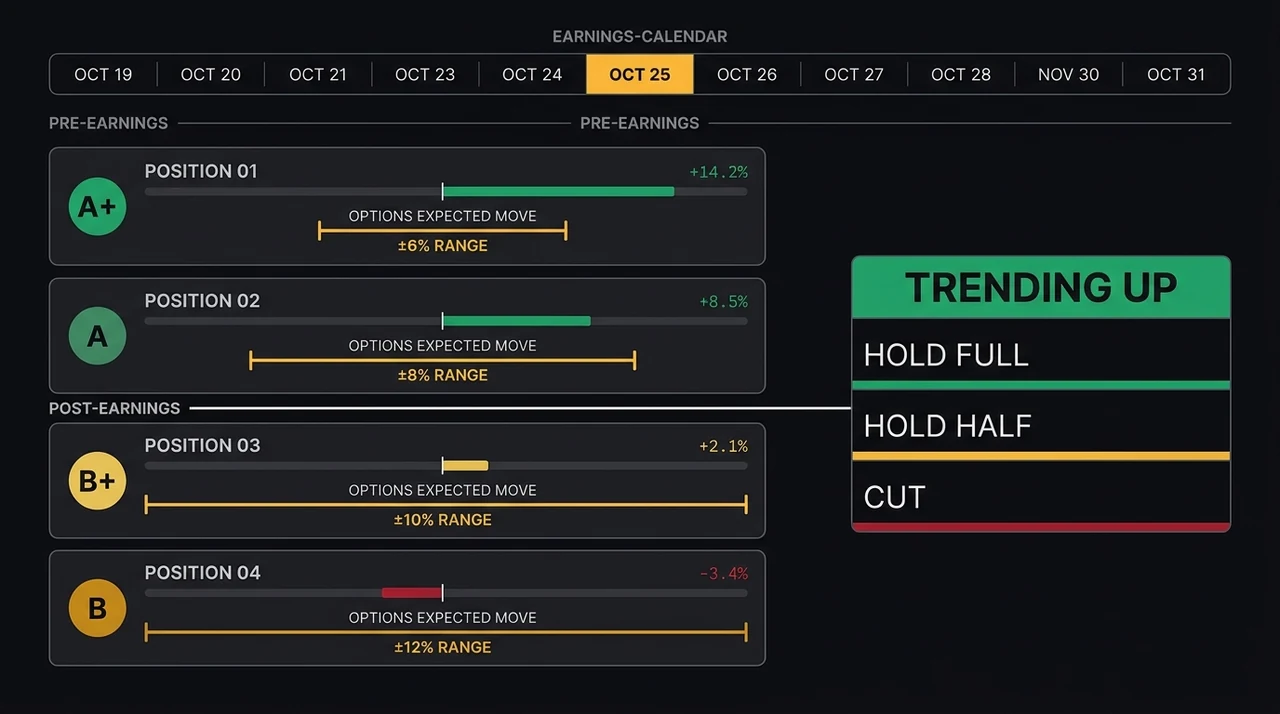
Before every earnings report that falls during an active swing position, the decision comes down to three options based on setup grade, gain cushion, and market regime.
Cut before. For B-grade and C-grade setups, cut the position before the report. These setups lack the institutional sponsorship and stage quality to absorb a miss cleanly. The B-grade setup that "should be fine" is the one that gaps down 15% on a slight revenue miss and takes weeks to recover. The cost of being wrong is asymmetric.
Hold full. For A+ and A-grade setups with a gain cushion greater than the expected move, a full hold is defensible. These are positions in leading stocks — high RS rank, clean Stage 2 uptrend, institutional volume on the breakout — where even a miss often produces only a brief pause rather than a breakdown. The setup earned the full hold through its quality.
Hold half. The default for B+ grade setups, or for A-grade setups where the gain cushion is less than the expected move. Reduce to half the position size before the close on the day before the report. This keeps exposure to an upside gap without catastrophic downside if the stock misses. The half that was sold can be re-entered after the report if the setup resumes cleanly.
EasySwing grades each setup A+ through C on a five-tier scale. That grade is the primary input into the hold/cut/reduce decision. See the position sizing guide for how to calculate the expected-move risk against your specific position size.
What the Post-Earnings Chart Tells You
The post-earnings chart is the highest-signal setup chart the market produces. A stock that reports strong earnings and holds its gap — staying above the gap-day close for two or three sessions — is showing institutional accumulation at the new level.
The Power Earnings Gap is the most documented post-earnings swing setup. A PEG requires a gap-up of 5% or more on at least 2× the 50-day average volume, in a stock that was already in a Stage 2 uptrend before the report. The entry is not on the gap-day open — it is after the first base forms. Gil Morales and Chris Kacher (Trade Like an O'Neil Disciple, 2010) documented that PEGs in leading stocks produced a median follow-through of 22% over the subsequent four to six weeks when entered at the first base pivot. See the dedicated power earnings gap guide for full entry criteria.
The earnings fade is the opposite scenario. A stock gaps up on the announcement, reverses intraday, and closes below the gap midpoint. This tells you the initial move was driven by short covering or retail momentum — not institutional buyers adding on strength. An earnings fade that holds below the gap high for two to three sessions is a short setup in the right regime.
The range consolidation is the most common post-earnings outcome: the stock gaps and immediately enters a tight consolidation. No clear direction for two to three weeks, then a resolution one way or the other. This is not a trade — it is a setup in formation. Watch it on the swing trading watchlist and enter when the base breaks with volume.
How Market Regime Changes Earnings Risk
The same earnings beat produces different price behavior depending on whether the broad market is trending or choppy. In a Trending Up regime — EasySwing's highest-confidence long environment — gap-ups on earnings beats follow through at a significantly higher rate. Institutional buyers add on strength because they have conviction in the broader market direction. In a Ranging or High Volatility regime, earnings gaps fade more often because institutions use the gap to lighten positions, not add.
EasySwing's market regime detector classifies the broad market each session — Trending Up, Ranging, Trending Down, and High Volatility. Long setups surface only in a Trending Up market, so the regime classification is the macro filter before applying any earnings-season decision. When the market is not Trending Up:
- Reduce hold/cut thresholds by one grade (what would have been a "hold A+" becomes "hold half A+")
- Skip post-earnings gap entries entirely unless the PEG criteria are met cleanly
- Extend the post-earnings wait period before entering a base breakout (three to five sessions minimum, not one to two)
In a Trending Up regime, you can hold A-grade setups through earnings and enter PEG setups more aggressively — the market tailwind reduces the probability of a false breakout.
| Regime | Hold Full Threshold | Hold Half Threshold | Post-Earnings Entry |
|---|---|---|---|
| Trending Up | A+ or A with cushion ≥ expected move | B+ with cushion > 0 | PEG + base entries |
| Ranging | A+ with cushion ≥ 1.5× expected move | A with gain cushion | PEG only, no base |
| High Volatility / Trending Down | A+ setups only | None — reduce all | No new entries |
Pre-Earnings Setup Screening
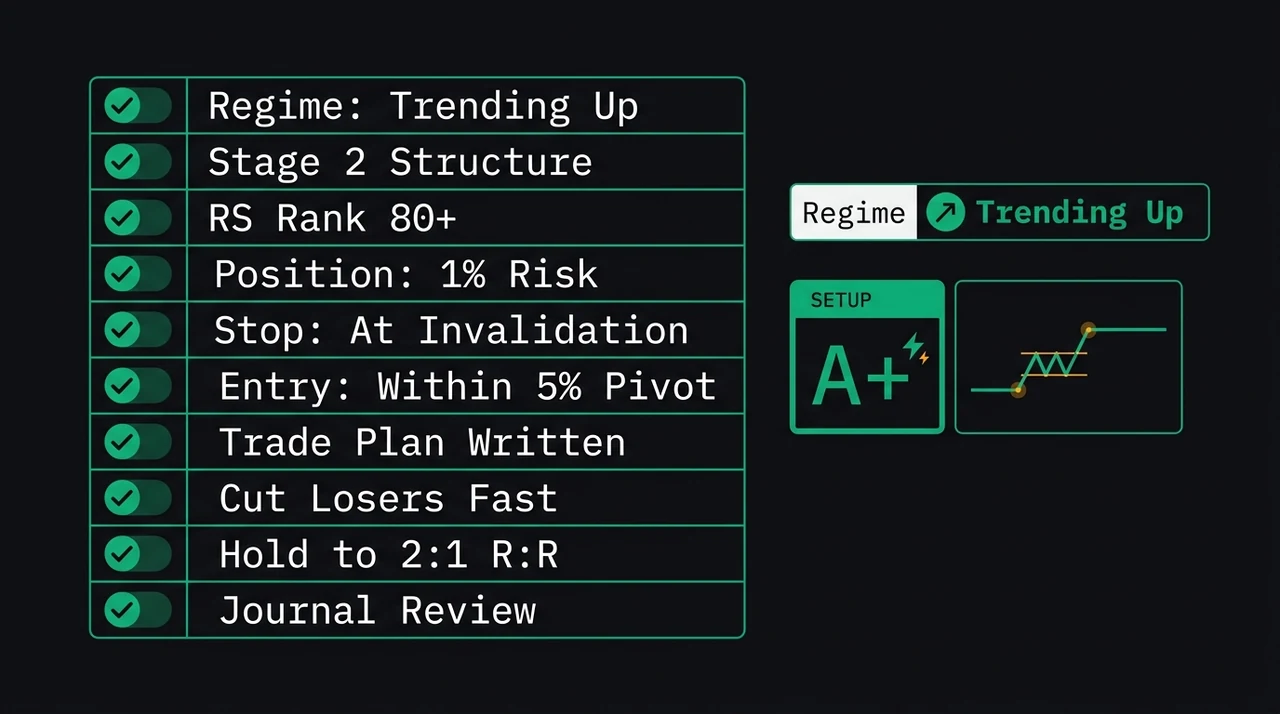
The best earnings trades are made before the report, not after. Stocks that enter earnings in the strongest chart position — clean Stage 2 uptrend, RS rank above 90, and volume contraction in the days before the announcement — have the highest probability of a gap-up continuation if the report beats.
This is the pre-earnings VCP setup: a stock that completes its tight consolidation phase in the sessions leading up to earnings is showing maximum supply exhaustion at exactly the right moment. When a positive surprise hits a stock at peak supply exhaustion, the explosive move has no overhead resistance to absorb it.
Screening criteria for pre-earnings swing setups:
- RS rank above 85 (stock is outperforming the broad market before the catalyst)
- Stock in confirmed Stage 2 uptrend (above rising 150-day and 200-day MA)
- Setup grade A or A+ on the current session
- Volume contraction over the past 5–10 sessions (tightening into the report)
- Position is not past a prior buy point by more than 5% (not extended before earnings)
EasySwing's daily scan surfaces all setups matching these criteria with the setup grade and relevant entry/stop/target levels. The screener does not predict earnings outcomes — that is not the job. The job is identifying setups that are positioned to benefit the most from a positive surprise.
Earnings Season Checklist
- ✅Know your earnings date before you enter the trade. Earnings date is the most critical piece of trade management information. If you do not know when the company reports, you cannot make an informed hold/cut decision.
- ✅Check the options expected move. The straddle price divided by the stock price gives you the market's implied ±move. This is your minimum gain cushion requirement for a full hold.
- ✅Apply the grade gate. A+ and A = hold full with cushion. B+ = hold half. B and C = cut before.
- ✅Respect the regime. Lower your hold/cut thresholds when the market is not Trending Up (Ranging, Trending Down, or High Volatility).
- ✅Wait for the base on post-earnings entries. Entering on the gap-day open is speculation. Entering after the first base forms with a defined stop below the gap support is a trade.
- ✅Use the earnings calendar to build the watch list. Identify A+/A-grade setups with upcoming reports two to three weeks ahead. These are candidates for pre-earnings accumulation and post-earnings continuation.
- ❌Do not hold C-grade setups through earnings. These setups lack the institutional quality to absorb a miss. The potential upside from a beat does not offset the risk of a prolonged breakdown.
- ❌Do not add to a position immediately before earnings. The period 48–72 hours before the report is the worst time to increase exposure. Wait for the setup to resolve post-announcement.
- ❌Do not short-sell a gap-up on strong earnings. Gap-ups on genuine earnings beats in high-RS stocks often fade intraday and then resume higher. Shorting the initial gap before seeing the intraday action is a low-probability trade.
- ❌Do not ignore the sector context. When a peer company in the same sector misses earnings badly, the entire sector often re-rates lower regardless of individual company performance. Reduce exposure across all setups in that sector before the next earnings report.
EasySwing.trading automatically screens for high-RS swing setups with setup grades updated daily, so you can apply the earnings-season decision framework — hold, cut, or reduce — across your entire position list in minutes each morning. Cross-reference the when to sell a swing trade guide for exit rules beyond the earnings event, and the position sizing framework for calculating expected-move risk against your account. Scan results are for informational purposes only. See our Risk Disclaimer.
Frequently Asked Questions
Should I hold my swing trades through earnings?
It depends on the setup grade and your gain cushion. A+ and A-grade setups with a gain larger than the options-implied expected move are defensible to hold. B+ setups warrant a half-position reduction before the report. B and C-grade setups should be cut before earnings to avoid binary risk on lower-quality setups.
What is the expected move in options and why does it matter for swing traders?
The expected move is the options market's implied range for an earnings announcement — roughly the price of a straddle divided by the stock price. For a $50 stock with a $3 straddle, the market implies a ±6% move. Swing traders use this to compare against their gain cushion: if your gain is smaller than the expected move, a miss puts you underwater.
What is a Power Earnings Gap and how do I trade it?
A Power Earnings Gap (PEG) is a gap-up of 5% or more on at least 2× average volume after an earnings beat, in a stock already in a Stage 2 uptrend with RS rank above 80. The entry is not the gap-day open — it is after the first base forms above the gap-day support, giving a defined stop below the base low.
How does market regime affect earnings season trading?
In a Trending Up regime, earnings gap-ups follow through at higher rates because institutional buyers add on strength. In a Ranging or High Volatility regime, gaps fade more often. EasySwing classifies the broad market each session — Trending Up, Ranging, Trending Down, or High Volatility — and surfaces long setups only in a Trending Up market. Swing traders should lower their hold/cut thresholds and avoid aggressive post-earnings entries when the regime is not Trending Up.
How do I find the best pre-earnings setups to watch?
Screen for stocks with RS rank above 85, confirmed Stage 2 uptrend, setup grade A or A+, and volume contraction over the past 5–10 sessions. These criteria identify stocks entering earnings at peak supply exhaustion — the highest-probability setup for a positive-surprise gap-up continuation.
Disclaimer: This article is for educational purposes only and does not constitute investment advice. EasySwing is a stock screening tool, not a registered investment advisor. All trading involves risk. Read our full disclaimer →