EasySwing Trading Blog
Deep-dives on swing trading setups, screening methodology, and the mechanics behind the strategies EasySwing automates.

Chart Patterns: The Complete Guide for Swing Traders
Every major chart pattern ranked by Bulkowski's tracked failure rates and target-met percentages — reversal vs. continuation, how to measure a target, and links to the full deep dive on head-and-shoulders, double tops, triangles, flags, and cup and handle.

Triangle and Wedge Patterns: Ascending, Descending, Rising, and Falling
A descending triangle breaks upward 53% of the time, despite the bearish-sounding name — and a rising wedge ranks dead last (36 of 36) among bearish patterns in Bulkowski's data. The anatomy of all three triangle types and both wedge variants, target math, and how each connects to EasySwing's regime and RS-rank signals.

Double Top and Double Bottom Patterns: The Full Guide
Bulkowski tracked 1,114 double tops with a 25% break-even failure rate — but the double bottom, tracked across 1,154 trades, fails only 16% of the time and averages a 39% rise. The anatomy, the Adam/Eve variant taxonomy, target math, and how each connects to EasySwing's regime and RS-rank signals.

Head and Shoulders Pattern: How to Trade the Reversal
Bulkowski tracked 2,800+ head-and-shoulders tops with a 19% break-even failure rate — but the inverse (bottom) variant outperforms it on every metric: 11% failure rate, 45% average rise, 71% target-met rate. The anatomy, target math, and how it connects to EasySwing's regime and RS-rank signals.

Flag and Pennant Patterns: How to Trade Continuation Setups
Flags and pennants look almost identical on a chart, but the data says they're not equally reliable — pennants break in the trend direction 57% of the time, yet 54% of those breakouts fail to clear even a 5% break-even threshold. The structural difference (parallel channel vs. converging triangle), the four directional variants, target math, and where each one holds up by market regime.

52-Week High Pullback: A Swing Trading Strategy
George & Hwang (2004) found stocks near their 52-week high keep outperforming — anchoring bias makes the market under-react to news that pushes price toward it. EasySwing's Proximity Pullback strategy trades a leadership-filtered version: RS rank leaders consolidating within 7% of their high, entered on a confirmed bounce. Tuned holdout: 2.01 profit factor over 1,056 trades.

Best Swing Trading Tools: The Complete Toolkit for 2026
Fewer than 4% of U.S. stocks account for all net market wealth created since 1926 (Bessembinder, 2018) — finding that 4% and holding it correctly takes more than one tool. This guide breaks a swing trading toolkit into six functions (screening, charting, alerts, backtesting, journaling, position sizing), covers what each needs to do, and maps which tools cover which function.

PEG Ratio: What It Means for Stock Screening
Peter Lynch's shorthand from One Up On Wall Street (1989): a fairly priced growth stock trades at a P/E close to its earnings growth rate. The PEG ratio formalizes that comparison — P/E divided by annual EPS growth — with a worked example, a good-PEG range, and an honest note on what EasySwing's P/E display and EPS-growth filter do (and don't) automate.
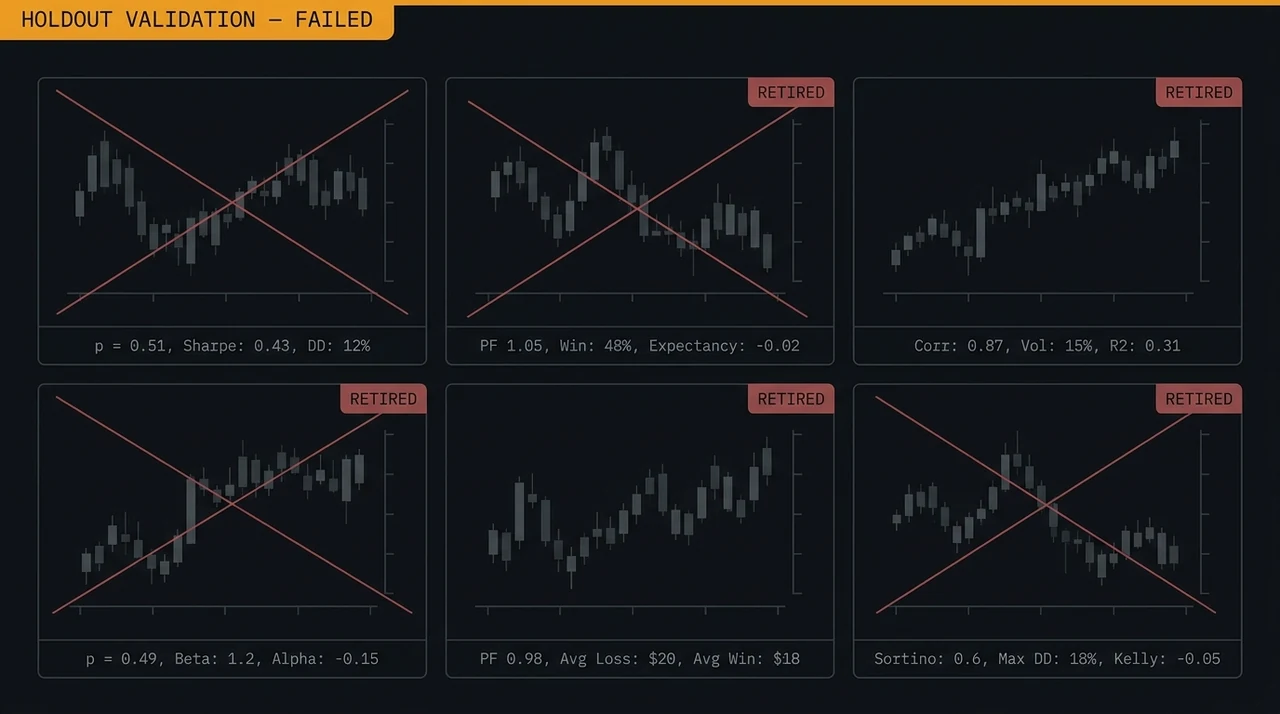
The Strategy Graveyard: 6 Strategies We Killed, and Why
Of 23 strategies evaluated in the 2026-07 sweep, 6 failed holdout and permutation testing and were formally retired — every one sits at a permutation p-value above 0.5. This is the record of what died and why: rsi-reversion, bear-flag, rsi-overbought, swing-condor, atr-stretch-reversion, and frog-in-the-pan. A validation pipeline that never kills anything has not been tested honestly.
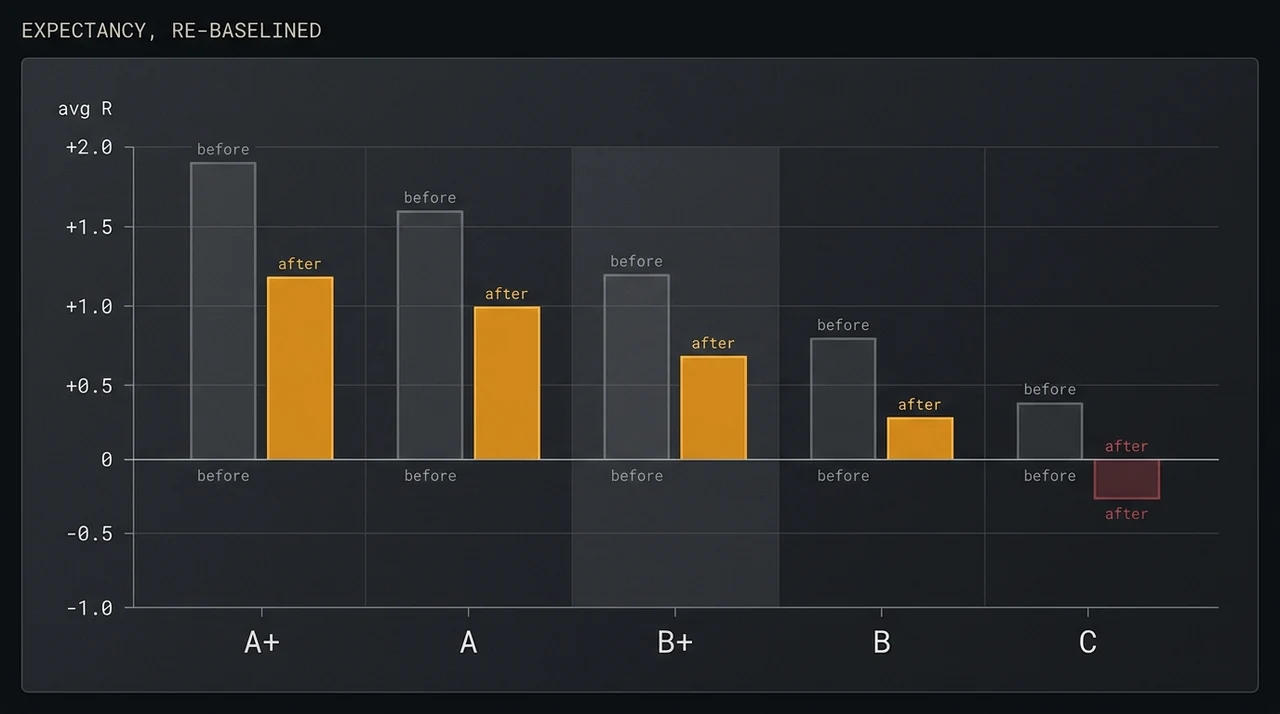
We Found Our Backtests Were Inflating Expectancy — Here's the Correction
A degenerate-risk floor bug let tiny risk denominators inflate backtest R-multiples. After the correction, per-grade average R fell hard — B+ by 72%, A by 64%, A+ by 39% — and we re-validated everything on the corrected baseline. What survived: C remains the only negative-expectancy grade, and grade-ranked selection still beats an RS-only baseline at every position cap. The full before/after record.
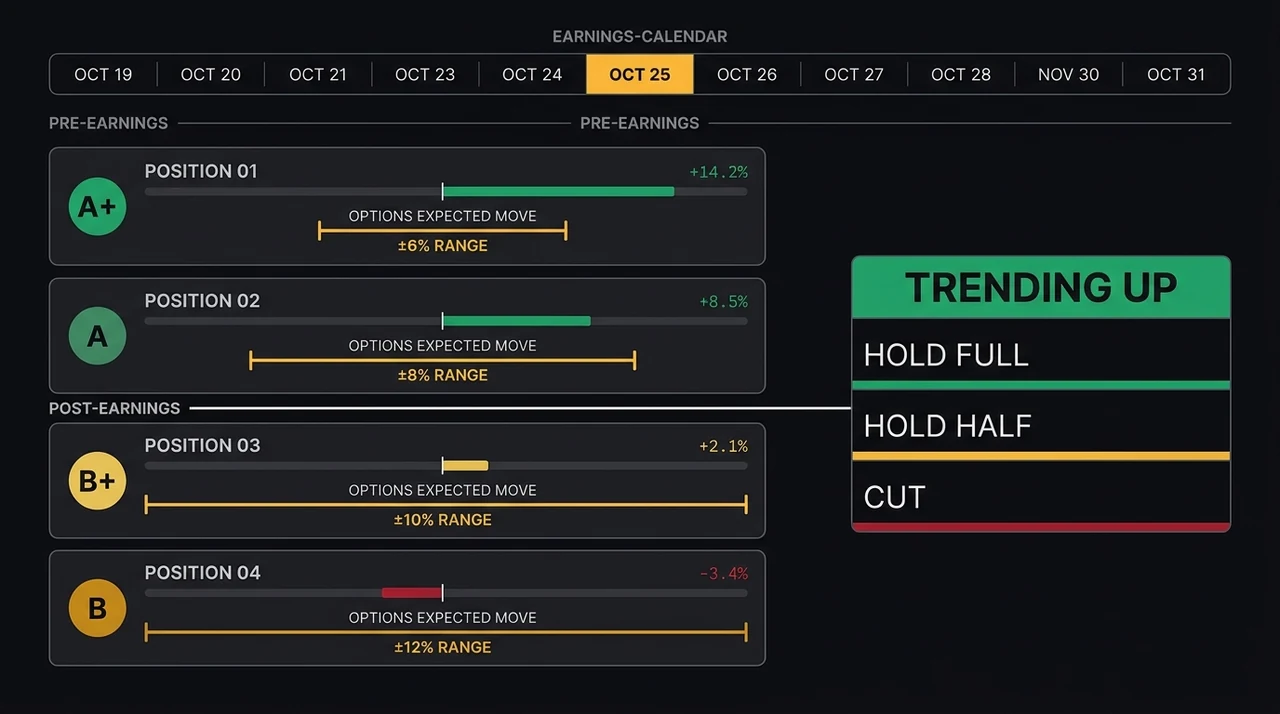
Swing Trading Earnings Season: When to Hold, Cut, or Enter
Stocks in the top decile of earnings surprises keep outperforming the market for weeks after the report — but only for traders who position correctly before the binary event. This guide covers the hold/cut/reduce decision framework by setup grade, how to use the options expected move as a cushion threshold, post-earnings chart setups including the Power Earnings Gap, and how market regime changes the decision rules.
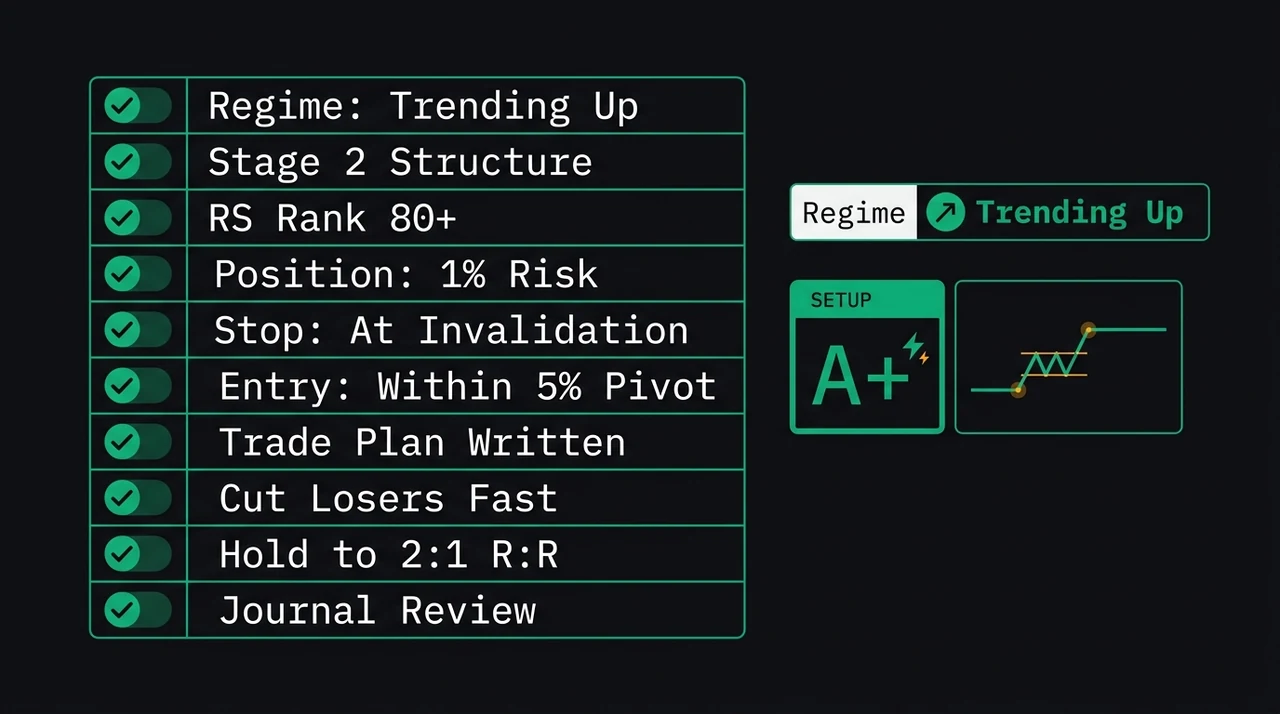
Swing Trading Rules: 10 Non-Negotiables for Consistent Results
Barber and Odean found that the most active retail traders earned 11.4% annually versus 17.9% for the market — a gap driven by poor timing and rule-breaking. This guide covers the ten structural rules that separate systematic swing traders from discretionary coin-flipping: regime gate, Stage 2 filter, RS rank 80+, 1% position risk, stop placement before entry, pivot discipline, pre-trade plans, loss cutting, winner management, and journal review.
Swing Trading Taxes: Short-Term Capital Gains and Wash Sales
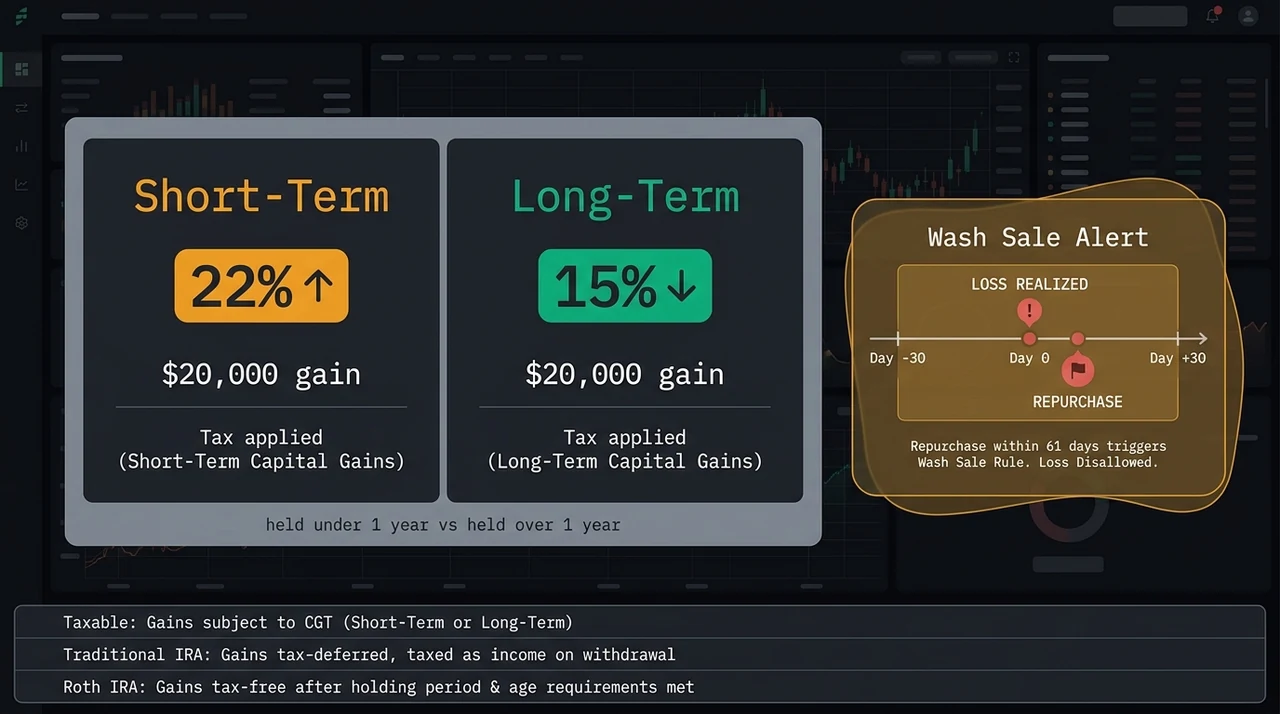
For a swing trader in the 24% federal bracket generating $50,000 annually in trading profits, short-term capital gains treatment costs $4,500 more in federal tax than long-term rates would. This guide covers 2024 rate schedules, the 61-day wash sale window, the 3.8% NIIT, Roth IRA structuring, and the estimated tax requirements most new traders miss.
Stochastic Oscillator for Swing Trading: How to Use It Without Getting Whipsawed
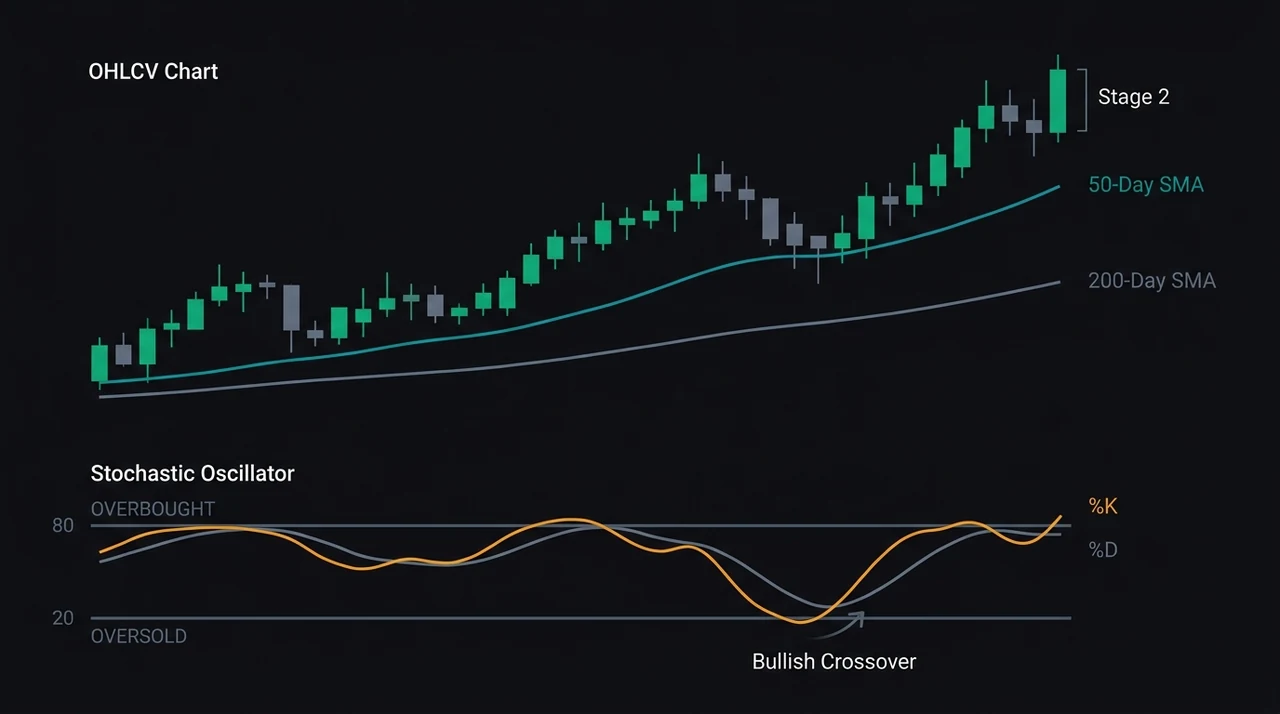
Connors & Alvarez found stochastic oversold readings resolve bullishly 68% of the time in Stage 2 uptrends — but less than 40% of the time in downtrending stocks. This guide covers the %K/%D crossover signal, two setups that work for swing traders, why trend context changes the signal completely, and a stochastic vs RSI comparison table.
Swing Trading with a Small Account: Position Sizing When Capital Is the Constraint
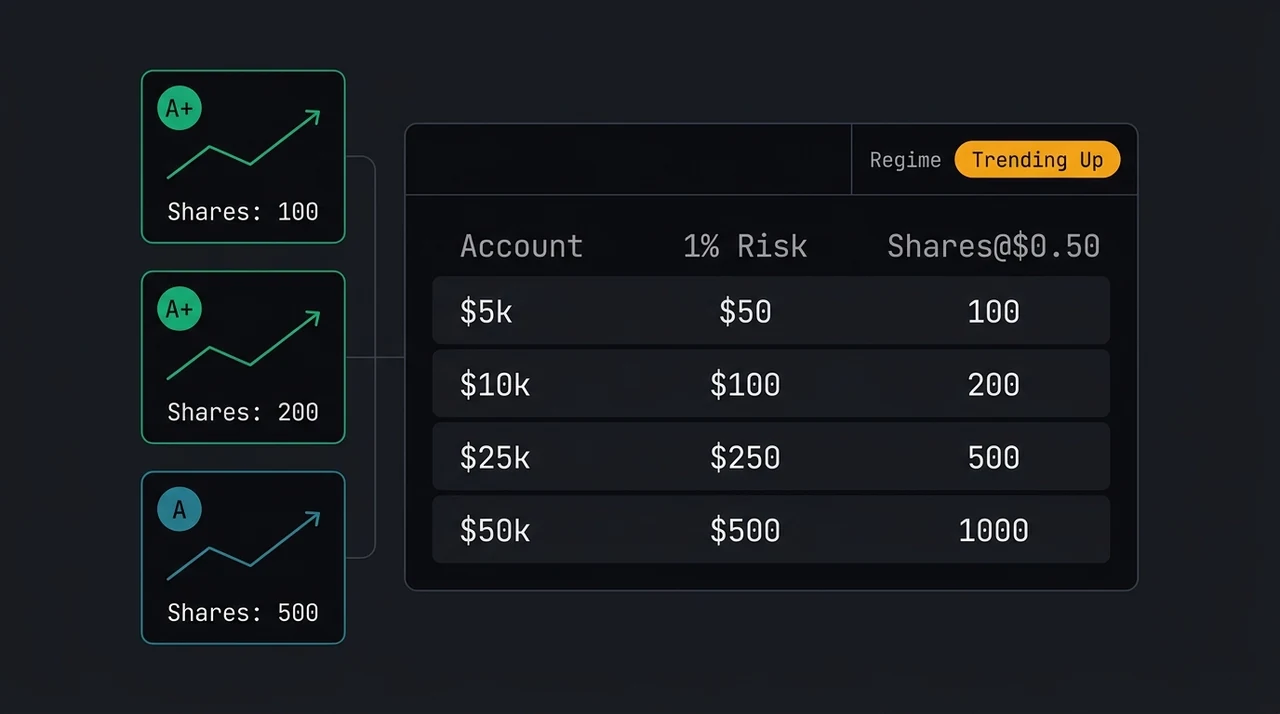
At 1% risk per trade, a $5,000 account limits each position to $50 of maximum loss — and at a $0.50 stop, that is 100 shares in a $15 stock, consuming 30% of the entire account. This guide covers the practical minimum capital floor ($10,000), the three-position rule, stock selection criteria for small accounts, and why the regime gate matters more when drawdown math is asymmetric.
How to Find Swing Trades: A 5-Step Pre-Session Framework
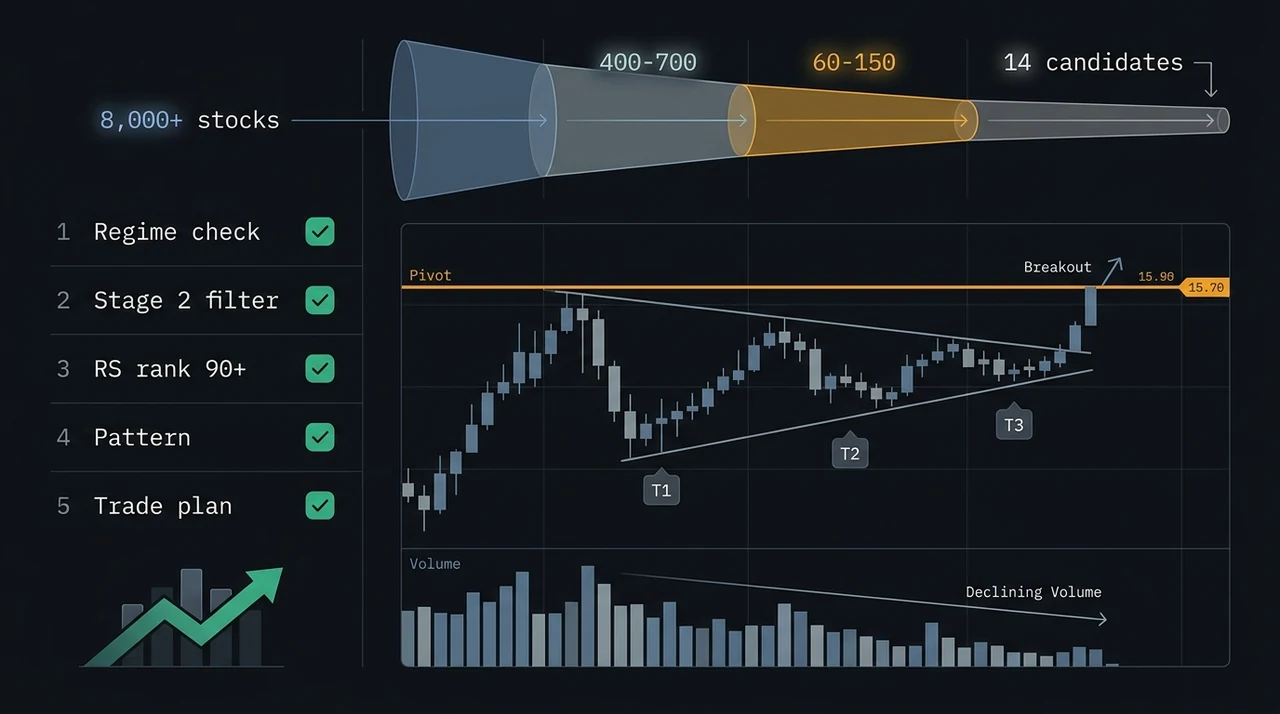
O'Neil's study of 600 of the biggest market winners found they shared a recurring chart footprint before their largest advances. The challenge is identifying which stocks are in that window each session. This guide covers the five-step pre-session framework — regime check, Stage 2 filter, RS rank screen, pattern identification, and pre-written trade plans — that narrows 8,000+ equities to a daily short list of 5–15 candidates.
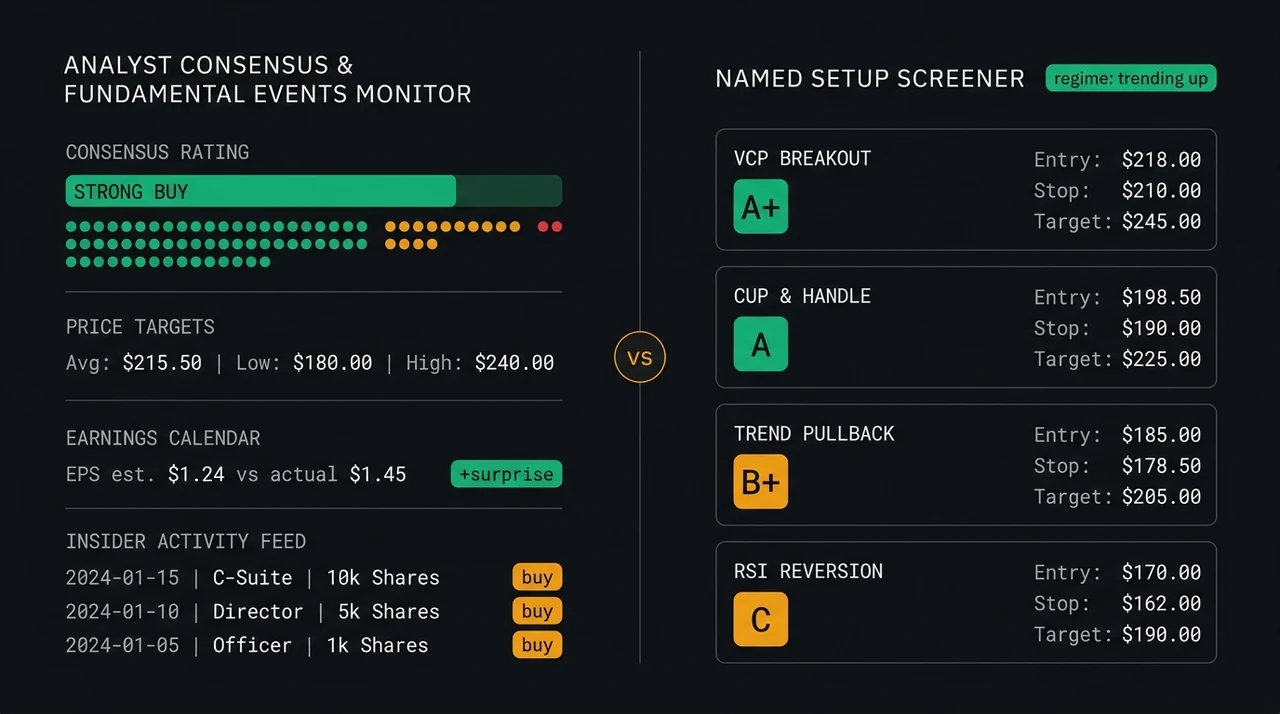
EasySwing vs MarketBeat: Swing Trading Alerts Compared
MarketBeat tracks analyst consensus, earnings estimates, and dividend alerts. EasySwing.trading detects named swing trading setups with A+–C quality grading and five-state market regime filtering. This comparison covers what each tool does well, where each falls short for systematic swing traders, and when using both makes sense.
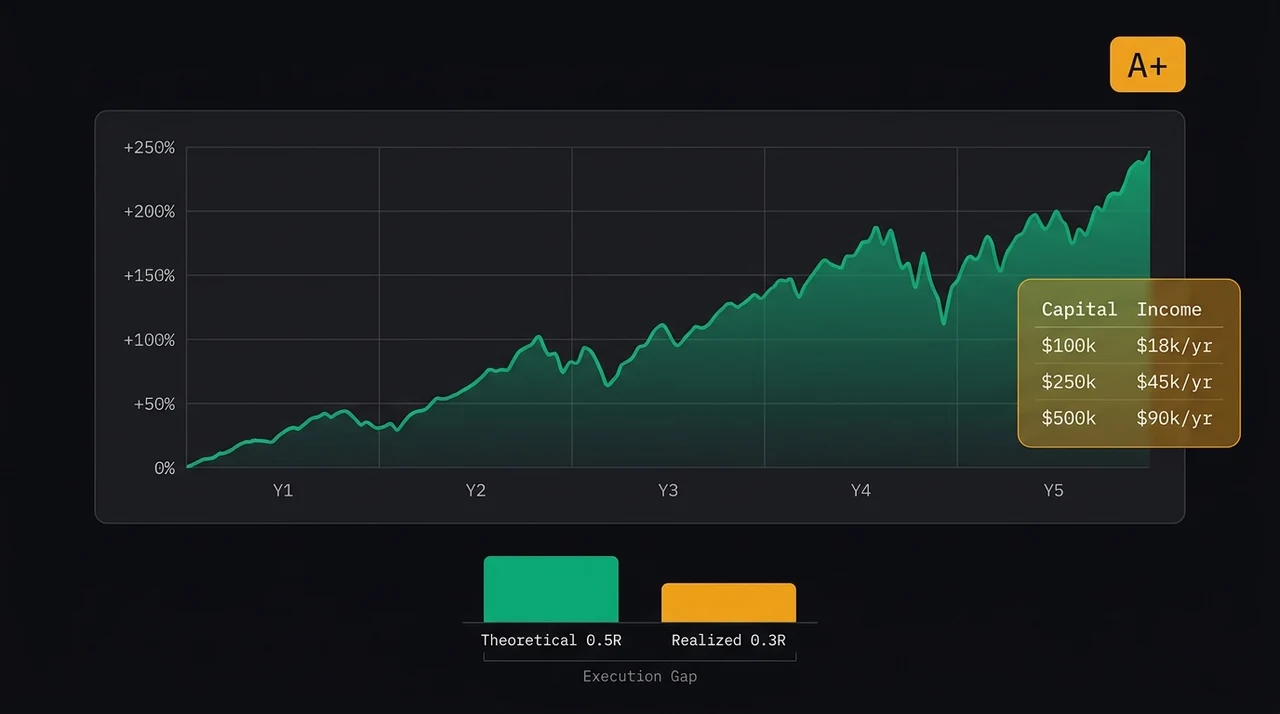
Can You Make a Living Swing Trading? The Honest Math
Barber and Odean (QJE, 2001) found the most active quintile of retail traders underperformed by 6.5% annually. This guide covers the honest capital requirements, realistic annual return targets, and the mathematical role of positive expectancy — and why execution consistency closes the gap between theoretical and realized returns.
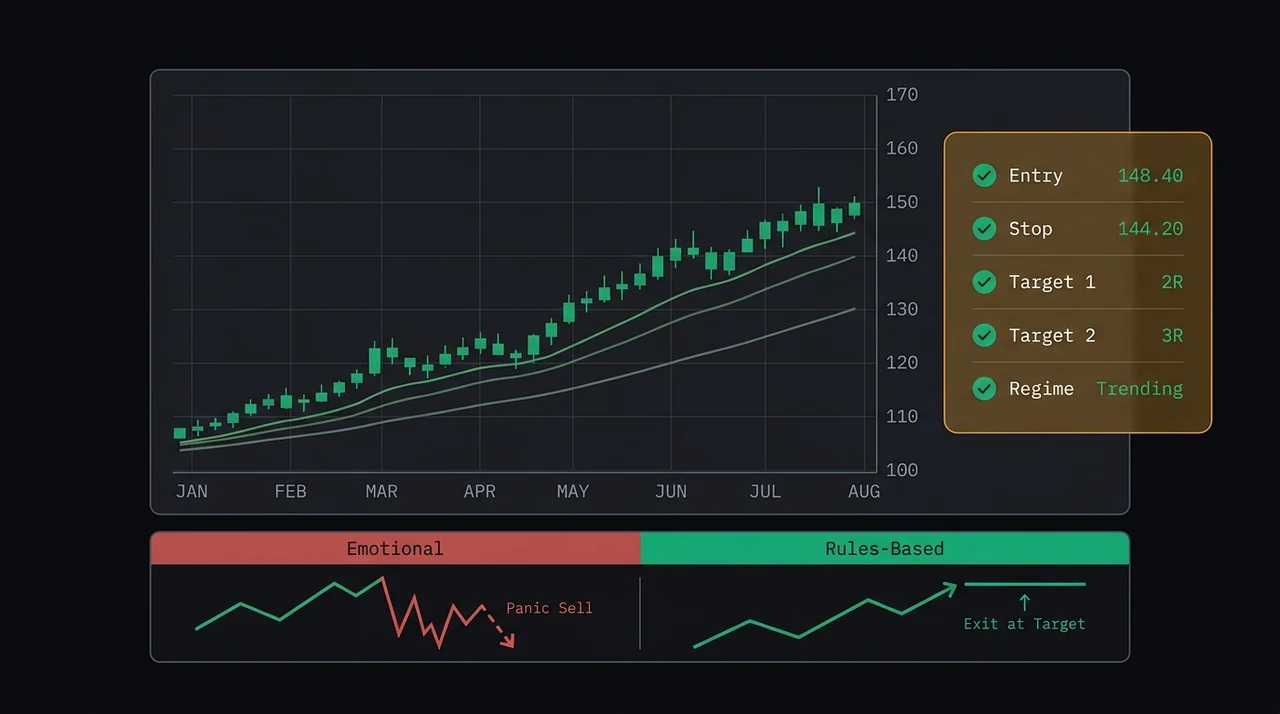
Swing Trading Psychology: Rules Over Reactions
Loss aversion costs active traders an estimated 1–4% in risk-adjusted returns annually — not from bad strategy but from decisions made under emotional pressure. This guide covers the four cognitive biases that most frequently break trading rules (loss aversion, the disposition effect, overconfidence, and FOMO), a behavioral fix for each, and a pre-session checklist that converts subjective in-session decisions into binary rule checks.
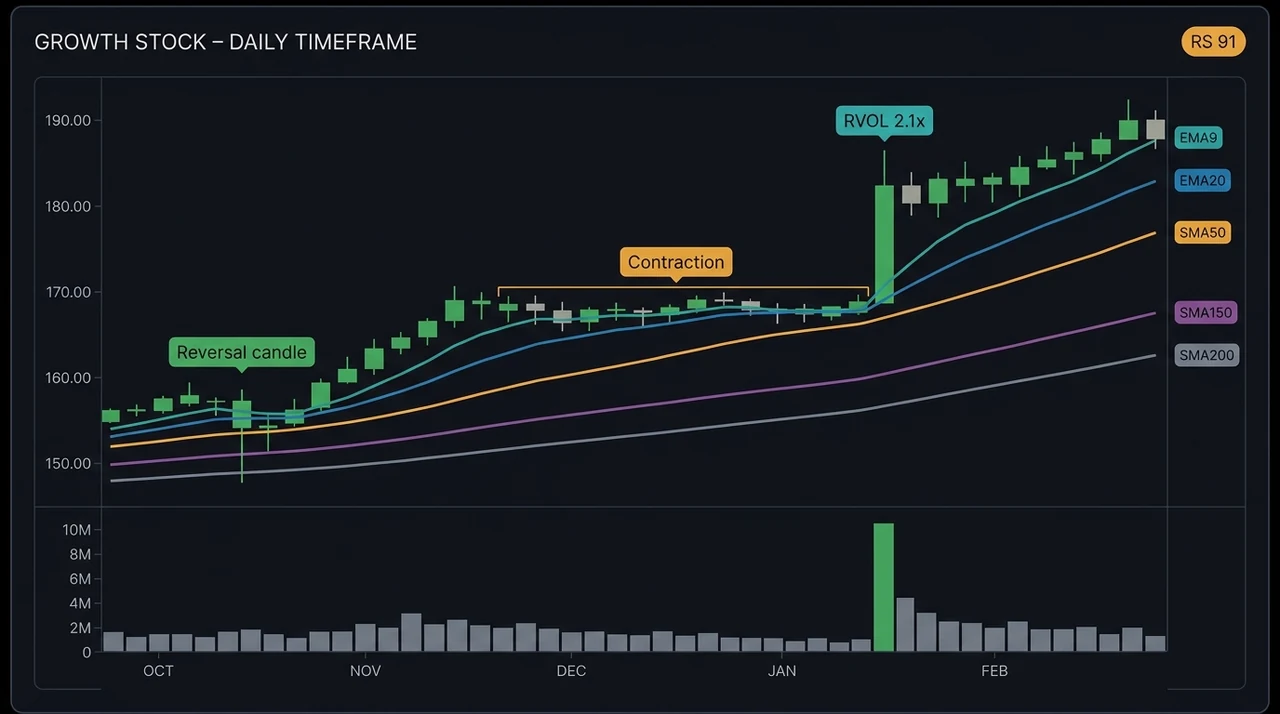
How to Read a Stock Chart: A Swing Trader's Step-by-Step Guide
William O'Neil studied over 600 of the greatest stock market winners and found every one left a distinctive footprint on a price chart before its biggest move. This guide covers the five-layer framework systematic swing traders use to read that footprint in under three minutes: MA stack trend direction, volume confirmation, relative strength rank, named pattern identification, and market regime context.
When to Sell a Swing Trade: Exit Rules That Protect Profits
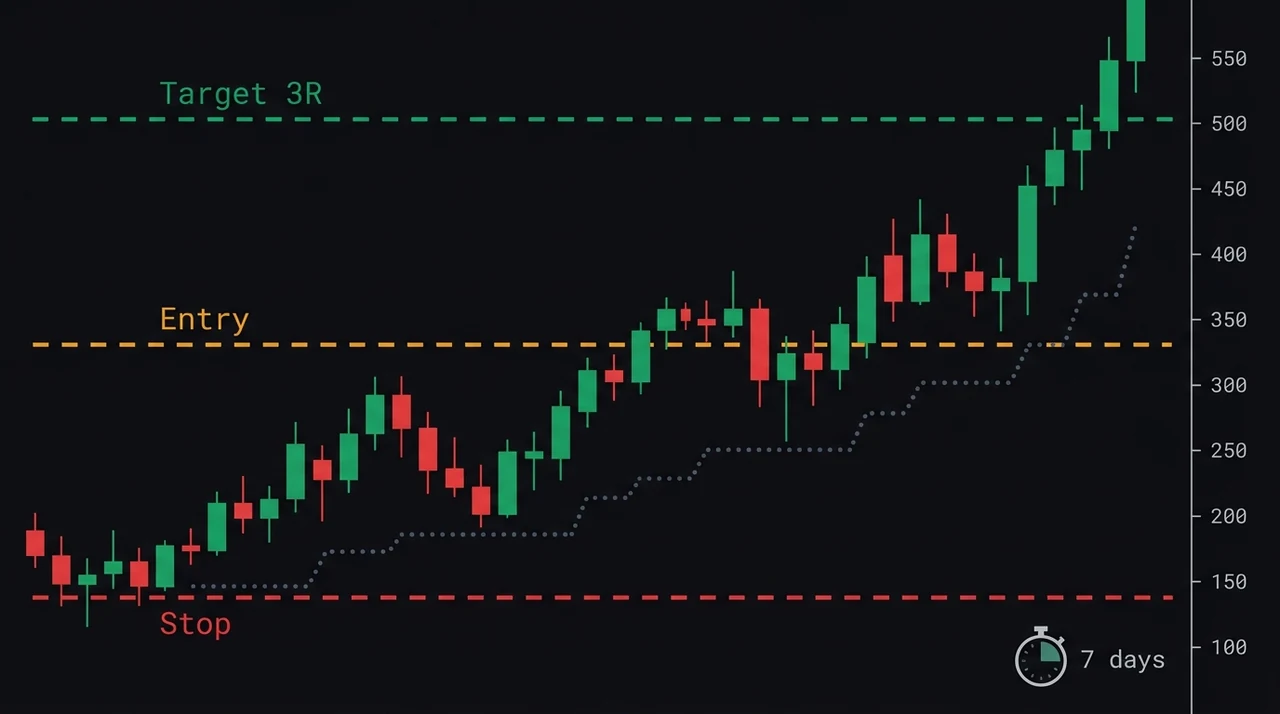
The disposition effect costs retail traders 1–4% annually in risk-adjusted returns. Most of that loss isn't from bad entries — it's from exits without a plan. This guide covers the three exit frameworks systematic swing traders use before placing any order: profit targets based on chart resistance or R-multiples, stop-losses set at structural invalidation levels, and time stops that close stalled positions before they compound.
EasySwing vs Schwab Stock Screener: What Swing Traders Need to Know
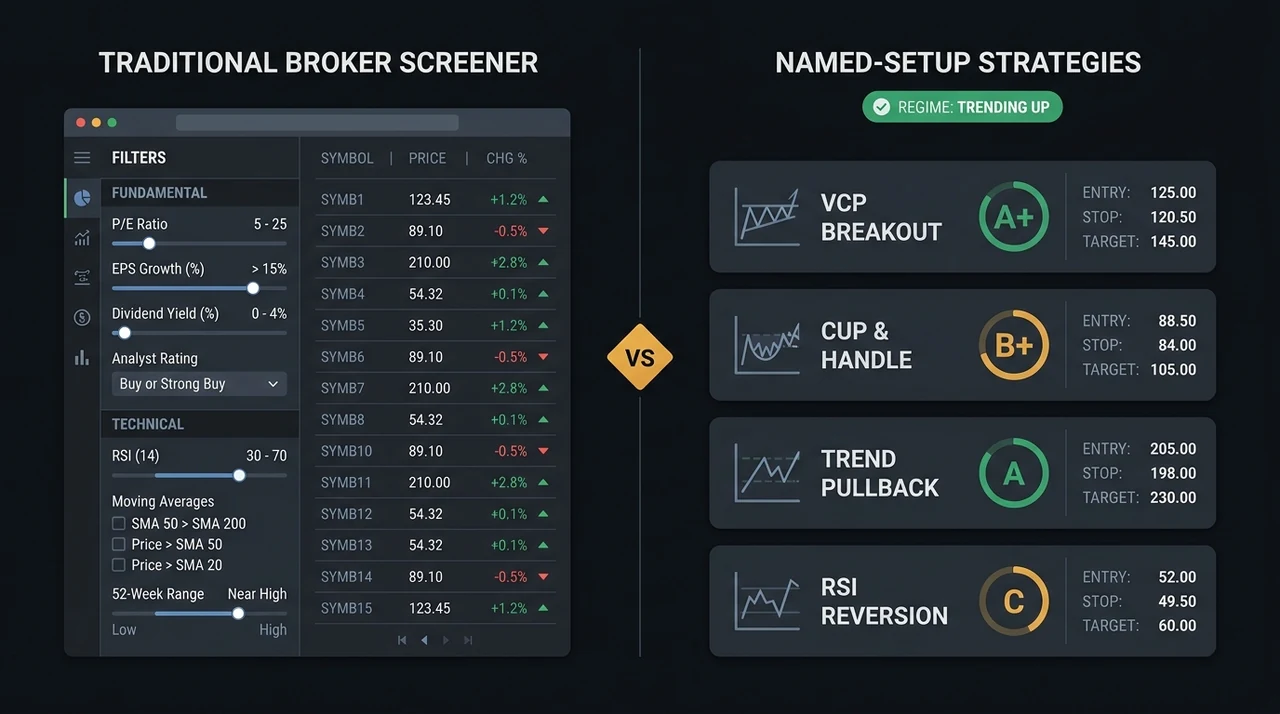
Charles Schwab's built-in stock screener offers 140+ fundamental and technical filter criteria free to all account holders. EasySwing.trading detects 13 named swing trading setups — VCP, Cup & Handle, Trend Pullback, Qullamaggie Breakout — grades each result A+/A/B+/B/C, and applies five-state market regime gating automatically. This comparison covers where Schwab's screener wins (fundamentals, real-time data, execution integration) and where systematic swing traders need a named-setup detector instead.
EasySwing vs Barchart: Which Screener Fits Swing Traders?
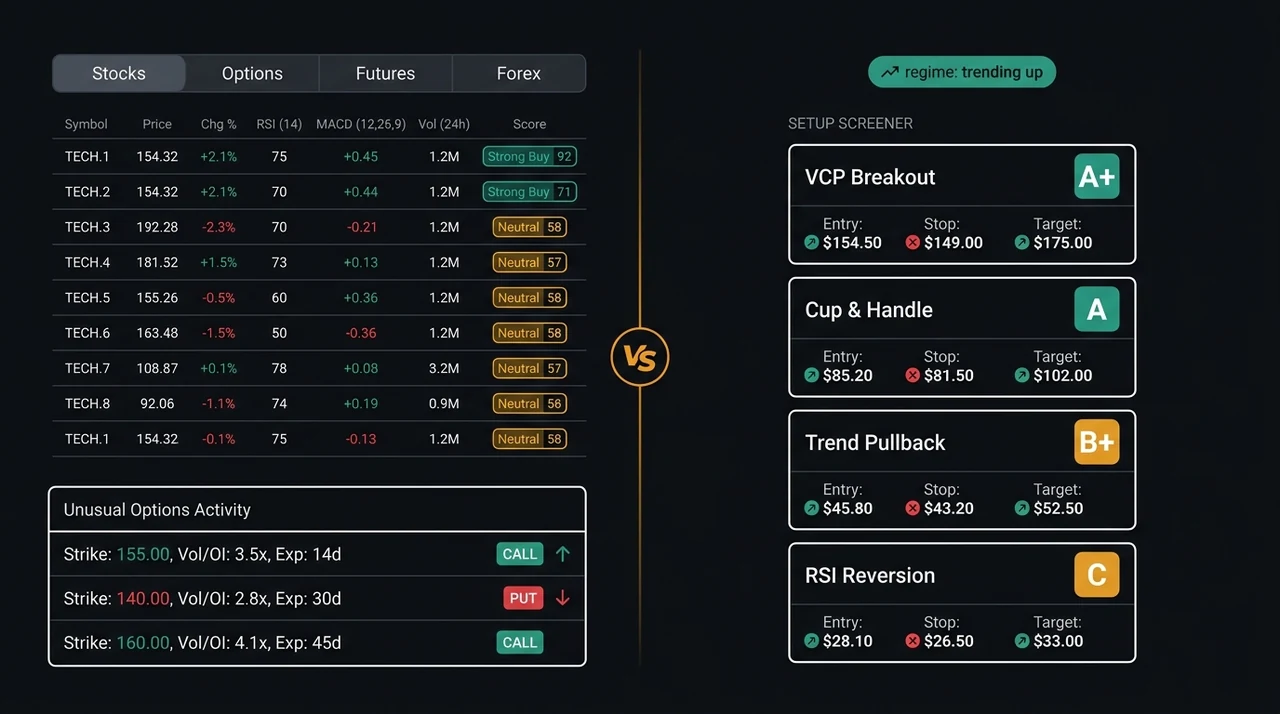
Barchart.com is a widely used market data platform offering free technical screening across stocks, options, futures, and forex — with Barchart Opinions ratings and 100+ filter criteria. EasySwing.trading detects 13 named swing trading setups, grades each A+/A/B+/B/C by quality, and applies a five-state market regime filter automatically. This comparison covers where Barchart wins (options flow, multi-asset coverage, free tier) and where systematic swing traders need specialized named-setup detection instead.
Swing Trading Watchlist: How to Build and Work Your Setup Pipeline
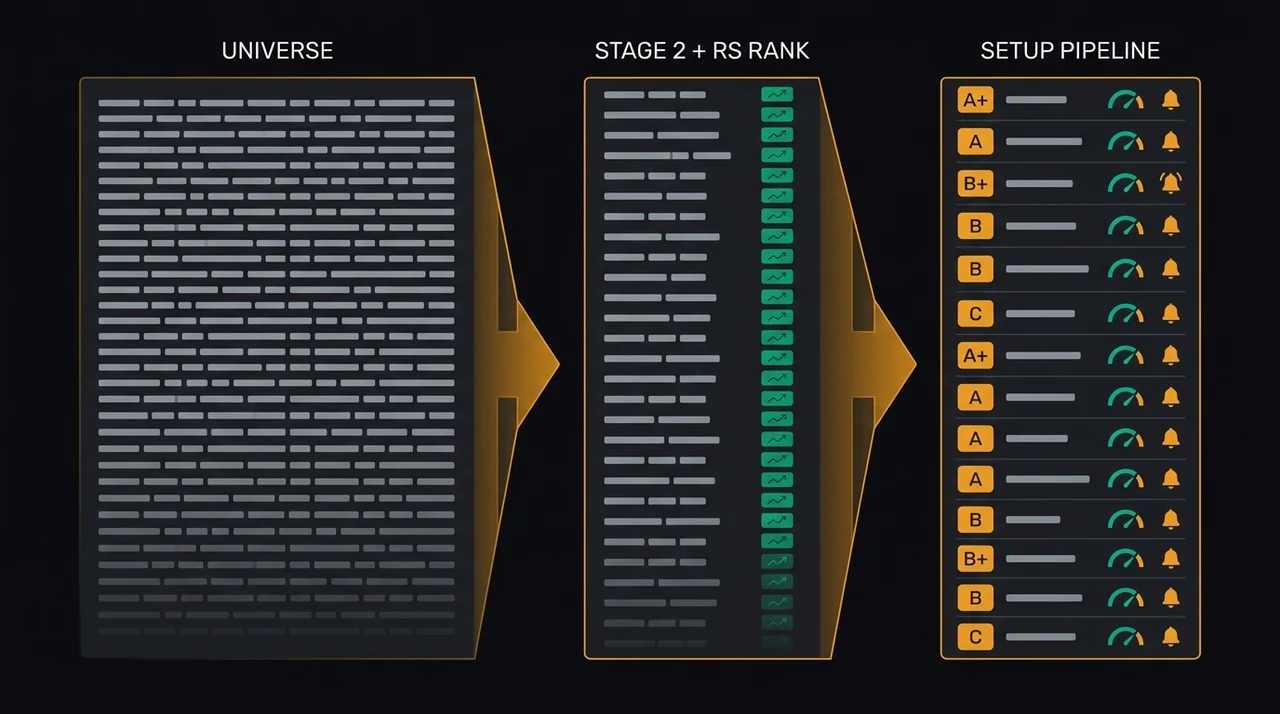
O'Neil's study of 600+ market winners found that 95% showed a recognizable technical pattern before their biggest advances. The watchlist problem follows: you cannot evaluate 2,000 stocks daily. This post covers the three-stage funnel from full universe to 10-25 qualified candidates, daily pruning rules, regime-adjusted sizing, and the alert-configuration step that connects watchlist to trade.
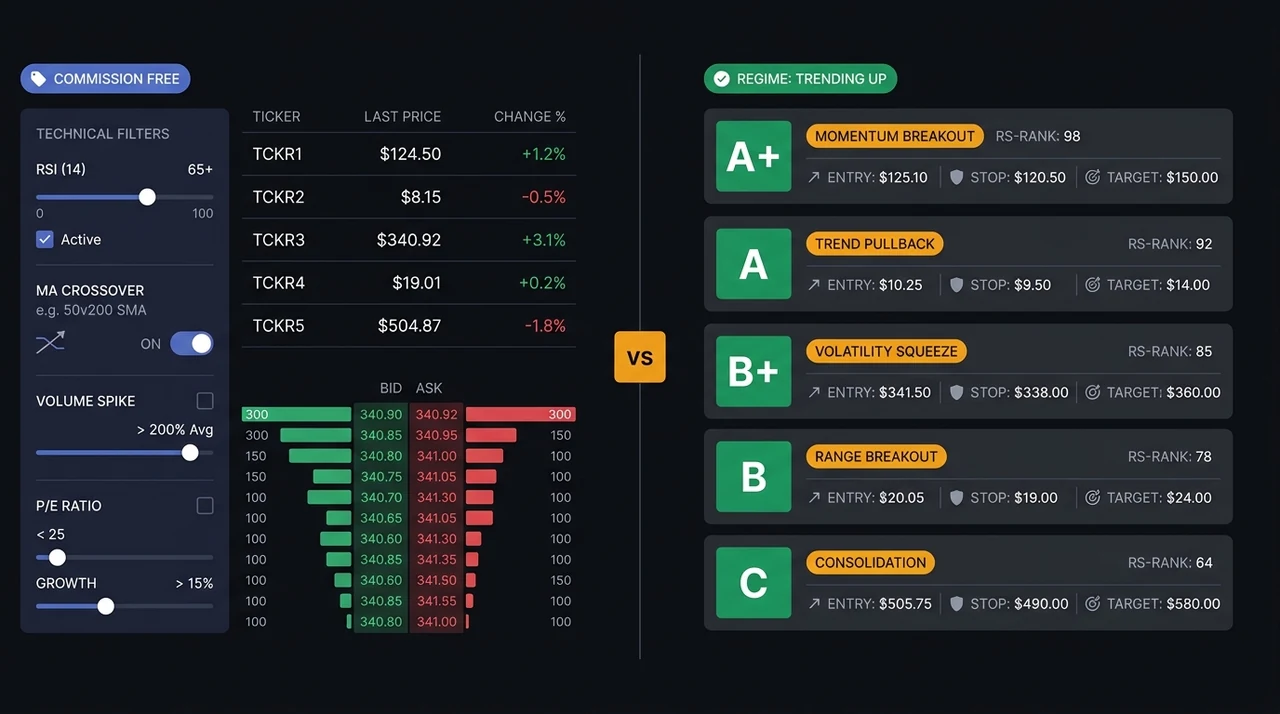
EasySwing vs Webull Stock Screener: What Swing Traders Need to Know
Webull is a commission-free broker with a built-in screener used by millions of US retail traders. EasySwing.trading detects 13 named swing trading setups — VCP, Cup & Handle, Trend Pullback, Qullamaggie Breakout — grades each result A+/A/B+/B/C, and applies five-state market regime gating automatically. This comparison covers where Webull wins (execution, Level 2 data, paper trading) and where systematic swing traders need a specialized screener instead.
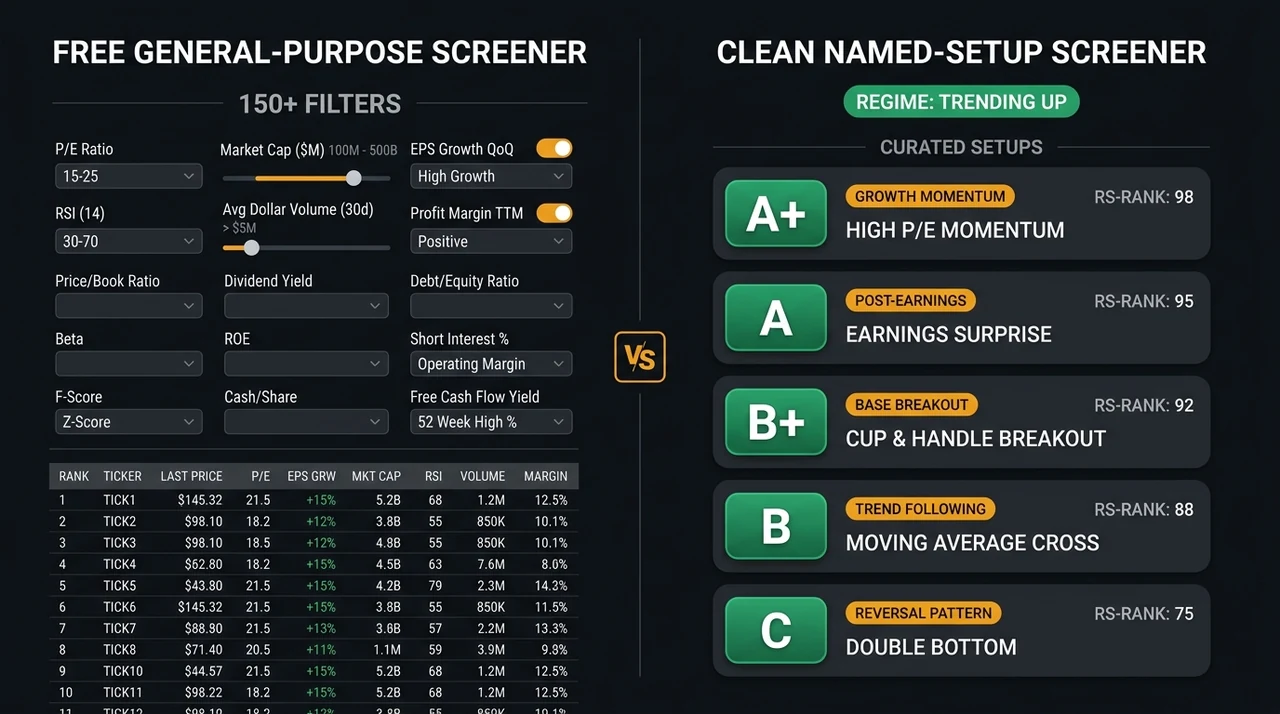
EasySwing vs Yahoo Finance Screener: Which Is Right for Swing Traders?
Yahoo Finance reaches 90 million monthly users and offers 150+ free screener filters across global markets. This comparison covers where Yahoo Finance genuinely wins (free fundamental screening, news integration, global coverage) and where systematic swing traders need a named-setup detector with quality grading and market regime gating instead.
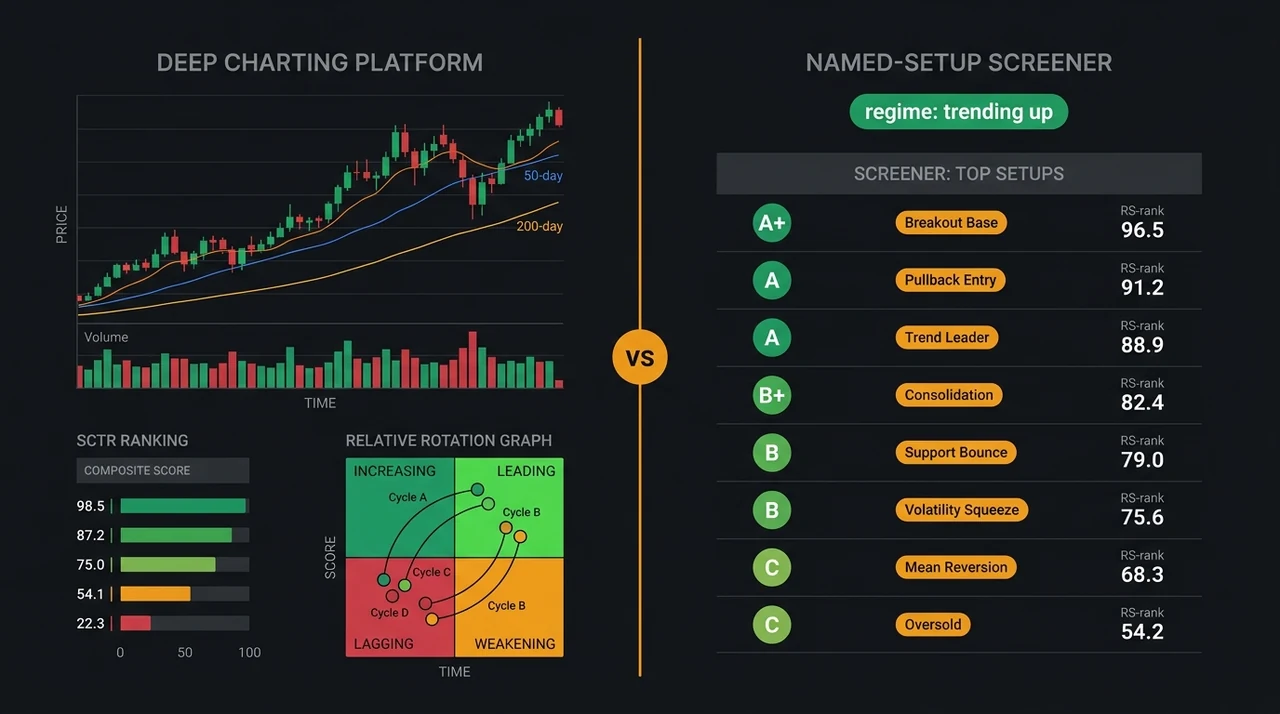
EasySwing vs StockCharts: Which Technical Analysis Tool Fits Swing Traders?
O'Neil's research on 600+ market winners found that 95% showed a recognizable chart pattern before their biggest price advances. StockCharts.com has served that discipline since 1999 — SCTR rankings, Relative Rotation Graphs, and SharpCharts. This comparison covers what each platform does, where StockCharts wins (charting depth, P&F, RRG, breadth tools), and a side-by-side feature table.
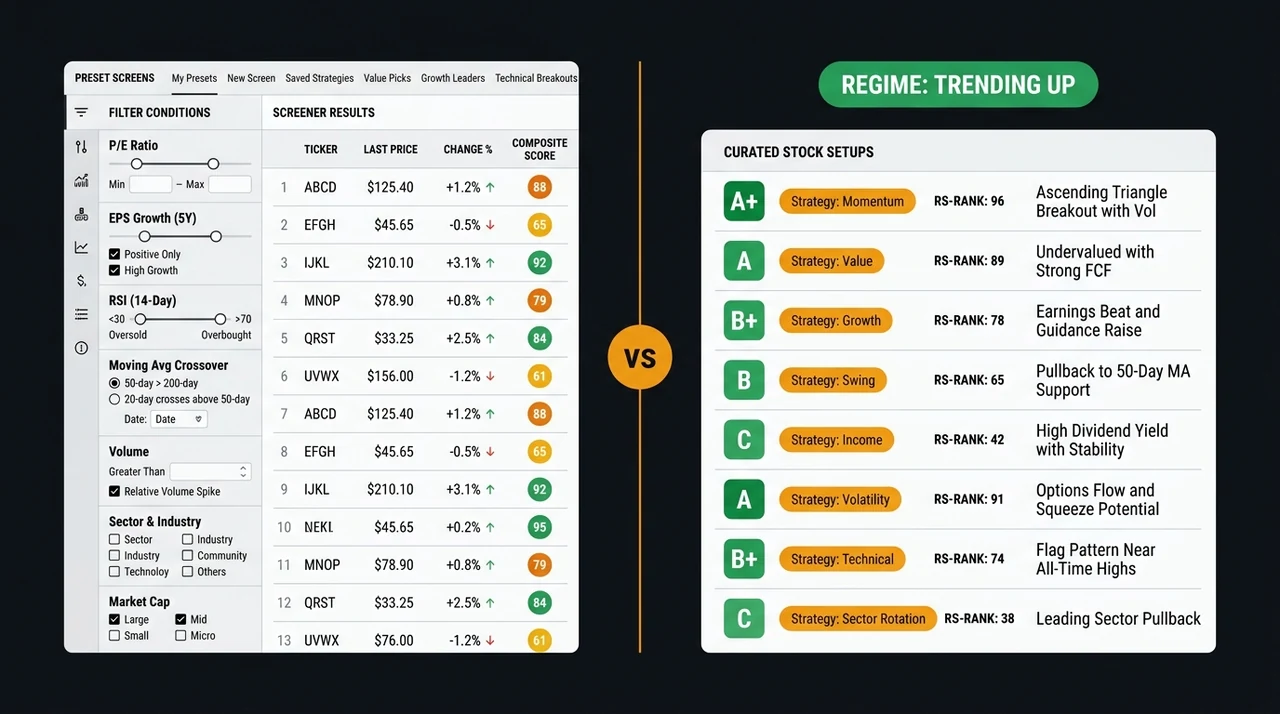
EasySwing vs Fidelity: Which Stock Screener Fits Swing Traders?
William O'Neil documented that the greatest stock winners carried an average relative strength rating of 87 before their major advances began. Fidelity's screener — free with any account via Fidelity.com and Active Trader Pro — provides 140+ fundamental and technical filter criteria. This comparison covers what each platform detects, where Fidelity genuinely wins (cost, fundamental depth, real-time, options), and a side-by-side feature table.
EasySwing vs Interactive Brokers: Which Stock Screener Fits Swing Traders?
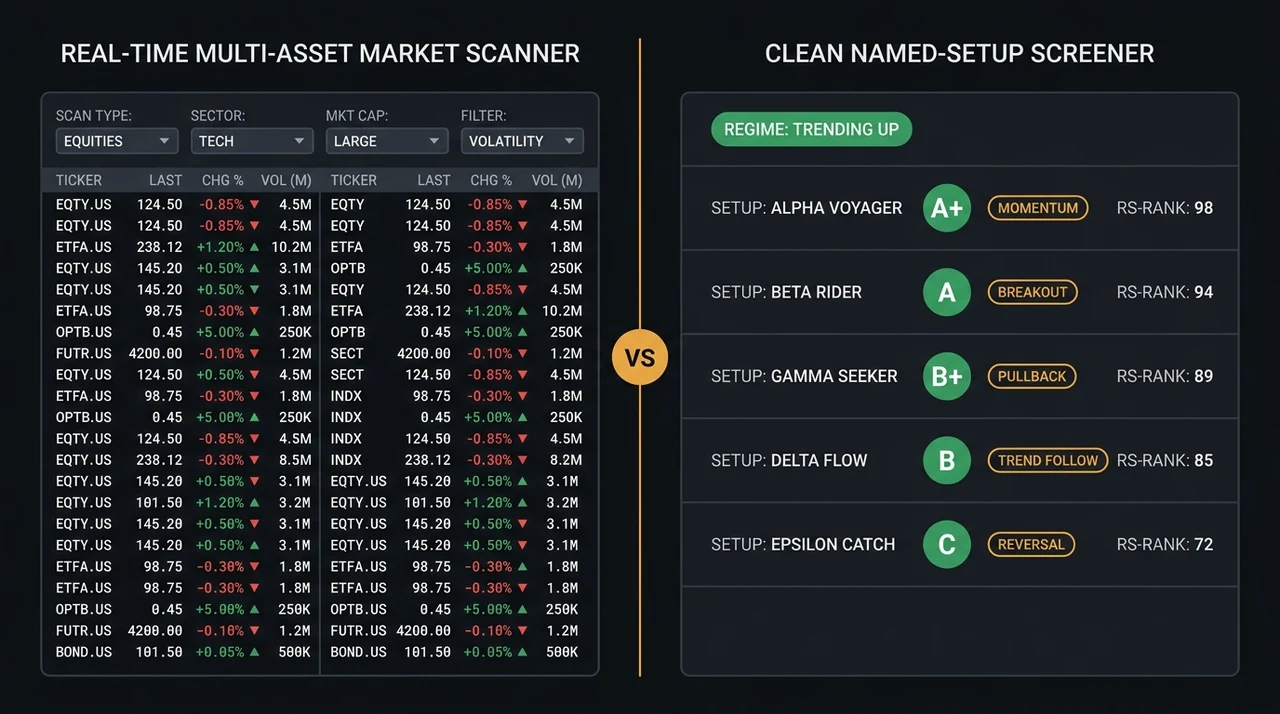
Barber and Odean's 2000 Journal of Finance study found the most active traders underperformed by 6.5% annually — driven by acting on low-conviction signals. Interactive Brokers' TWS Scanner reaches 150+ global markets in real time across equities, options, and futures. This comparison covers what TWS does and doesn't detect, where IBKR genuinely wins (cost, global reach, options, API flexibility), and a side-by-side feature table.
CANSLIM Stock Screener: How to Apply O'Neil's 7-Criteria System
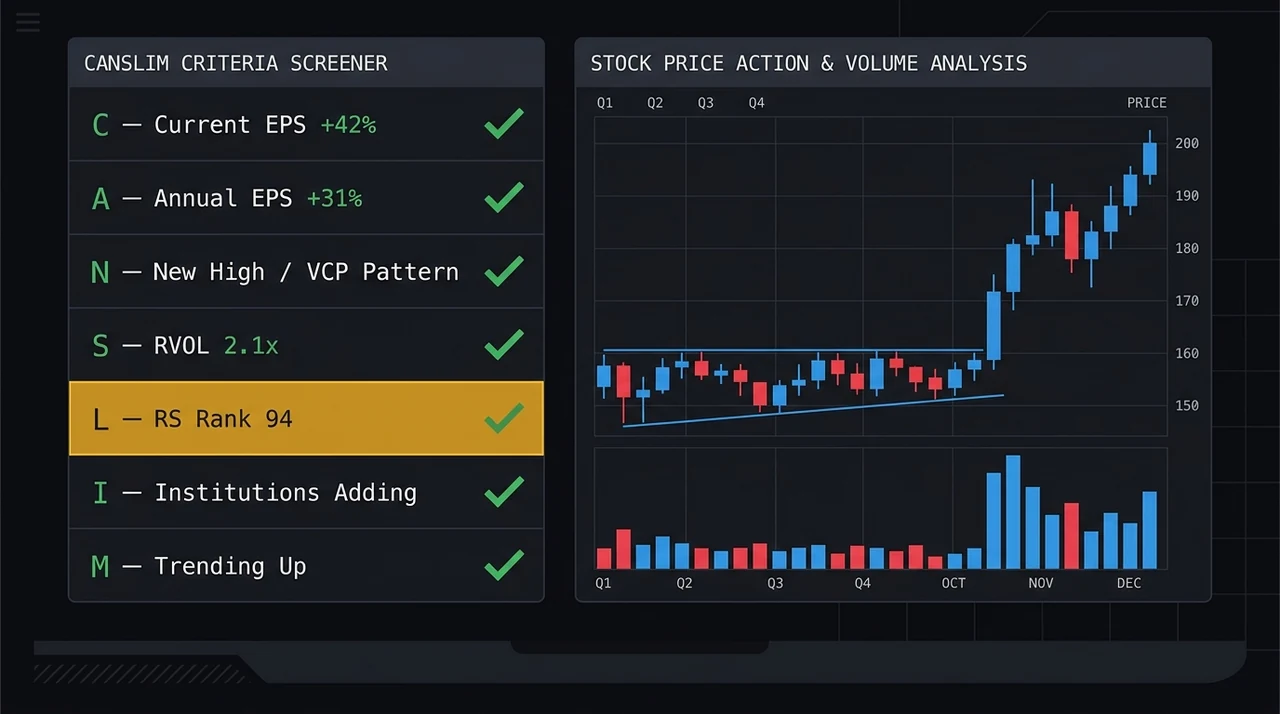
William O'Neil documented that the market's greatest winners carried an average relative strength rating of 87 before their major advances began. Four of the seven CANSLIM criteria — RS Rank 80+, Stage 2 structure, breakout volume expansion, and market regime direction — can be fully automated in a technical screener. This guide covers all seven criteria, which ones EasySwing handles, how to layer earnings filters on top, and a step-by-step two-stage workflow.
AI Stock Screener for Swing Traders: Automated Setup Detection With Market Regime Filtering
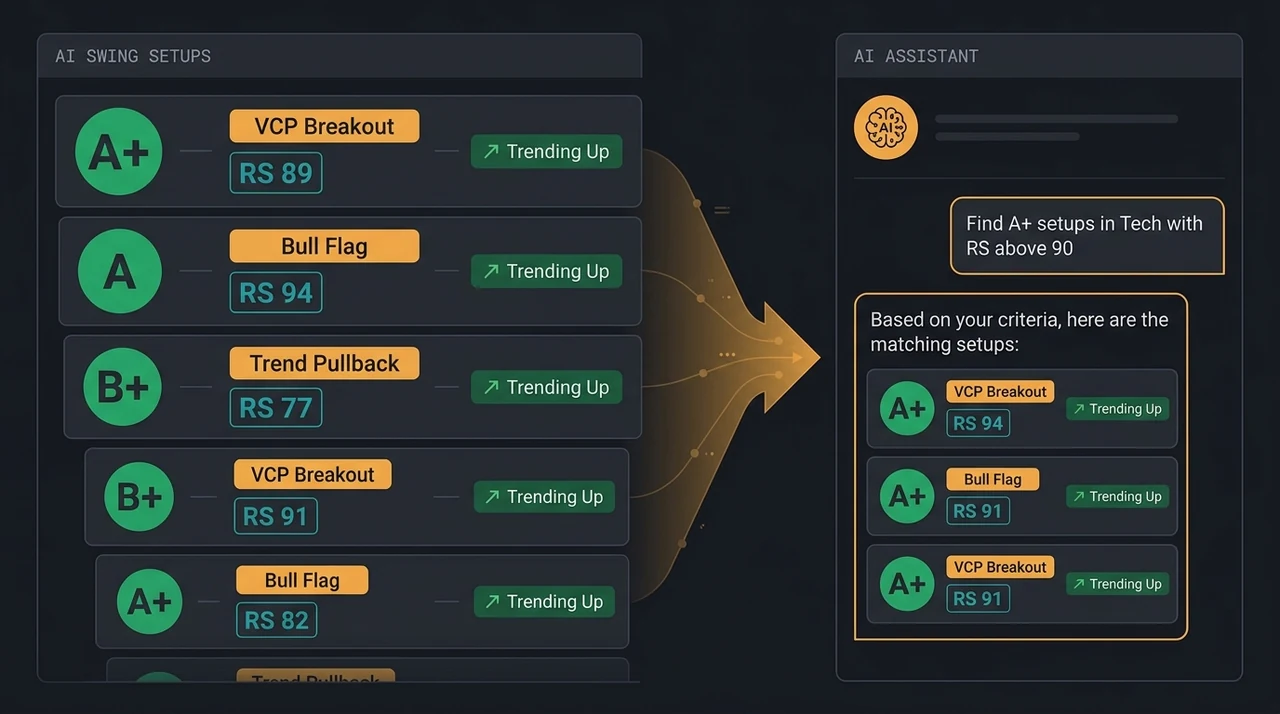
Jegadeesh and Titman (1993) documented a 12.01% compounded annual excess return from buying recent winners and selling recent losers — but finding qualifying setups across 2,000+ equities requires automation. This guide explains how AI-powered stock screening differs from manual filters, how EasySwing's validated strategy engine detects named setups automatically, and what to look for when evaluating any systematic screener.
Industry Group Rotation: How to Find Swing Trading Setups in Leading Sectors
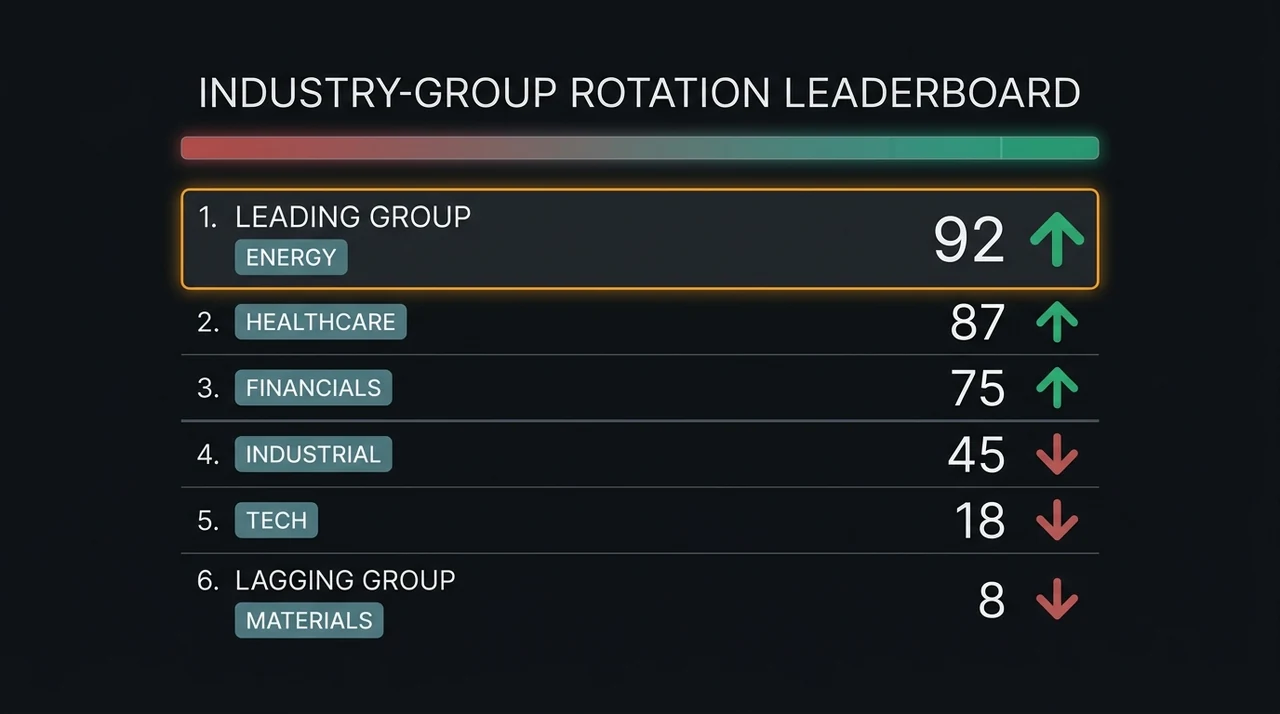
William O'Neil studied 600+ stock market winners and found that roughly 37% of a stock's price move comes from its industry group. EasySwing's group rotation tracker ranks every qualifying sector by median relative strength, updated daily. This guide covers how to read group rank and trend signals, apply them to the screener workflow, and avoid the four most common sector rotation mistakes.
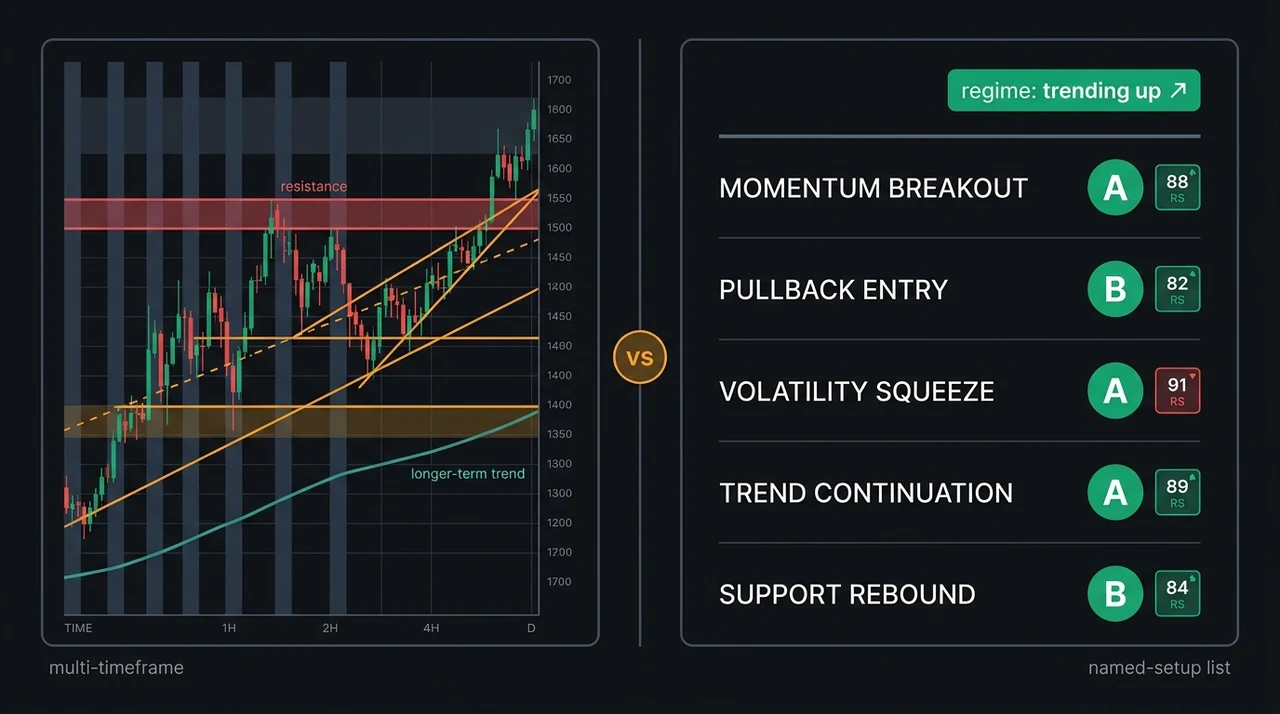
EasySwing vs TrendSpider: Which Technical Analysis Tool Fits Swing Traders?
TrendSpider automates trendline drawing, multi-timeframe analysis, and pattern alerts on individual charts. EasySwing scans 2,000+ US equities each session and returns a ranked list of named setups — pre-graded A+/A/B+/B/C, regime-validated. This comparison covers MTFA vs named-setup detection, where each tool genuinely wins, the workflow most systematic traders use (screen with EasySwing, confirm on TrendSpider), and how to choose.
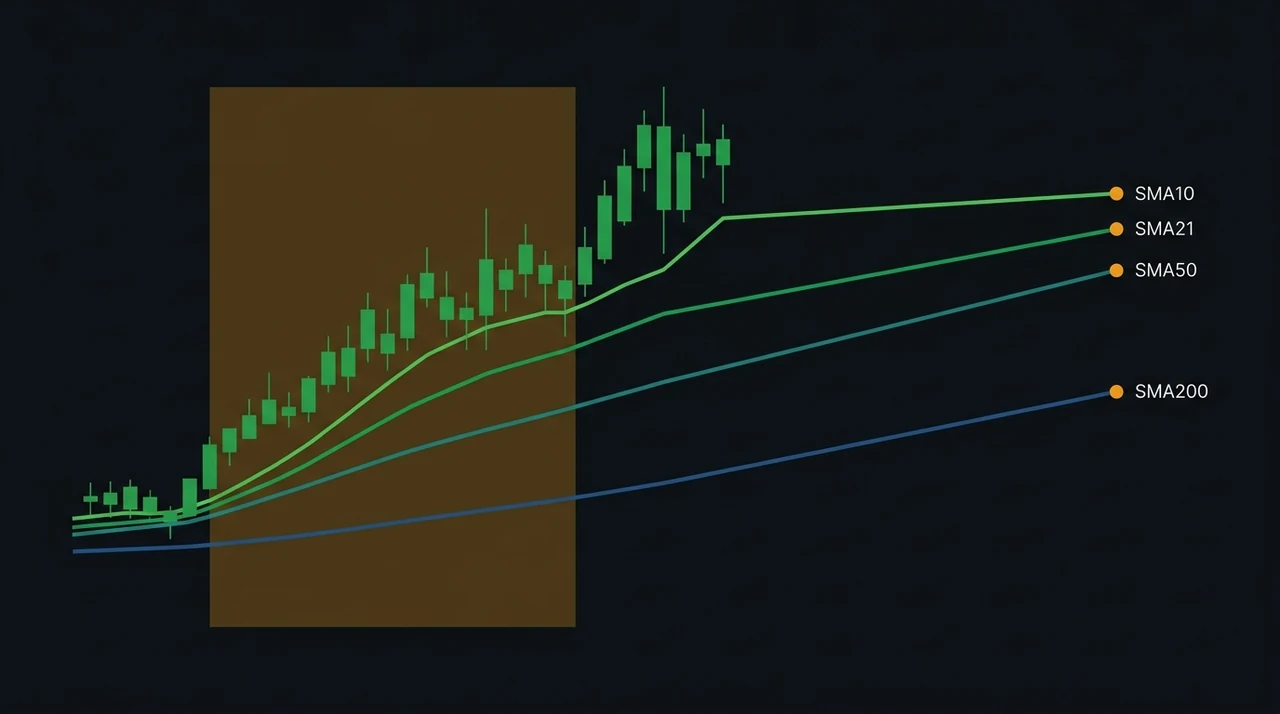
MA Stack Confluence: How Perfect Moving Average Alignment Identifies Market Leaders
Jegadeesh & Titman (1993) documented 12.01% annual outperformance from sustained momentum — the stocks delivering it continuously are identifiable by one structural signal: all four key moving averages rising in perfect alignment simultaneously. This guide covers the four-SMA stack mechanic, the three hard entry gates, EasySwing's confluence score, the validated trade structure (2.31 net profit factor over 859 holdout trades), and the regime gate that concentrates results in trending markets.
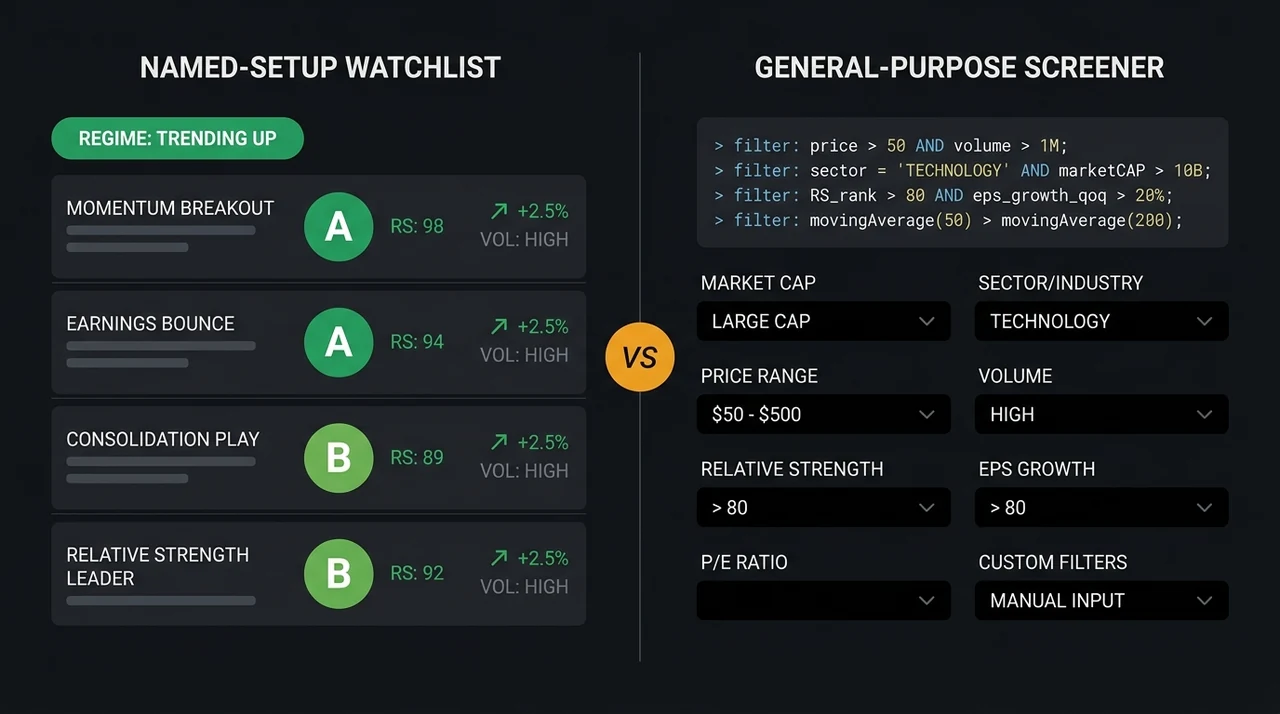
EasySwing vs ThinkorSwim: Which Scanner Fits Swing Traders?
ThinkorSwim's Stock Hacker is free for every Schwab customer and covers options, futures, and equities in one platform. EasySwing.trading is purpose-built for swing traders: 13 named strategies detected automatically, each graded A+/A/B+/B/C, all gated by a five-state market regime engine. This comparison covers the thinkScript-vs-detection gap, where ThinkorSwim genuinely wins (cost, real-time alerts, options scanning, charting depth), who each platform fits, and a side-by-side feature table.
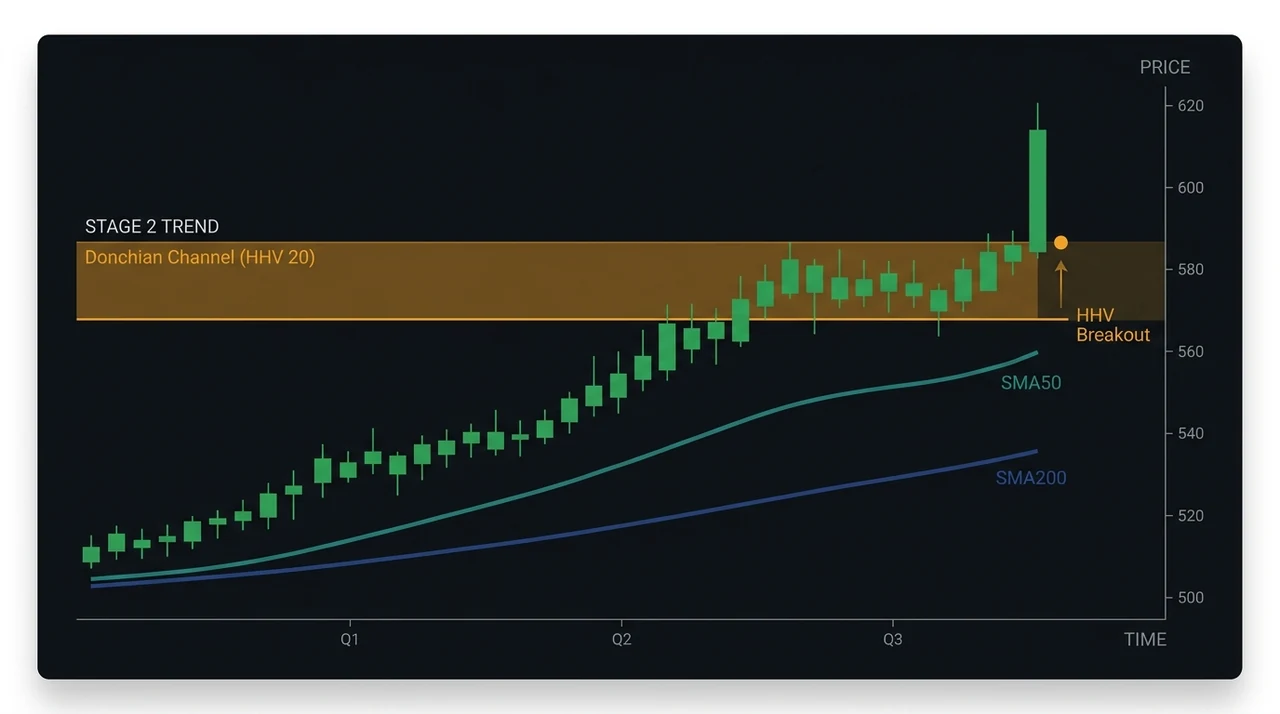
HHV Breakout: How the Donchian Channel Captures Trend-Following Leaders
Richard Dennis turned the Donchian 20-day channel breakout into a $200 million career — the Turtle Experiment proved a purely mechanical system could be taught and replicated. This guide covers EasySwing's HHV Breakout strategy: the four entry conditions (Stage 2, RS rank ≥ 81, 3-month momentum, channel close), holdout backtest results (2.76 profit factor across 1,075 trades, 52% win rate, +0.63R expectancy), the three-level trade structure with 2.28×ATR stop and 2.96R/5.17R targets, how it compares to VCP Breakout, and a ready-to-use trading checklist.
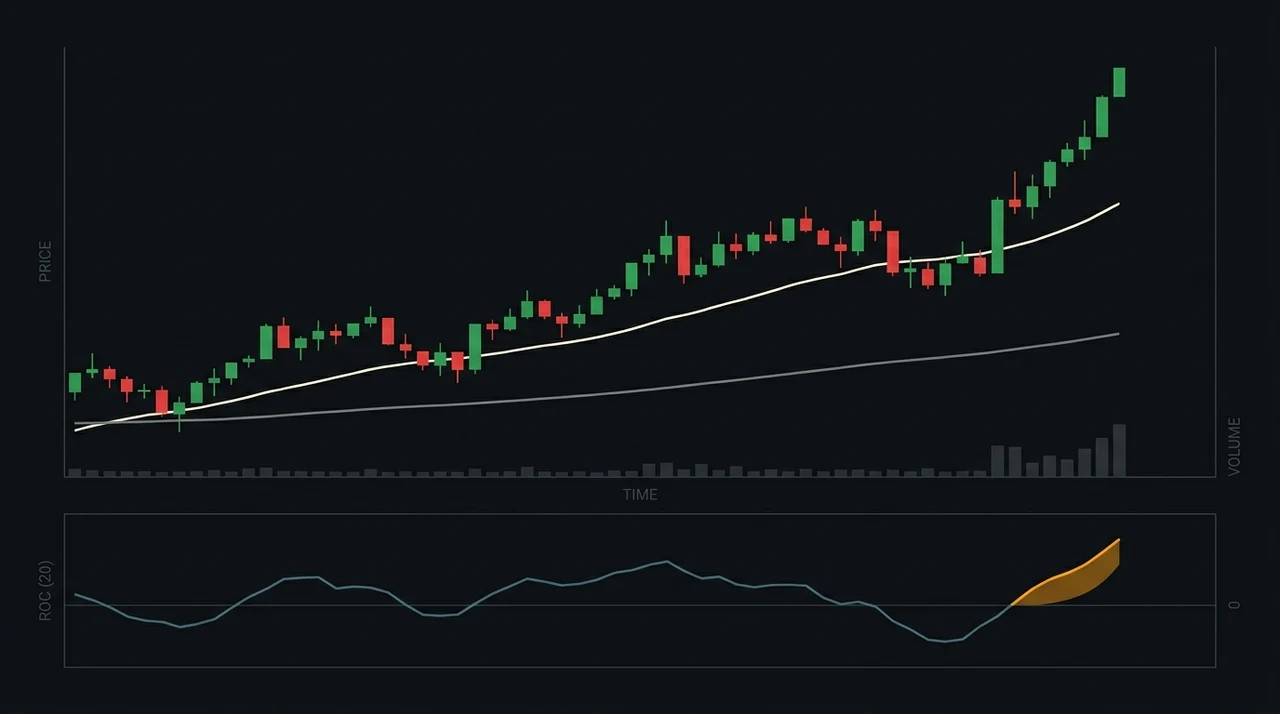
ROC Breakout: How Rate of Change Identifies Momentum Acceleration Before the Move
Jegadeesh & Titman (1993) found momentum strongest in the first weeks after acceleration began — not after months of steady trending. Rate of Change captures that initiation event. This guide covers the five entry conditions EasySwing checks, the 20-day ROC rule (positive and rising) and why it works, holdout backtest results (2.02 profit factor, 2,625 trades), the three-level trade structure, and how ROC Breakout complements VCP, Qullamaggie, and Frog-in-the-Pan in a momentum-strategy portfolio.
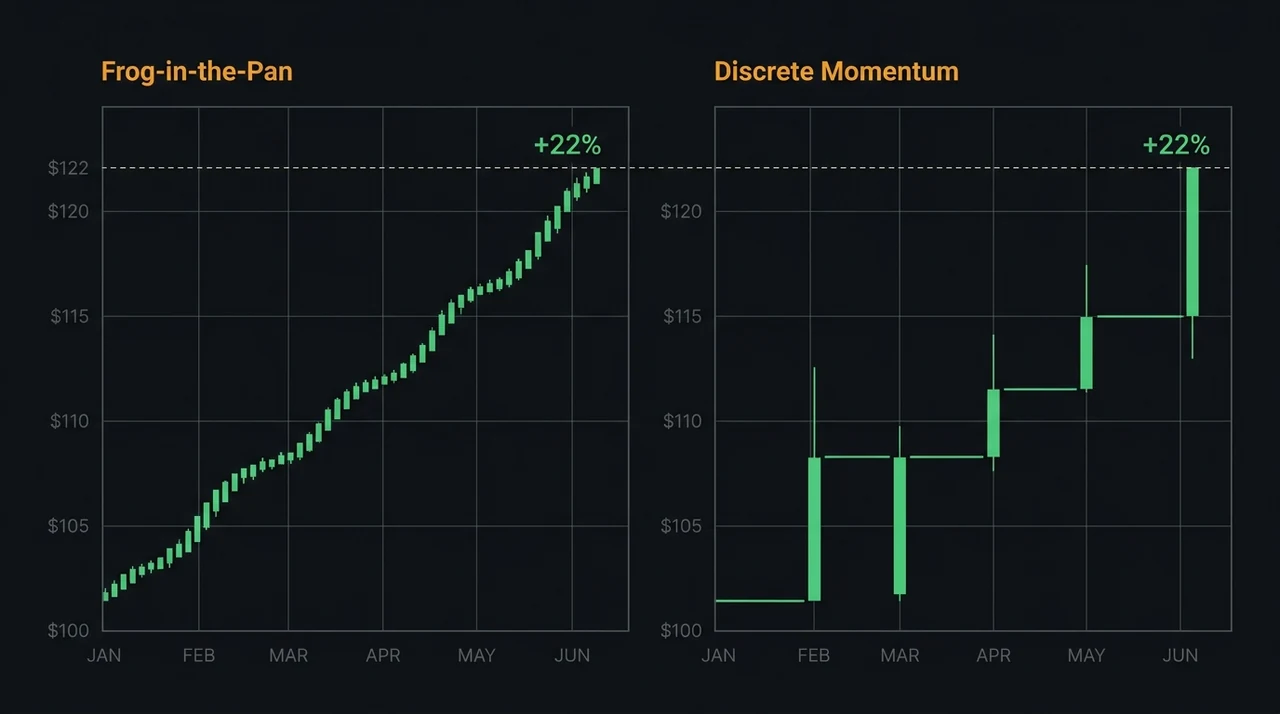
Frog-in-the-Pan Momentum: How Smooth Price Paths Signal Institutional Accumulation
Da, Gurun & Warachka (2014, Review of Financial Studies) found that stocks whose six-month return arrived via continuous daily increments outperform stocks with the same return delivered via a few large jumps — a finding that has persisted across decades. The mechanism is investor attention: gradual institutional accumulation stays below the retail radar, creating lower supply overhang when the stock finally breaks to new highs. This guide covers the Information Discreteness signal, the five-condition entry checklist, EasySwing's tuned parameters (1,341 holdout trades, 1.99 profit factor), and how to apply it alongside other momentum strategies.
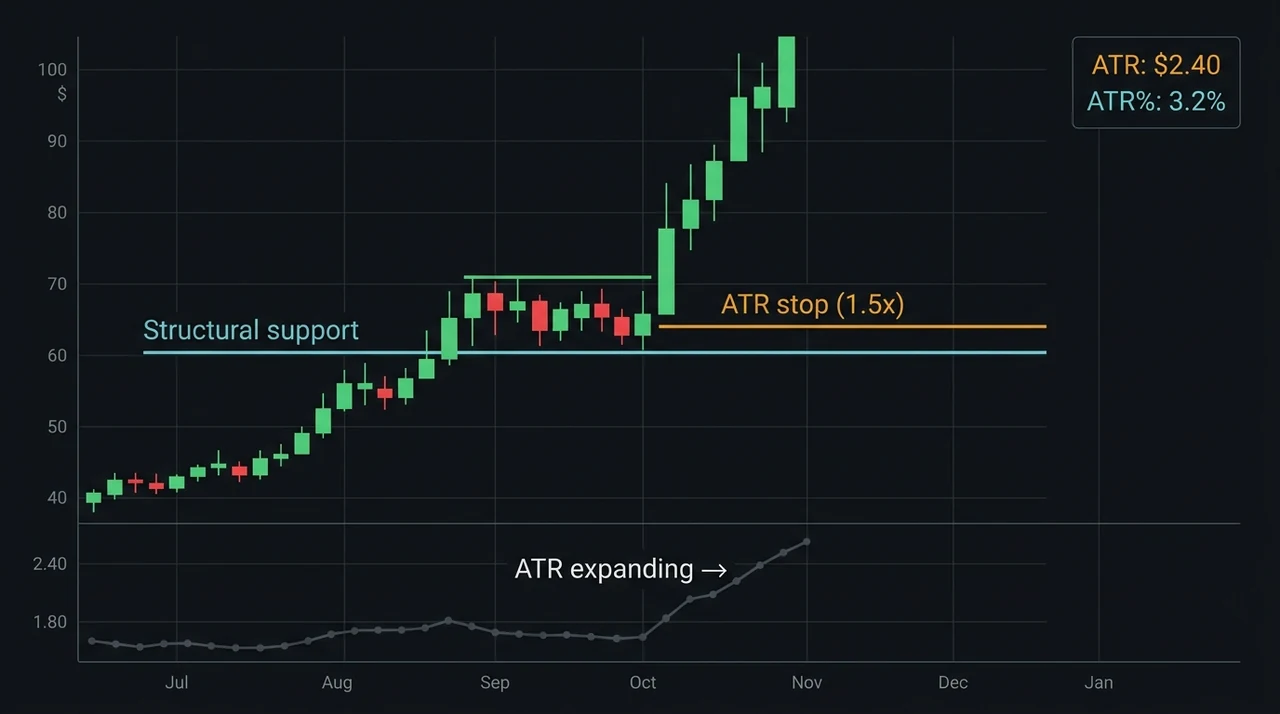
ATR Indicator for Swing Trading: How Average True Range Sets Optimal Stops
J. Welles Wilder introduced Average True Range in New Concepts in Technical Trading Systems (1978) alongside ADX and RSI to solve one problem: fixed-dollar stops fail on volatile stocks and over-trigger on calm ones. ATR adjusts stop placement to each stock's actual daily price rhythm. This guide covers the True Range formula, ATR multipliers by setup type, position sizing from ATR, and the three misreads that most often widen losses.
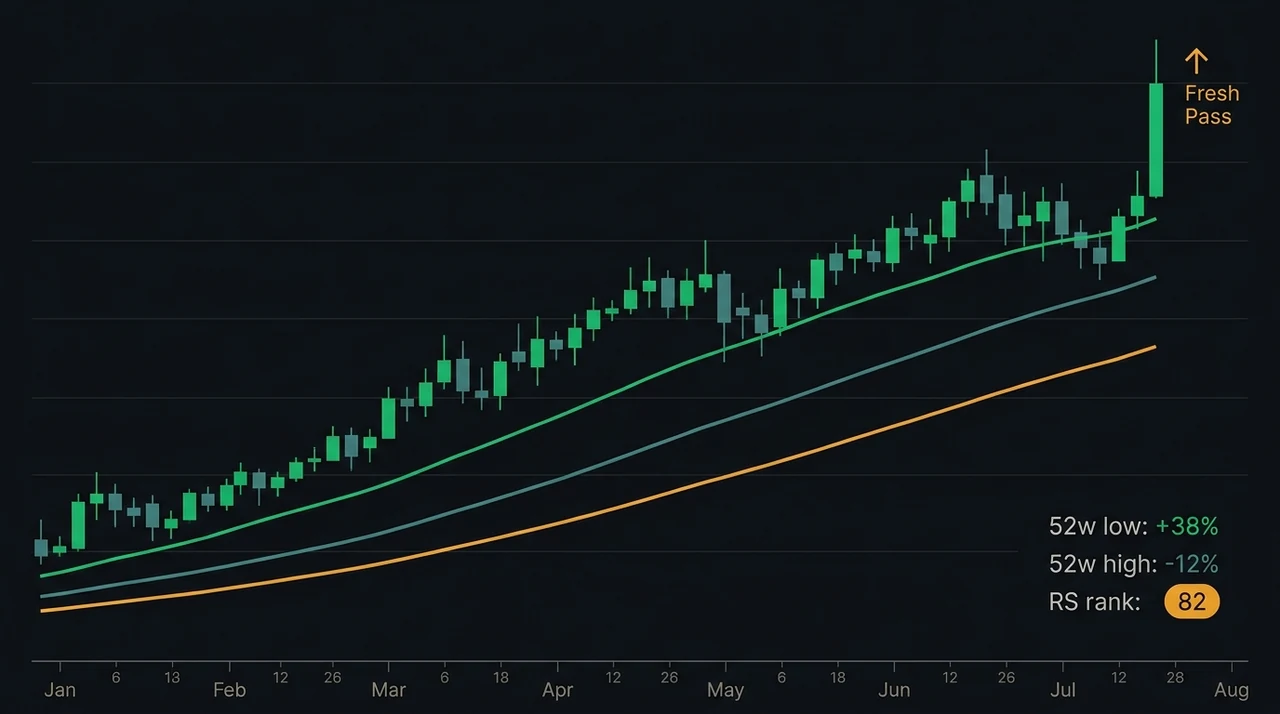
Minervini Trend Template: The 8-Criteria Screen That Identifies Market Leaders
Mark Minervini analyzed the trades behind his two US Investing Championship wins and found every winner shared one structural condition before any chart pattern formed: it had already cleared an eight-point moving average and price-level filter that eliminated more than 90% of the equity universe. This guide covers all eight Trend Template criteria, the SMA stack logic, the 30%/25% price rules, and EasySwing's Fresh-Pass signal that catches stocks entering the leadership cohort for the first time.
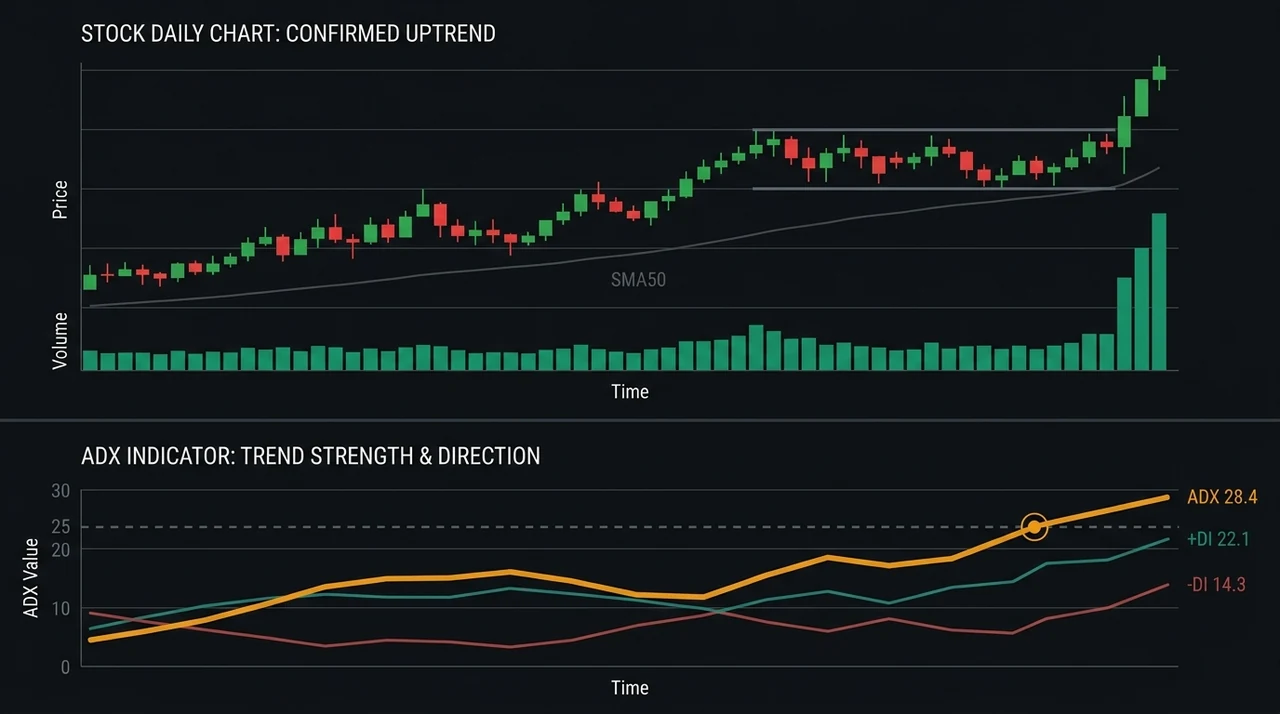
ADX Indicator: How Swing Traders Use Trend Strength to Filter Setups
J. Welles Wilder introduced the Average Directional Index in New Concepts in Technical Trading Systems (1978) to answer one question: is this market actually trending? ADX above 25 separates trending markets from ranging ones — and has remained the standard threshold for nearly five decades. This guide covers how to read ADX values, the three-line system with +DI and -DI, and how to use it to filter bull flags, pullbacks, and MACD entries.
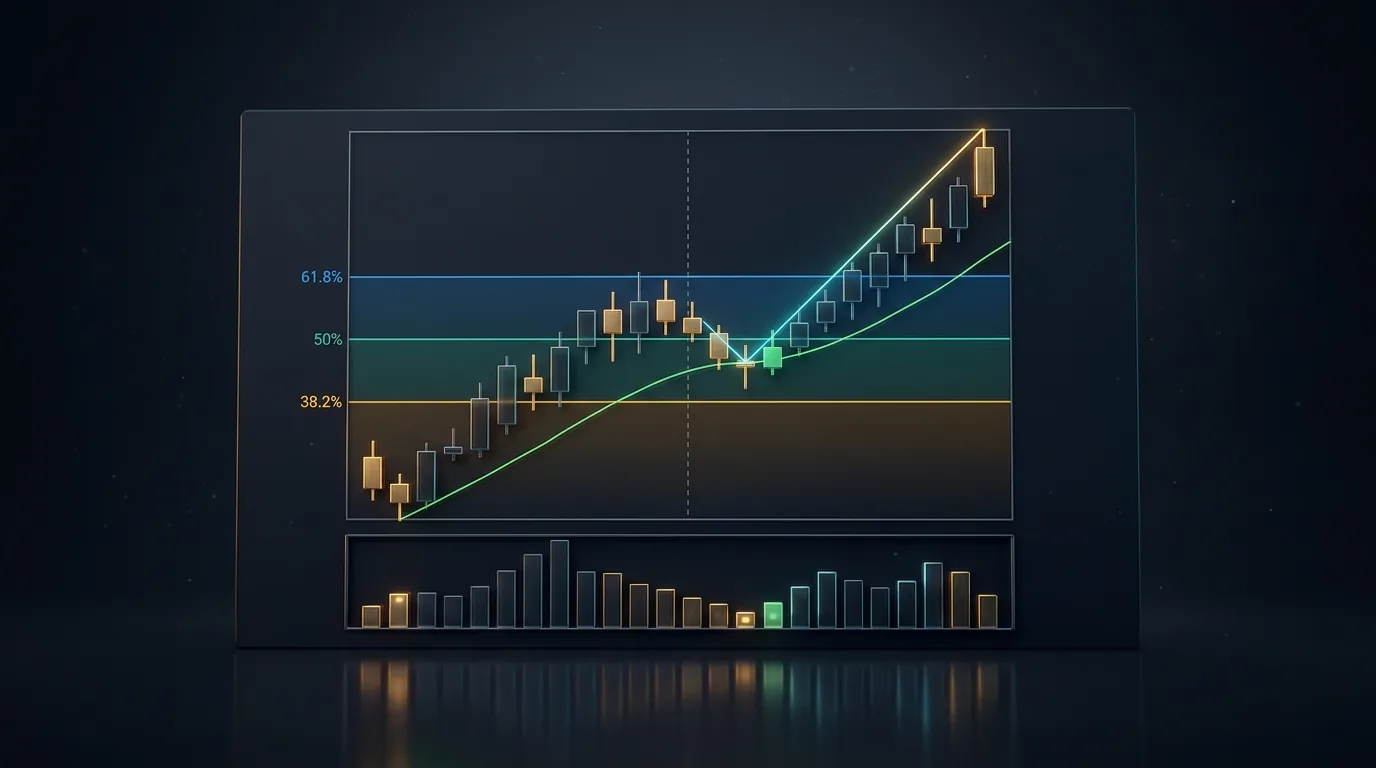
Fibonacci Retracement in Swing Trading: 3 Levels That Work
Thomas Bulkowski analyzed thousands of continuation patterns and found that the median pullback before a successful breakout ran to 38% of the prior advance — the first major Fibonacci retracement level. Fibonacci retracements are the zones where institutional participants consistently re-enter a trend. This guide covers the 38.2%, 50%, and 61.8% levels, how to anchor the grid correctly, and where Fibonacci analysis fails.

EasySwing vs IBD MarketSmith: Which Research Platform Fits Swing Traders?
William O'Neil's CANSLIM methodology identifies exceptional earnings and relative strength before a stock's major move — IBD MarketSmith was built to deliver that ratings stack. EasySwing.trading was built for the technical side of the same workflow: automated detection of eight named swing setups, A+/A/B+/B/C quality grading, and regime-adjusted output with pre-calculated entry, stop, and target levels. This comparison covers what each platform does, where each holds the advantage, and which trader profile each serves.

Support and Resistance in Swing Trading: How to Identify Key Price Levels
Edwards and Magee analyzed more than 5,000 charts and found that prior swing highs and lows reliably predicted future price behavior. Support and resistance are the price zones where supply and demand last reached equilibrium — and where they are likely to engage again. This guide covers the four methods for identifying key levels, how Weinstein stage analysis reframes resistance into support at breakouts, and the confirmation signals that turn a static price level into a valid trade trigger.

Volume Analysis for Swing Trading: How RVOL Separates Real Breakouts from Traps
William O'Neil's study of 400 market winners found that 95% showed volume at least 40–50% above their daily average on the initial breakout day. Relative volume — today's trading pace measured against the stock's own historical baseline — is the single volume metric that counts for swing trading. This guide covers the RVOL thresholds that separate breakout confirmation from noise, what healthy base volume looks like, and the three patterns that decide whether a breakout holds or reverts.

Qullamaggie Breakout: The Continuation Setup After a Momentum Leg
Kristjan Kullamägi's discretionary playbook reduces to three measurable rules: a prior +30% leg in the last 60 days, a 20-bar consolidation hugging the EMA20, and a close above the 20-day high on expansion volume. This guide covers what makes the Breakout Continuation distinct from the Episodic Pivot, why the prior-leg gate is the load-bearing rule, how the EMA20 trail and 60-bar time stop manage the trade, and an honest disclosure of why the strategy is structurally adversarial in deep bear regimes.
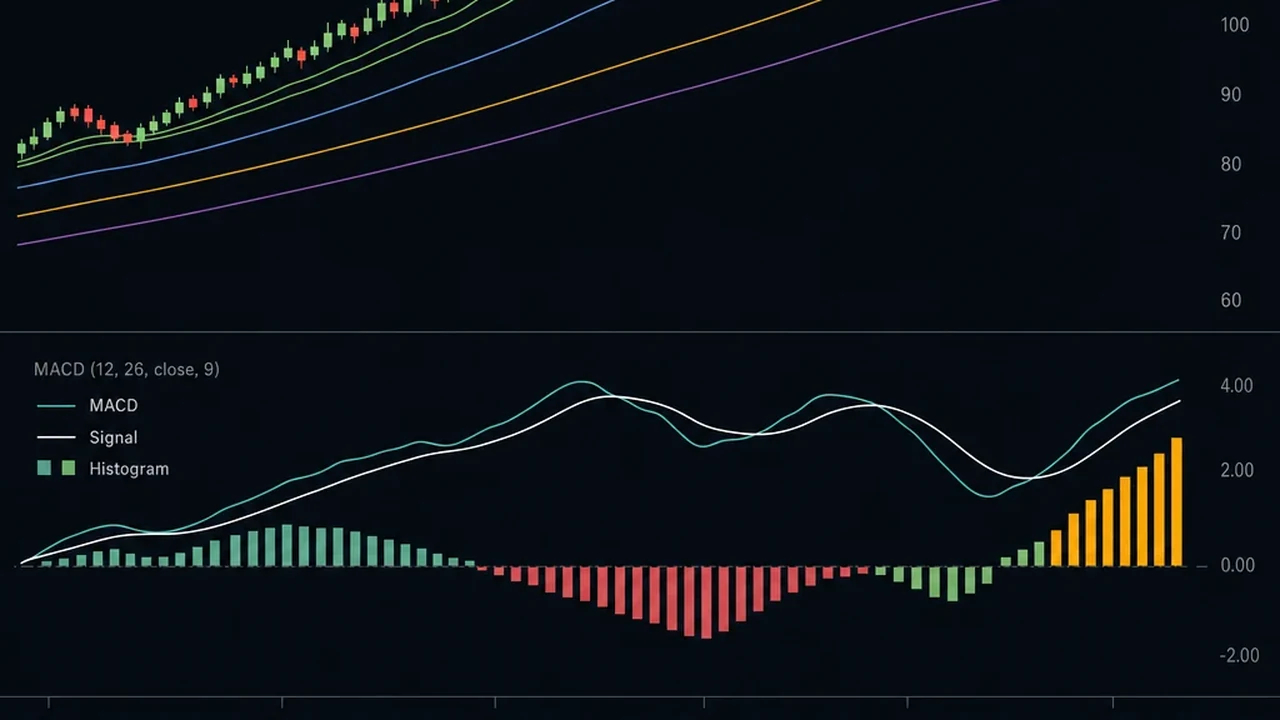
MACD for Swing Trading: How to Read Momentum Shifts and Filter False Crossovers
Gerald Appel built the MACD in 1979 because ordinary moving-average crossovers fired entries weeks after a trend had already turned. The histogram — not the line crossing — is where the actual momentum signal lives. This guide covers what each MACD component really tells you, why histogram re-acceleration is a more reliable entry trigger than the crossover, how divergence acts as a setup quality filter, and how regime and Stage 2 context decide when MACD signals carry real edge.

VWAP in Trading: What It Is and How Swing Traders Use It
VWAP (Volume-Weighted Average Price) resets every session, which makes it a sharp intraday tool and a poor fit for a 2-to-30-day swing hold. This guide covers what VWAP measures, how day traders use the standard version, why it breaks down outside a single session, and the anchored-VWAP adaptation that gives swing traders a genuine multi-day read.

Moving Averages for Swing Trading: The 5-MA Stack That Separates Setups from Noise
William O'Neil's analysis of 50 years of stock market data found that stocks above their 200-day SMA outperformed stocks below it by 24.7 percentage points per year. The full moving average stack for swing trading is five lines — EMA9, EMA20, SMA50, SMA150, and SMA200 — each with a distinct role from intraday timing to Stage 2 stage classification. This guide covers what each MA does, how to read alignment and slope together, and how EasySwing screens 2,000+ stocks using the MA stack before a single setup is graded.
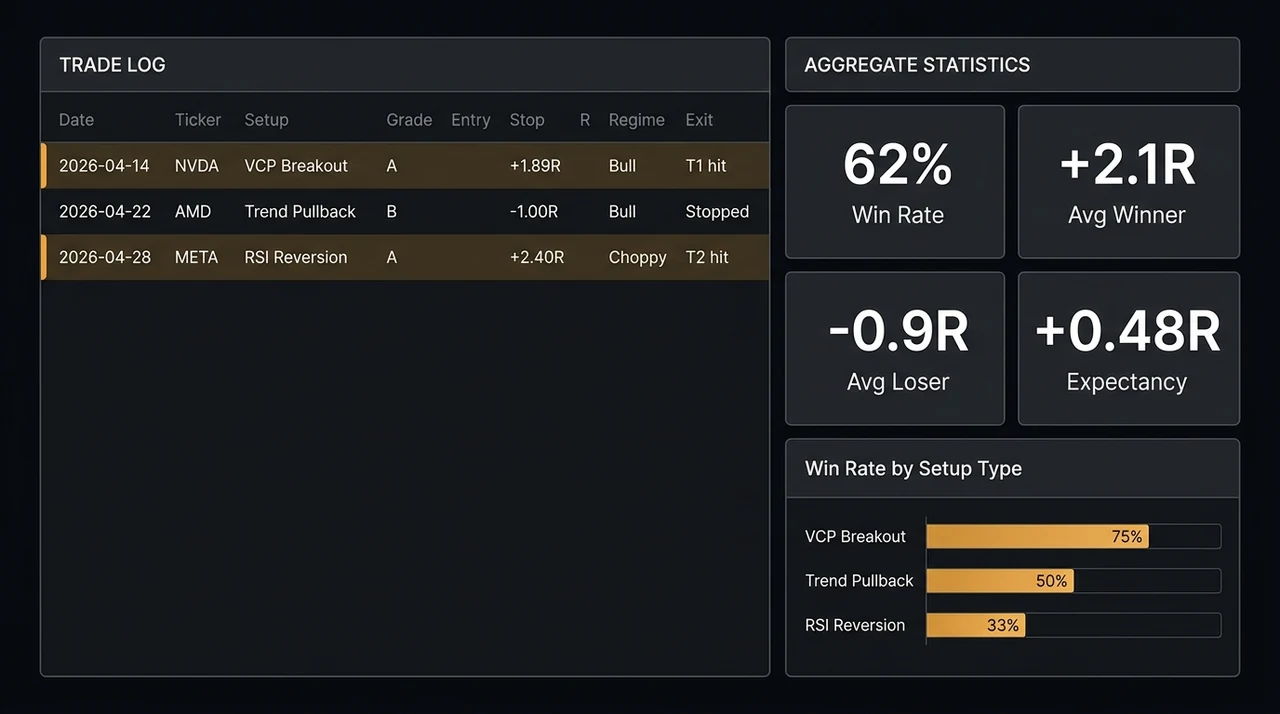
Swing Trading Journal: How to Track Setups and Build a Real Edge
Van Tharp documented in Trade Your Way to Financial Freedom (1998) that a trader's system expectancy can only be reliably computed from journal data across 30 or more closed trades. This guide covers exactly what to record, how R-multiples turn every trade into a comparable data point, and which four aggregate metrics reveal the hidden patterns in your execution — including how EasySwing's built-in journal pre-fills setup type, grade, entry zone, stop level, and target automatically.
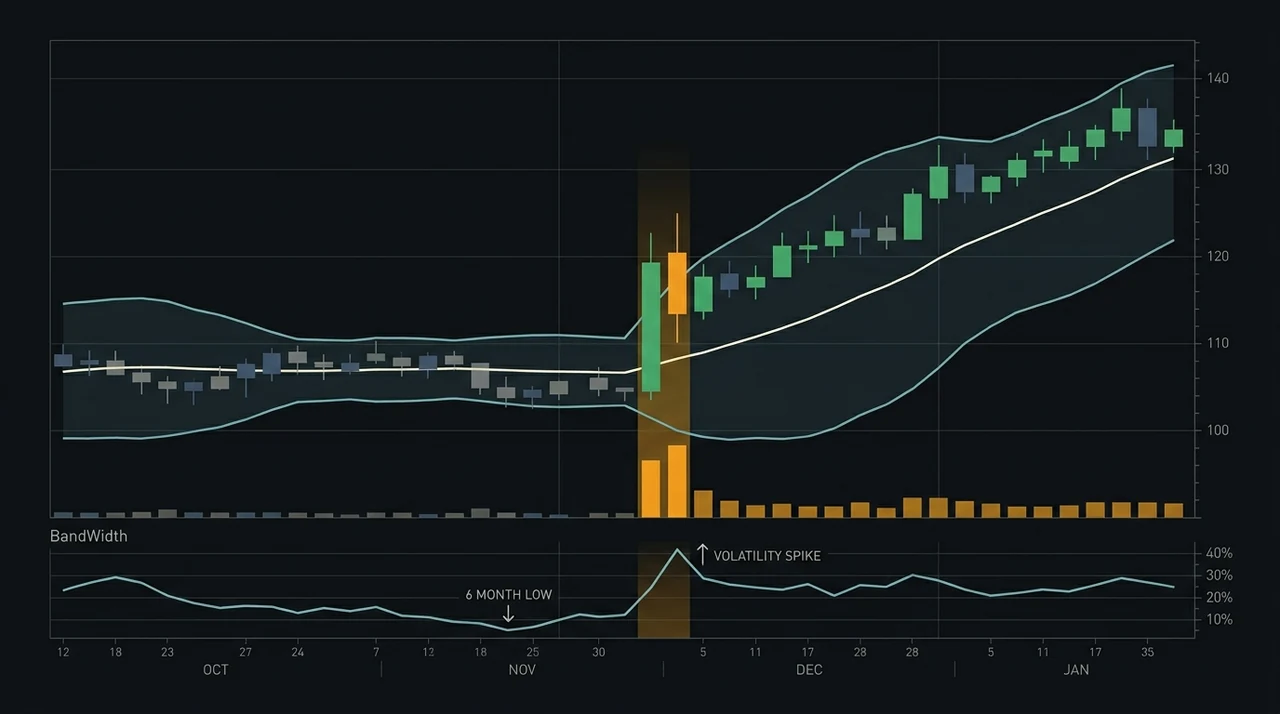
Bollinger Bands in Swing Trading: Reading the Squeeze
John Bollinger introduced Bollinger Bands in the early 1980s to solve a problem percentage envelopes couldn't: fixed-width channels ignored the fact that volatility is never constant. His solution — bands set 2 standard deviations from a 20-period moving average — dynamically widen in volatile markets and narrow in quiet ones. According to Bollinger on Bollinger Bands (2002), the standard settings contain approximately 89% of price action. This guide covers the squeeze-to-breakout framework: how to identify a confirmed squeeze, what the expansion trigger looks like, how to set stops, and how Bollinger Band squeezes connect to the VCP pattern EasySwing already detects.

EasySwing vs DeepVue: Which Swing Trading Screener Fits Methodology Traders?
DeepVue ships 100+ preset screens, named-trader partnerships with Minervini, Kell, and Webster, and an AI terminal for natural-language screen building — built for traders who want a deep menu of strategies. EasySwing ships thirteen pre-built setups graded A+/A/B+/B/C, gated by a market regime filter, with Soren as the built-in AI coach. Same price band, two opposing philosophies — opinionated workflow vs flexible research stack.

Swing Trading Stop Loss: 4 Methods That Protect Your Capital
Daniel Kahneman and Amos Tversky's 1979 study in Econometrica established that losses feel 2 to 2.5 times more painful than equivalent gains feel rewarding. A swing trading stop loss is the single rule that contains that asymmetry. This guide covers the four stop placement methods professional swing traders use — structural, ATR-based, moving average, and fixed percentage — with setup-specific stop rules for VCP, bull flag, pullback, RSI bounce, and bear flag entries.

EasySwing vs Trade Ideas: Which Scanner Wins for Swing Traders?
Fewer than 4% of U.S. stocks account for all net market wealth created since 1926, according to Bessembinder (Journal of Financial Economics, 2018) — which makes the right screening framework essential. Trade Ideas delivers real-time intraday alerts and Holly AI pre-market picks. EasySwing runs once per session, after the close, with seven pre-built swing strategies and a market regime filter. A direct comparison for traders deciding between an AI day-trading scanner and a regime-aware swing setup screener.

Top 10 Candlestick Patterns for Swing Trading
Thomas Bulkowski's Encyclopedia of Candlestick Charts (2008) tracked 103 patterns across more than 4.7 million candles of US equity data and found that fewer than a quarter produced a measurable directional edge — and even those edges were context-dependent. The practical lesson is narrow: a small set of patterns, read inside the right trend and at the right location on the chart, carries real signal. This guide covers the ten worth memorising — hammer, bullish engulfing, morning star, shooting star, and six more — with the swing-trading context that turns each shape into a usable read.

Best Stock Screeners for Swing Trading: 7 Tools Compared (2026)
Barber and Odean's 2000 study found that the most active retail traders underperformed passive investors by 6.5 percentage points per year — largely by acting on noise instead of signal. The right stock screener eliminates that noise. This comparison covers the seven most capable screeners for swing traders, evaluated on strategy detection, market regime awareness, pre-built risk frameworks, and price.

Swing Trading Signals: How to Find High-Probability Setups
Fewer than 1 in 100 active traders consistently outperform the market over five years, according to Barber, Lee, Liu, Odean, and Zhang (Management Science, 2017). The gap starts with signal quality — acting on high-volume, unfiltered alerts without regime context or pre-calculated risk parameters. This guide covers the five components that separate a valid swing trading signal from noise, how EasySwing's strategy engine generates seven signal types, and the pre-signal checklist for sizing in with confidence.

Momentum Stock Screener: 5 Filters That Identify Market Leaders
Jegadeesh and Titman (1993) found that top-quintile momentum stocks returned 12.01% annually above the market — a result replicated across 40 international markets. A momentum stock screener turns that research into a daily operational filter, narrowing 8,000+ equities to the handful where five signals align: RS rank 90+, EMA stack alignment, relative volume above 1.5x, ADX above 25, and sector leadership. This guide covers each filter, the five-step workflow for reading screener output, regime considerations, and a pre-trade checklist.

Best Free Stock Screener for Swing Trading: 5 Tools Compared
Fewer than 2% of all US-listed stocks account for the outsized gains that active traders target, according to O'Neil (2009). A swing trader's job is to isolate those candidates before the move — and a screener is the only practical way to do it at scale. This comparison covers the five best free stock screeners for swing trading: EasySwing.trading, Finviz, TradingView, StockAnalysis.com, and Barchart — each evaluated on RS rank, Stage 2 detection, named pattern labelling, and workflow depth.

Swing Trading for Beginners: 5 Mistakes to Avoid and the Right First Setup
The most active retail traders underperform a passive index by 6.5 percentage points per year, according to Barber & Odean (2000). The gap comes from trading without a defined process, not bad luck. This guide covers the five process errors that end most beginner accounts in the first 90 days — and why the VCP Breakout is the one setup worth mastering first.

EasySwing vs TC2000: Which Screener Fits Swing Traders?
TC2000 by Worden Brothers has been the go-to scan platform for Minervini-method operators for 30+ years — its RealCode builder gives experienced traders unlimited flexibility. EasySwing.trading pre-detects 13 named strategies, grades each setup A+/A/B+/B/C on quality, and filters results by market regime automatically. A direct comparison of the two screening models for traders choosing between code-based flexibility and strategy-ready structure.

Day Trading Stock Screener: 6 Filters That Matter Most
Fewer than 1% of day traders earn consistent profits over multiple years, according to Barber, Lee, Liu, Odean, and Zhang's 15-year analysis of retail trading activity (Management Science, 2017). The gap between the profitable minority and everyone else starts with stock selection — specifically, the six scanner filters that identify stocks with the supply-demand imbalance required to produce meaningful intraday moves. Float, RVOL, gap%, price range, catalyst, and VWAP — each filter explained with thresholds.

RSI Overbought: How to Screen for the Mean-Reversion Fade
When RSI(5) spikes above 70 on three consecutive rising days in a stock below its 200-day moving average, the bounce is statistically running on borrowed time. This guide covers the Connors RSI(5) framework, the three-condition entry trigger, stop placement, and exit criteria — a setup retired from EasySwing's active screener, kept here for the mean-reversion logic. Live strategy results are tracked on the performance page.

Swing Trading Technical Analysis: A Practitioner's Framework
Fewer than 4% of publicly traded stocks account for the net gain of the entire US stock market since 1926, per Bessembinder (2018). Swing trading technical analysis is the discipline of identifying those stocks before the major move — using trend, pattern, volume, and relative strength as a four-layer confirmation system. This guide covers the exact framework practitioners use, with a 12-condition pre-trade checklist.

PDT Rule Eliminated: Should Swing Traders Care?
The SEC eliminated the $25,000 Pattern Day Trader rule on April 14, 2026 — effective June 4. For swing traders the operational impact is near zero, but the second-order effect on retail intraday tape quality is the part worth your attention. Concrete predictions for the first 30 trading days post-cutover, a sharper checklist of what to do this week, and the EasySwing house view on why systematic swing process gets more valuable when noise rises, not less.

EasySwing vs ChartMill: Which Screener Fits Swing Traders?
ChartMill detects 59 chart patterns across US, Canadian, and European markets. EasySwing.trading runs 13 named swing trading strategies with regime gating, composite quality scoring, and strategy-based Telegram alerts. A direct comparison of the two screening models — pattern detection vs strategy detection — for swing traders choosing between them.

How to Swing Trade Stocks: A 7-Step Process From Screen to Exit
Jegadeesh and Titman (1993) confirmed that systematic momentum trading returned 12.01% annually above the market — the process was the edge, not prediction. This guide breaks down the seven-step workflow every disciplined swing trader follows: screening, regime check, trade plan, position sizing, alert, management, and review. Concrete criteria for each step, a 12-item pre-trade checklist, and a protocol you can run in under 30 minutes.

Swing Condor: EasySwing's Strategy for Ranging Markets
The Swing Condor is a direction-neutral setup that aims to profit from stocks oscillating within a defined support-and-resistance channel — five conditions, five-day average hold. It has since been retired from EasySwing's 13-setup registry; live results for the current lineup are tracked on the performance page.

Best Stocks for Swing Trading: How to Find High-Conviction Setups Each Week
Fewer than 2% of stocks produce the majority of market gains in any year — William O'Neil's research across decades of stock market winners. Five quantitative criteria separate high-conviction swing trade candidates from the noise: RS Rank 85+, Stage 2 MA stack, a named setup pattern, relative volume confirmation, and an EasySwing grade of B or better. Here is the screening workflow.
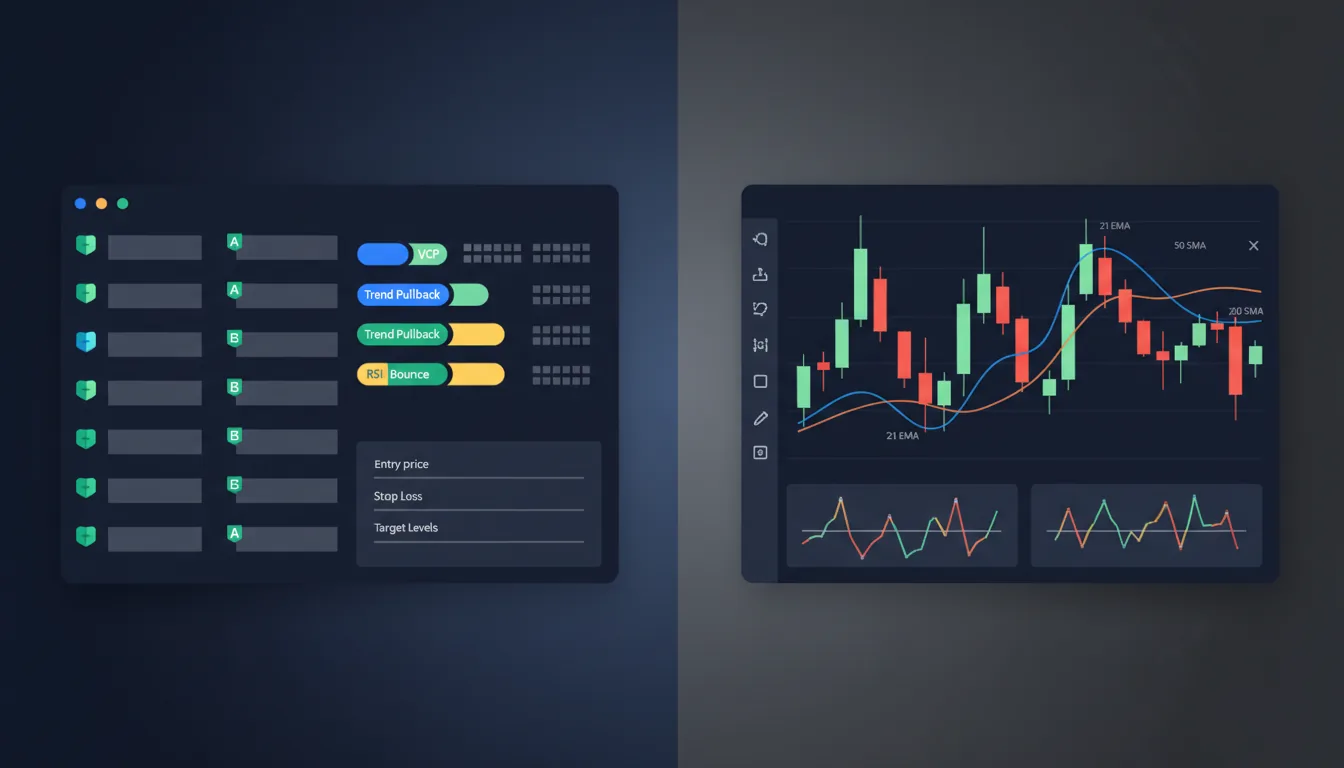
EasySwing vs TradingView Screener: Built for Swing Traders vs Built for Everyone
TradingView returns stocks matching your indicator conditions. EasySwing.trading returns stocks in named setups with quality grades, pre-calculated entry/stop/target levels, and market regime gating. A direct comparison of the two screening models — condition matching vs strategy detection — for swing traders choosing between the two.

Bull Flag Pattern: How to Trade This High-Probability Breakout Setup
Thomas Bulkowski's Encyclopedia of Chart Patterns found the bull flag met its price target 66% of the time in bull markets, with an average gain of 14% within three weeks. This guide covers the full entry checklist — pole requirements, flag depth limits, EMA stack confirmation, and the volume trigger that separates real breakouts from false ones.

Momentum Trading: How to Find Breakout Stocks Before They Run
Momentum is the most replicated anomaly in finance — buying past 6-month winners returned 12.01% per year above the benchmark in Jegadeesh and Titman's landmark 1993 study. Three signals define a high-probability breakout: RS Rank above 85, Stage 2 trend structure, and volume expansion of 1.5× or more on the breakout candle.
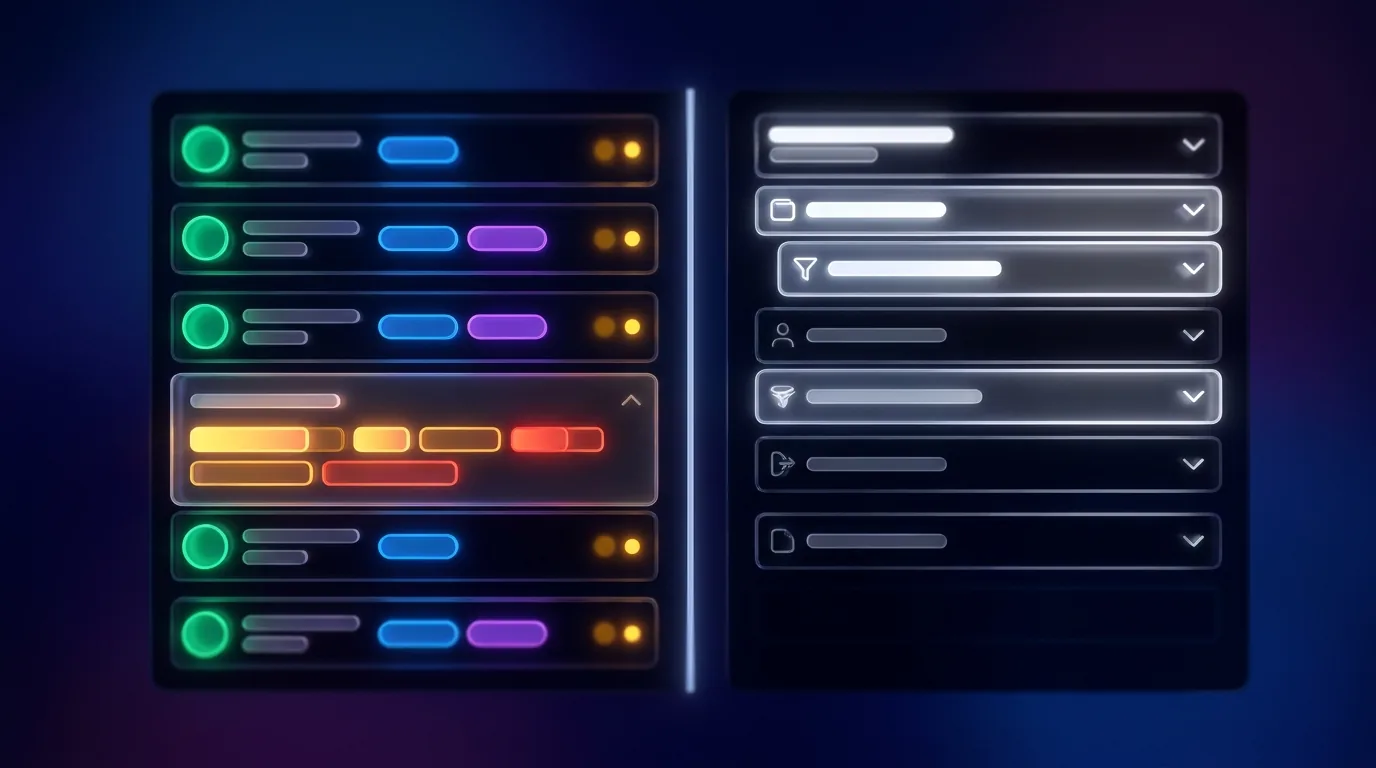
EasySwing vs Finviz: Which Screener Fits Swing Traders?
Finviz returns stocks matching your filters. EasySwing.trading returns stocks in named setups with quality grades, pre-calculated entry/stop/target levels, and market regime gating. A direct comparison of the two screening models — filter assembly vs strategy detection — so you can choose the right tool for your workflow.

How to Set Up Swing Trading Alerts: A Strategy-First Approach
Most swing trading alerts fire on a single condition -- price above SMA50, volume above average -- and generate noise. A strategy-specific alert encodes five conditions: setup type, entry trigger, trend structure, RS rank filter, and market regime gate. Here is how to configure each one.

Swing Trading Examples: 5 Real Setups With Entries, Stops, and Targets
Five concrete swing trading examples -- bull flag, VCP breakout, RSI mean reversion, trend pullback, and bear flag short -- each with the screening criteria that flagged them, entry price, stop placement, profit target, and outcome. The pattern recognition you need before you open a live scan.

How to Use a Stock Screener for Swing Trading: From Scan to Setup in 3 Steps
Strategy mode vs raw filters, reading grades and tags, converting a screener hit into a trade with defined risk — the practical workflow for going from 2,000+ stocks to a shortlist of high-conviction setups in under 60 seconds.

Swing Trading Strategies: 8 Proven Setups for Every Market
Swing trading strategies covering bull, bear, and ranging markets -- each with a defined entry checklist, stop rule, and target. Momentum breakouts, pullbacks, mean reversion, and range-bound setups, including retired strategies kept for education, with live results tracked on the performance page.
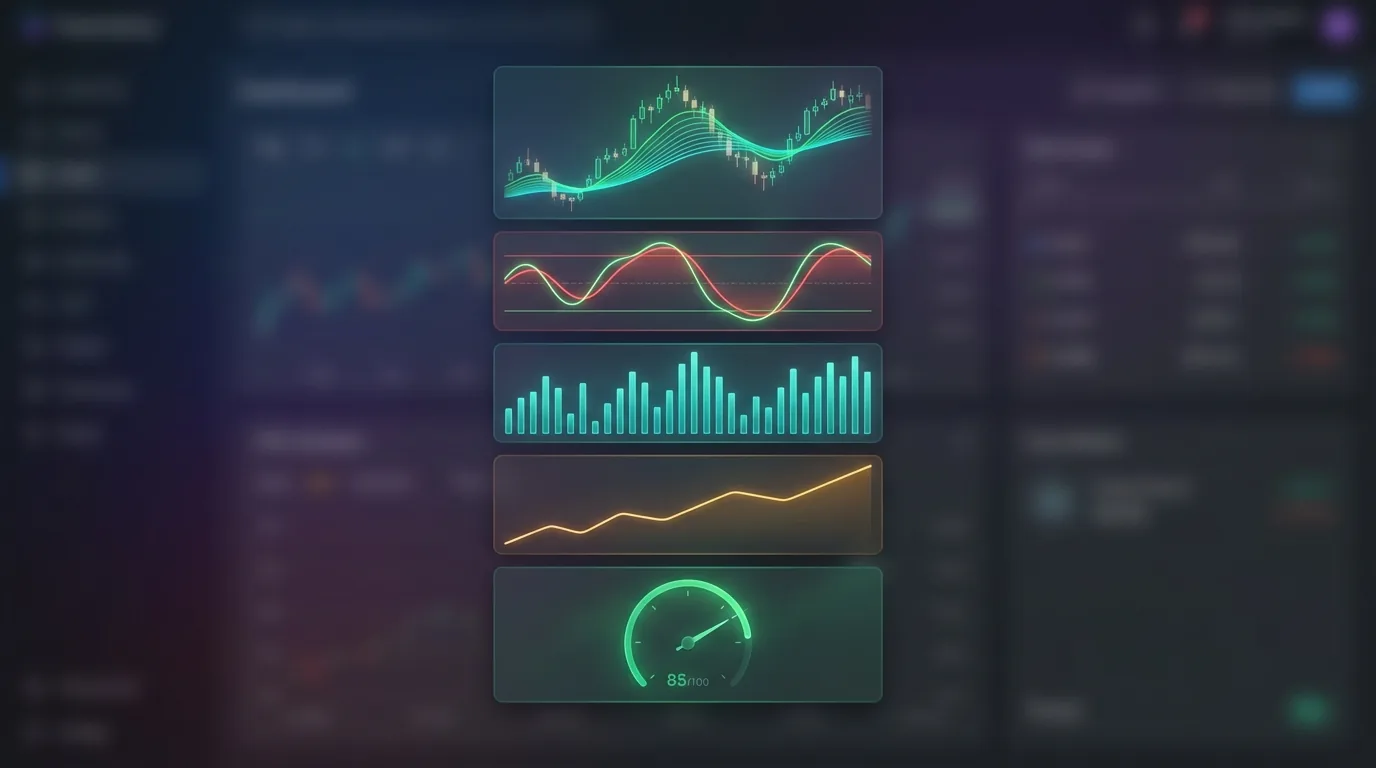
Best Indicators for Swing Trading: The 5 That Actually Work
Five indicators cover every decision in swing trading -- no more, no less. Moving averages define the trend, RSI times the entry, relative volume confirms the breakout, ADX filters the market regime, and RS rank selects the strongest stocks. Here is how to use each one.

5 Swing Trading Screener Filters That Separate Signal from Noise
Stage 2 trend structure, RS rank above 80, relative volume above 1.2x, market cap sweet spot, and named setup pattern match — the five filters every swing trading screener needs, the research behind each one, and why generic screeners fall short.
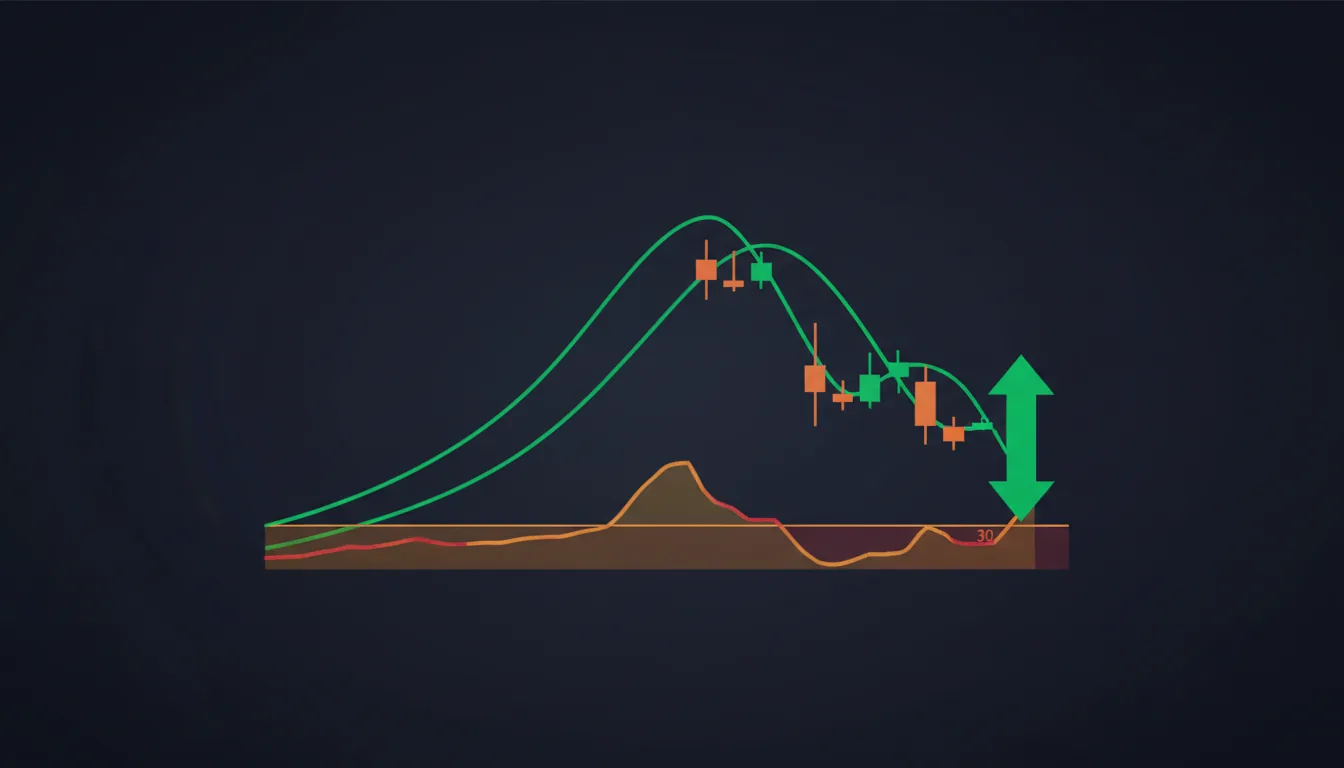
RSI Mean Reversion: How to Trade Oversold Bounces
RSI Mean Reversion buys stocks when RSI(14) drops below 30 in Stage 2 uptrends, then triggers entry on a confirmed bounce candle. It has since been retired from EasySwing's active screener — this guide covers the mechanics for education; live results for the current 13-setup lineup are tracked on the performance page.

Power Earnings Gap (PEG): The Swing Trader's Approach
A Power Earnings Gap is a gap-up of 5%+ after a strong earnings beat, backed by institutional volume. Most traders chase the open and get burned. The smarter play: wait for the first VCP or pullback to MA after the gap — then enter with defined risk after the base forms.

How to Use the EasySwing Stock Screener: A Complete Walkthrough
A step-by-step guide to EasySwing's StockFinder — from filter categories and strategy mode to setup cards, alerts, and preset screens. Learn how to find high-conviction swing trading setups in under 60 seconds.

What is Swing Trading? A Complete Guide for Beginners
Jegadeesh and Titman documented 12.01% annual excess returns in momentum strategies — the academic foundation of swing trading. This guide covers the three pillars of every high-probability setup (Stage 2 trend, RS rank 80+, named pattern), the 1% risk rule with position-sizing tables, and what to expect in your first year.
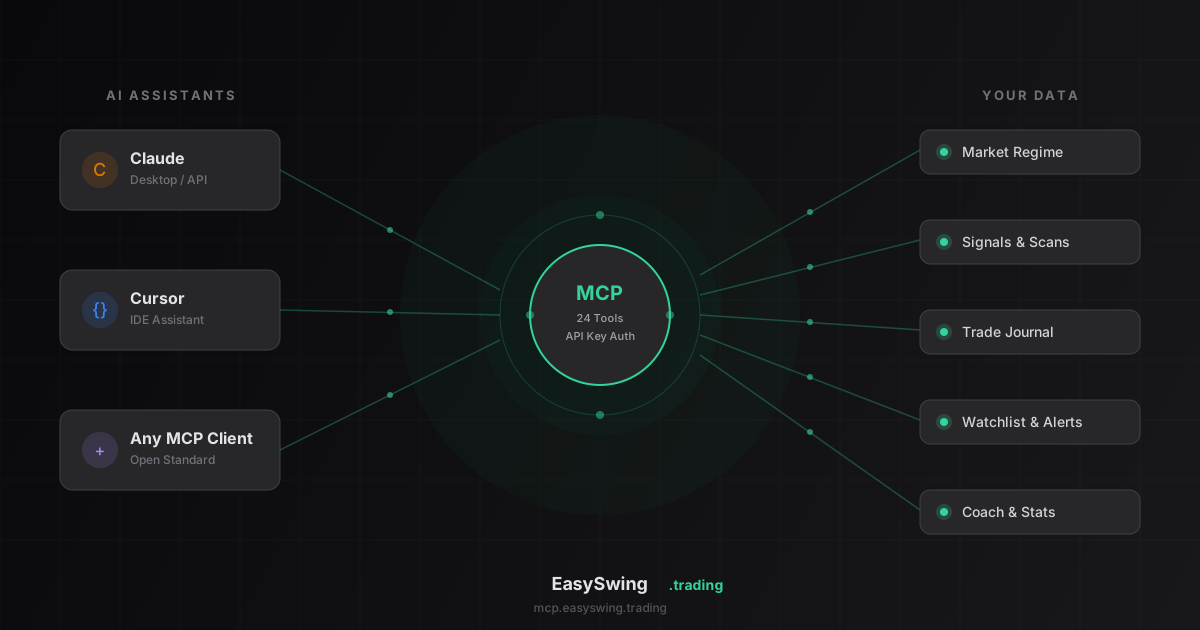
Your AI Assistant Now Speaks EasySwing
EasySwing now works with AI assistants like Claude and Cursor via the Model Context Protocol. One API key gives your assistant access to market regime, strategy scanning, your watchlist, trade journal, and more — without leaving the conversation.

Market Regime: How to Read Bull, Bear, and Choppy Markets
Market regime is the single biggest factor in whether your trade works. EasySwing detects 5 regime states — from strong bull to strong bear — using breadth, VIX, and trend data. Learn how to read the regime and adapt your strategy accordingly.

Pullback to Rising MA: The Safest Entry in a Trending Stock
A pullback to a rising moving average is one of the highest-probability entries in swing trading. Learn the EMA9/EMA20 Bone Zone framework, the exact entry checklist, ATR-based stops and targets, and why trend context makes this one of the higher-probability entries, with live stats on the performance page.

What is a VCP Setup? The Volatility Contraction Pattern Explained
The Volatility Contraction Pattern (VCP) is one of Mark Minervini's most reliable breakout setups. Learn exactly what to look for — tightening price action, declining volume on contractions, and the pivot buy point that signals institutional accumulation.
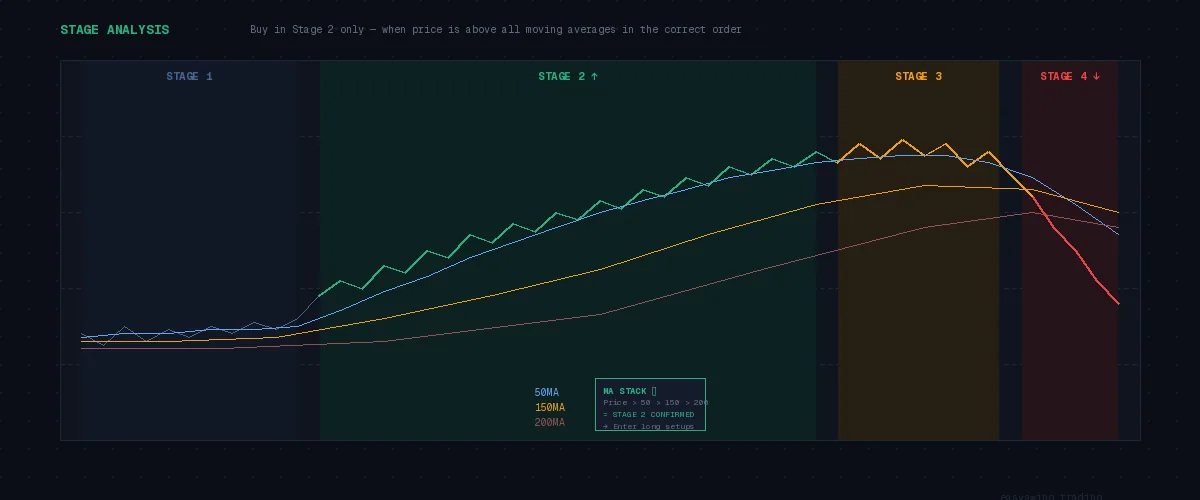
Stage 2 Stock Analysis: How to Find Stocks in a Mark Minervini Uptrend
Stan Weinstein's Stage Analysis divides a stock's life cycle into 4 stages. Stage 2 — the advancing phase — is where the biggest wins happen. Here's how EasySwing identifies Stage 2 stocks automatically, and what to look for before you buy.

Relative Strength Rank: Why RS 90+ Matters for Swing Traders
Relative Strength (RS) rank scores a stock's price performance against the whole market as a 0-99 percentile. Stocks with RS rank above 90 are outperforming 90% of the market — and research shows they tend to keep outperforming. Here's how to use it.

Position Sizing with R-Multiples: Risk Management for Swing Traders
Position sizing determines how much you risk per trade — and it matters more than your win rate. Learn how to use R-multiples to calculate the right position size, why a 40% win rate can be highly profitable, and how EasySwing makes this easy with every setup card.

Bear Flag: How to Profit from Short Setups in Downtrending Stocks
A bear flag is a bearish continuation pattern where a stock in a confirmed downtrend pauses in a tight upward channel before breaking down. Learn the inverted EMA stack and entry checklist for this classic short-side pattern — retired from EasySwing's active screener but covered here for education.

Swing Trading vs Day Trading: Which Style Fits You?
Swing trading and day trading both aim to profit from short-term price moves, but they differ in time commitment, capital requirements, and lifestyle fit. This comparison helps you decide which style matches your goals — or whether a hybrid approach works best.

Cup and Handle Pattern: William O'Neil's Classic Breakout Setup
The cup and handle is William O'Neil's classic Stage 2 breakout pattern — a U-shaped consolidation followed by a tight handle pullback and high-volume breakout. Learn the exact entry checklist, stop placement, volume signature, and why bull-market conditions matter far more to this setup than ranging ones.
Ready to scan for these setups automatically?
EasySwing scans 2,000+ stocks for VCP patterns, Stage 2 uptrends, and RS 90+ candidates twice daily. Create an account to start using the workflow.
Start free