Swing Trading for Beginners: 5 Mistakes to Avoid
The most active retail traders underperform a passive buy-and-hold index by 6.5 percentage points per year, according to Barber & Odean (2000) in the Journal of Finance. The gap does not come from bad markets — it comes from trading without a defined process. Swing trading, approached systematically, is one of the most learnable disciplines for independent retail traders. This guide covers five mistakes that end most beginner accounts early, and the one setup worth learning first.
Why Swing Trading Suits Independent Retail Traders
Swing trading's 2-to-30-day holding period eliminates the millisecond execution pressure of day trading while capturing documented momentum returns. Jegadeesh & Titman (1993) showed 12.01% excess annual returns from medium-term momentum strategies over a 30-year dataset. A swing trader analyses setups once per day — after the market closes — and sets entry, stop, and target levels in advance, before the open.
The pace fits human decision-making. You review candidates in the evening, write your parameters for the next session, and let the market come to your price. No intraday tick charts, no multi-monitor setups, no split-second execution.
The statistical edge is real and durable. Jegadeesh & Titman (1993) identified consistent excess returns from 3-to-12-month momentum portfolios across three decades of US market data. Swing trading with 2-to-30-day holds captures the granular end of the same phenomenon — stocks that have already demonstrated relative strength and are continuing a confirmed uptrend.
EasySwing.trading automates the screening step. Each night, 2,000+ US equities are scanned for Stage 2 trend structure, RS rank thresholds, and named setup patterns. The results — ranked by quality grade — are ready before the market open. A beginner can focus entirely on learning to execute one setup, not on building a scanner from scratch.
The 5 Mistakes That End Most Beginner Accounts
Most new traders fail not because the markets are unpredictable, but because of five specific process errors that compound over weeks. Fixing all five before committing real capital is the highest-impact preparation step available to a new trader — more valuable than any technical study in the first month.
Mistake 1: Trading Without a Defined Setup
The most common beginner error is entering trades without a specific, pre-written entry template. Forum tips, news-driven reactions, and vague "it looks good" chart reads do not constitute a repeatable edge.
A defined setup specifies five things: the pattern type (e.g., VCP, bull flag), the trend requirement (Stage 2), the RS rank minimum, the volume condition on entry, and where the stop goes. Every missing element is a gap that intuition fills — and intuition in markets is unreliable without years of pattern recognition.
Mark Minervini documents this discipline in Trade Like a Stock Market Wizard (2013): every winning trade in his championship years — including his 220% annual return from 1997 — met a precise template before he placed the order. The discipline to pass on near-matches is what converts a process into a repeatable edge. Before trading any setup, write all five criteria on an index card. If a candidate does not meet every criterion exactly, skip it.
Mistake 2: Ignoring Market Regime
A valid setup in a downtrending broad market fails at a much higher rate than the same setup in an uptrend. EasySwing's internal data shows win rates for long-side breakout setups dropping from approximately 65% to 38% when the broad market is in a confirmed downtrend — the same setup, opposite regime, radically different outcome.
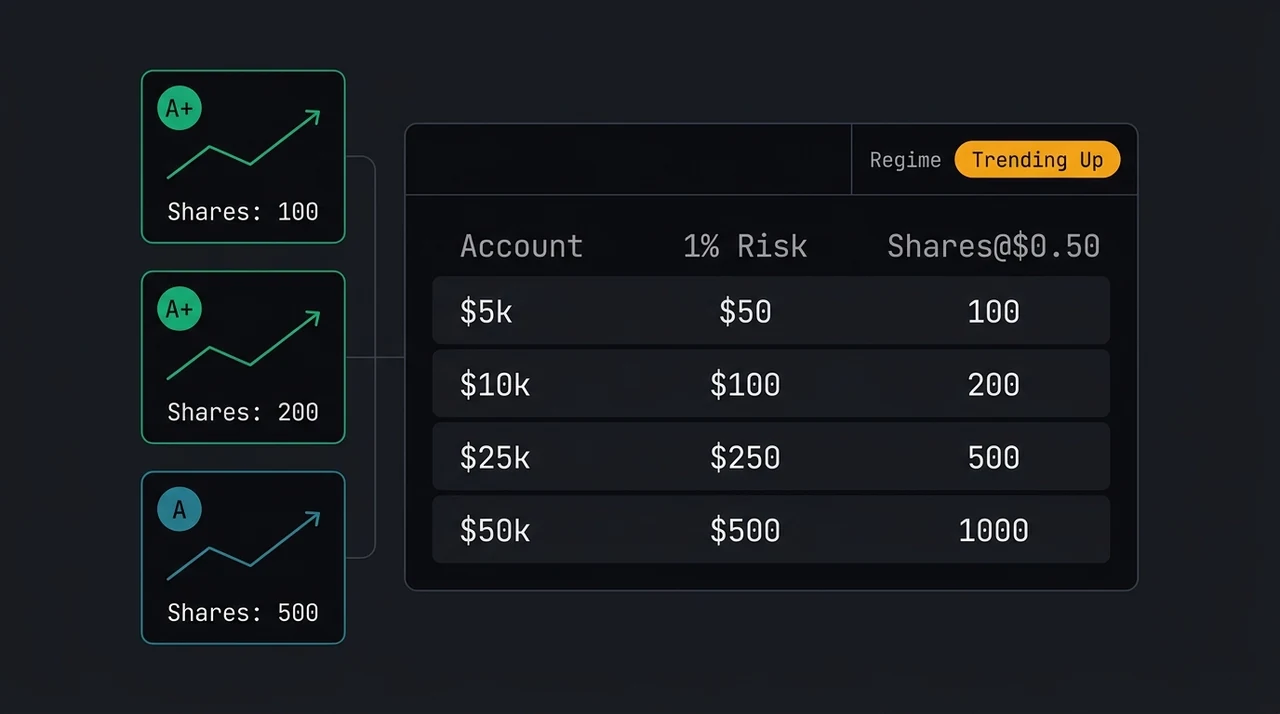
The market regime indicator classifies the environment as Trending Up, Neutral, Choppy, Trending Down, or Strong Down. For beginners, the rule is simple: only enter long breakout setups when the regime is Trending Up. In any other regime state, paper trade or hold cash.
Mistake 3: Risking Too Much Per Trade
The standard risk budget for a new trader is 1% of total account capital per trade — $100 at a $10,000 account if the stop is hit. Most beginners start at 3–5% because small losses feel inconsequential. They are not: three consecutive 3% losses erase 9% of the account and generate the emotional pressure that leads to revenge trading and larger mistakes.
Position sizing with R-multiples is the discipline that keeps you in the market long enough to build a real edge. At 1% risk per trade, you absorb 25 consecutive maximum losses before losing 22% — statistically near-impossible if your setup has any genuine edge at all.
Mistake 4: Skipping Paper Trading
Most new traders skip paper trading because it feels slow and paper profits do not feel real. The opposite view is correct. Paper trading 10 complete trade cycles under real market conditions — checking setups each evening, recording entry and stop prices, tracking daily prices, executing exits — builds the execution habit without capital risk.
Ten cycles at swing trading's 2-to-30-day hold pace takes 4–8 weeks. That is a small time cost relative to preserving your entire starting account.
Mistake 5: Chasing Multiple Setups at Once
Each chart pattern has subtleties in contraction structure, volume behaviour, and regime context that take weeks to internalize properly. Beginners who follow all 13 setups EasySwing detects simultaneously end up half-familiar with all of them and fully confident in none.
The efficient path is sequential: learn one setup completely, paper trade it until the entry criteria feel automatic, then add a second. William O'Neil writes in How to Make Money in Stocks (2009) that mastering one buy signal so well that you could identify it instantly is far more valuable than broad but shallow pattern recognition.
The One Setup Every Beginner Should Learn First
The VCP Breakout is the best first swing trading setup for new traders because its criteria are specific, its edge is extensively documented, and EasySwing detects it automatically. You focus on execution, not on building recognition skills from scratch. The clear pivot stop makes risk management straightforward from day one.
A VCP (Volatility Contraction Pattern) is a stock in Stage 2 — price above the MA stack (50-day, 150-day, 200-day), all moving averages trending up — that has gone through two to four progressively tighter pullbacks. Each contraction is shallower than the last. Volume dries up on each down-leg. When the stock breaks out above the most recent pivot high on 2× average volume, that is the entry signal.
Minervini documents in Trade Like a Stock Market Wizard (2013) that over 70% of his winning trades from 1997–2007 exhibited VCP-type consolidation before their breakout. Clenow (Stocks on the Move, 2nd ed., 2019) found a 58% win rate for breakouts from tightening-range consolidations over three-month holding periods — meaningfully above the 43% baseline for random entries in the same dataset.
EasySwing screens for VCPs nightly across 2,000+ US equities. When a stock passes the Stage 2 filter, the RS rank threshold (80+), and the contraction sequence check, it appears in the screener with a VCP tag and a quality grade (A+/A/B+/B/C). Beginners should focus on Grade A or B setups in a Trending Up regime, with the stop below the final contraction low and two targets at 1R and 2R.
Full criteria and stop-placement mechanics are in the VCP Setup guide.
A 30-Day Plan: From Paper Trades to First Real Capital
A structured 30-day plan bridges the gap between reading about a setup and executing it with real money. Week 1 is study and setup definition; weeks 2–3 are paper trading; week 4 is the first live trade at half-size. Minimal structure is deliberate — complexity is the main obstacle in the first month, not information.
Week 1: Study and Setup Definition
- Read the VCP Setup guide twice, focusing on contraction criteria and stop-placement logic
- Read the market regime guide once — understand the five regime states and which ones support long VCP entries
- Write your criteria on a physical index card: pattern (VCP), trend (Stage 2), RS rank (80+), entry volume (2× 50-day average), stop (below final contraction low)
- Each evening, review EasySwing signals — find VCP-tagged stocks that match the criteria card and log them, even without trading
Weeks 2–3: Paper Trading
- Record at least five paper trades in a simple log: date, ticker, regime at entry, entry price, stop price, target prices
- Update the log daily; exit when the stop is hit or target is reached
- After five trades, review: did every entry match the criteria card exactly? Were stops honoured?
Week 4: First Live Trade
- Choose one Grade A or B VCP setup in Trending Up regime
- Size at 0.5% account risk — half the normal maximum — for the first live trade
- Execute from the criteria card, not from impulse or news
After the first live cycle completes, read the full how to swing trade workflow and move to standard 1% position sizing for subsequent trades.
Pre-Trade Checklist for Swing Trading Beginners
This 12-item checklist applies to every trade in the first 60 days. Any single ❌ item is a veto: if even one fails, skip the candidate and move on. The goal is to confirm a setup genuinely qualifies — not to find a justification for entering.
- ✅ Setup matches the written criteria exactly — not "close enough"
- ✅ Market regime is Trending Up or Neutral (not Choppy, Trending Down, or Strong Down)
- ✅ Stock is in confirmed Stage 2 (price above 50/150/200 MA, all MAs sloping upward)
- ✅ RS rank is 80 or higher
- ✅ Volume dried up on the final contraction leg (below 50-day average volume)
- ✅ Entry trigger is defined in advance (pivot breakout with above-average volume)
- ✅ Stop level is defined before entry (below the low of the final contraction)
- ✅ Position size limits risk to 1% of account (0.5% for the first live trade)
- ✅ Two price targets (T1 at 1R, T2 at 2R) are written before entry
- ❌ Do not enter if the setup originated from a tip, social media post, or news headline
- ❌ Do not enter if price has already extended more than 7–10% past the pivot
- ❌ Do not move the stop wider after entry — exit at the defined level and move on
Frequently Asked Questions
How much money do you need to start swing trading? There is no legal minimum for a cash account. A practical minimum is $2,000–$5,000 so that 1% account risk per trade ($20–$50) translates into enough shares to make execution meaningful. Accounts below $2,000 frequently force position-sizing math that requires risking more than 1% per trade to buy even a single share of mid-priced stocks.
How long does it take to become consistently profitable at swing trading? Research by Barber, Lee, Liu & Odean (2011) found that fewer than 1% of day traders remain consistently profitable after two years. Swing trading carries a more favourable baseline — longer hold times, larger documented edges, lower execution pressure — but realistic expectations are still 6–12 months of structured paper and live trading before drawing conclusions about whether your process is working.
Should beginners trade short-side strategies as well as long? No. Short selling requires a margin account, involves borrowing costs that erode returns, and carries theoretically unlimited risk. Master long-side breakout setups fully before approaching short-side strategies. Bear flag and RSI Overbought short setups are best treated as intermediate-level additions after 12+ months of live experience on the long side.
What is the most common error beginners make with stops? Moving the stop wider after entry to avoid being stopped out. A stop should be placed at the technical invalidation level — below the final contraction low in a VCP — and held there regardless of short-term noise. Widening the stop after entry converts a planned 1R loss into a 3R or 4R outcome. If a trade needs a wider stop, the correct fix is a smaller position size, not a wider stop.
Does swing trading work in bear markets? Long-side breakout setups have significantly lower win rates when the broad market is in a confirmed downtrend. The correct bear-market adjustment is to reduce position sizes, increase cash allocation, and wait for the regime to shift back to Trending Up or Neutral. EasySwing's market regime indicator provides a daily classification — treat it as the first filter before entering any long setup.
EasySwing.trading automates the screening and grading steps for beginners — nightly scans across 2,000+ US equities flag VCP, Trend Pullback, Cup and Handle, and four other named setups with quality grades before the market open. For the complete trading workflow once you have your first setup mastered, read How to Swing Trade Stocks: A 7-Step Process. To build the risk management discipline around your entries, read Position Sizing with R-Multiples. Scan results are for informational purposes only. See our Risk Disclaimer.
Disclaimer: This article is for educational purposes only and does not constitute investment advice. EasySwing is a stock screening tool, not a registered investment advisor. All trading involves risk. Read our full disclaimer →