Market Regime: How to Read Bull, Bear, and Choppy Markets
The Market Has a Weather System
Market regime is the current state of the broad market — the directional trend, volatility, and breadth conditions that determine which trading strategies work and which ones fail. Think of it as the market's weather: you can have the best sailboat in the harbor, but if a hurricane is blowing, you stay docked.
The single most important decision a swing trader makes is not which stock to buy — it's whether the current environment supports buying at all. Research by Ang & Bekaert (2002) on regime-switching models demonstrated that equity returns follow fundamentally different statistical distributions in bull vs bear regimes, and that strategies optimized for one regime consistently underperform in the other.
The Five Regime States
EasySwing classifies the market into five distinct states, updated twice daily:
- Trending Up (Strong Bull): S&P 500 above its 200-day moving average, ADX above 25 and rising, more than 60% of stocks above their 200-day MA. This is the "green light" environment where momentum and breakout strategies thrive.
- Ranging (Choppy/Neutral): ADX below 20, breadth between 35% and 65%. The market is going sideways. Breakout strategies get chopped up; mean-reversion and range-bound strategies work best here.
- Transitioning: Conditions don't fit cleanly into any other category. This is the "yellow light" — reduce exposure, tighten stops, wait for clarity.
- High Volatility: VIX above 30 or ADX above 25 with breadth below 30%. Fear is elevated. Only short-biased and hedging strategies belong here.
- Trending Down (Strong Bear): S&P 500 below its 200-day MA, ADX above 25 and rising, breadth below 40%. Most long strategies fail in this environment. Short setups and cash preservation dominate.
How Regime Detection Works
EasySwing's regime engine combines four inputs to classify the market:
- S&P 500 trend: Price relative to its 200-day simple moving average — the most widely followed long-term trend indicator
- ADX (Average Directional Index): Measures trend strength on a 0-100 scale. Above 25 = strong trend (up or down). Below 20 = weak/no trend
- ADX slope: The 5-period change in ADX — rising ADX means the trend is strengthening, falling ADX means it's weakening
- Market breadth: The percentage of stocks in the universe trading above their own 200-day MA. Breadth above 60% = broad participation in the uptrend. Below 30% = widespread weakness
Additionally, the VIX (CBOE Volatility Index) acts as an override: if VIX exceeds 30, the regime is classified as High Volatility regardless of other signals. This catches sudden market dislocations that breadth and trend indicators are slow to reflect.
The engine runs twice daily — at midday and after the close — so regime classification reflects same-day price action.
Why Regime Matters for Your Win Rate
The difference in strategy performance across regimes is dramatic. Using EasySwing's backtest data across the seven built-in strategies:
- VCP Breakout: by design, a Trending Up strategy — breakouts need institutional buying pressure that a Ranging market doesn't supply. Live, tracked win rate on the performance page.
- Trend Pullback: works across both Trending Up and Ranging, though conviction and position size should scale down outside Trending Up. Live, tracked win rate on the performance page.
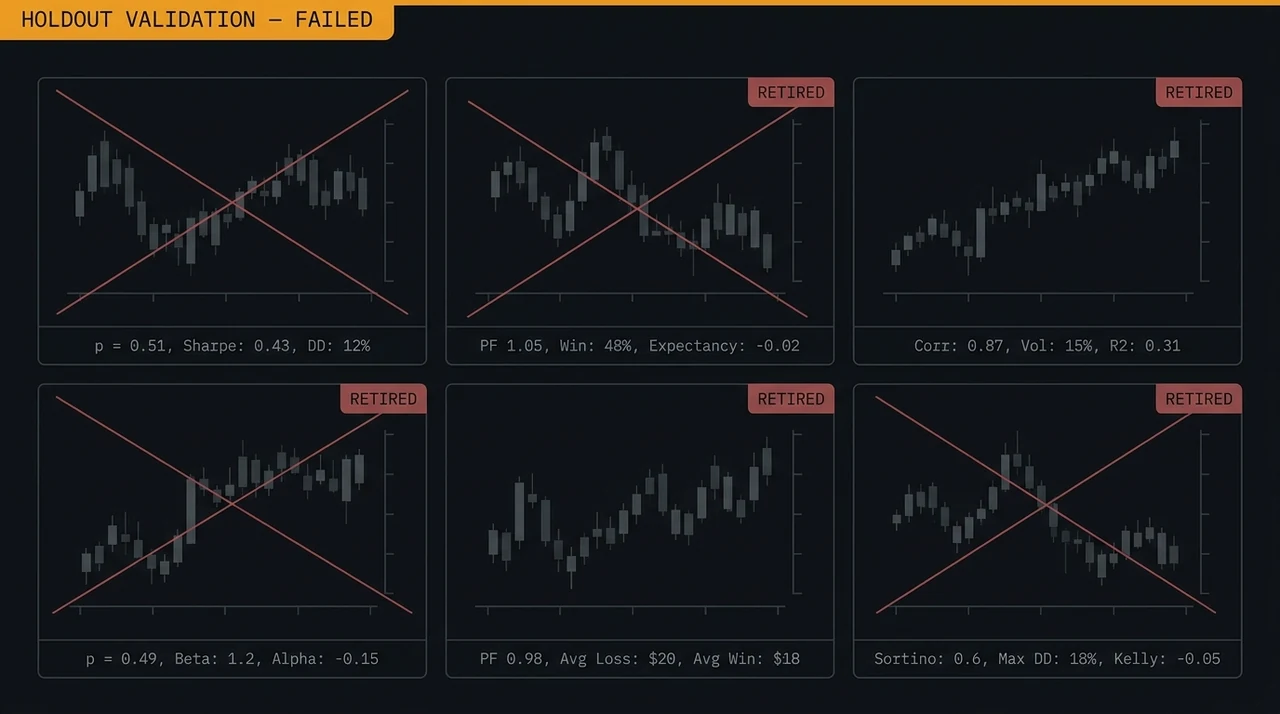
- RSI Reversion, Swing Condor: illustrative regime-fit examples only — both did not clear EasySwing's out-of-sample selection-edge bar and are retired from the active picks; see the strategies guide for status.
Moskowitz, Ooi & Pedersen (2012) in their paper "Time Series Momentum" found that trend-following strategies across 58 liquid instruments generated annualized returns of 1.58 Sharpe in trending regimes but were flat-to-negative in mean-reverting environments. The implication for swing traders: the same setup that works beautifully in a bull market will bleed you dry in a choppy one.
Which Strategies Work in Which Regime
Here is how EasySwing's thirteen strategies map to market conditions:
Trending Up (Strong Bull):
- VCP Breakout — primary strategy, highest conviction
- Trend Pullback — high-probability entries on dips to the EMA zone
- Cup & Handle — classic Stage 2 breakout pattern
Ranging (Choppy/Neutral):
- Swing Condor — designed for range-bound markets
- Trend Pullback — still viable but with reduced position size
- RSI Overbought — short-biased mean reversion for overextended bounces
High Volatility / Trending Down (Bear):
- Bear Flag — the short-side mirror of Trend Pullback
- RSI Overbought — short overbought bounces in downtrending stocks
- Swing Condor — only if clear support/resistance channels exist
The key insight: no single strategy works in all regimes. The traders who consistently lose money are the ones running a bull-market playbook in a bear market.
Position Sizing by Regime
Regime doesn't only affect which strategies to use — it should directly control how much capital you deploy. A practical framework:
- Trending Up: Full position sizes (1-2% risk per trade). This is where you press your edge.
- Ranging: Half position sizes (0.5-1% risk per trade). Setups work but with lower conviction and more false signals.
- Transitioning: Quarter positions or cash. Wait for the regime to resolve before committing capital.
- High Volatility / Trending Down: Minimal exposure (0.25-0.5% risk) or fully in cash. Protect capital first.
For a detailed breakdown of how to calculate exact share counts based on risk percentage, see Position Sizing with R-Multiples.
Common Mistakes: Fighting the Regime
The two most expensive regime mistakes swing traders make:
1. Buying breakouts in a bear market. VCP setups and Stage 2 breakouts require institutional buying pressure to work. In a Trending Down regime, institutions are distributing — not accumulating. Even a textbook VCP in a bear market has a coin-flip win rate at best.
- ❌ Forcing long breakout entries when breadth is below 40%
- ❌ Ignoring a VIX spike above 30 because "this stock is different"
- ❌ Averaging down in a Trending Down regime
- ✅ Switching to short-biased strategies (Bear Flag, RSI Overbought) when regime turns bearish
- ✅ Reducing position sizes immediately when regime shifts from Trending Up to Transitioning
- ✅ Waiting for breadth to confirm before re-engaging after a selloff
2. Ignoring regime transitions. The shift from Trending Up to Transitioning is the most dangerous moment for swing traders. Many traders see the first dip as a "buying opportunity" when it's actually the start of a regime change. Watch for ADX rolling over (slope turning negative) and breadth dropping below 60% — these are early warning signs.
EasySwing displays the current regime prominently in the dashboard and in every strategy scan. The regime badge is color-coded: green for Trending Up, amber for Ranging/Transitioning, red for Trending Down and High Volatility.
Key Takeaways
- Market regime is the single most important context for every trading decision — it determines which strategies have an edge and which ones don't
- EasySwing detects five regime states using S&P 500 trend, ADX, market breadth, and VIX — updated twice daily
- Momentum and breakout strategies (VCP, Trend Pullback, Cup & Handle) thrive in Trending Up but fail in Ranging and Trending Down
- Mean-reversion and range-bound strategies (RSI Reversion, Swing Condor) outperform in choppy markets
- Position sizing should scale with regime: full size in bull, half in neutral, minimal in bear
- Never fight the regime — the market environment matters more than the individual setup
Frequently Asked Questions
How often does the market regime change?
On average, the market spends about 40-50% of the time in Trending Up, 20-25% in Ranging, 15-20% in Transitioning, and 10-15% in Trending Down or High Volatility. Regime shifts typically happen over days to weeks — not overnight. EasySwing updates regime classification twice daily, so you'll see the shift developing before it fully resolves.
Can I still trade during a bear market?
Yes, but you need different strategies. In Trending Down and High Volatility regimes, short-biased strategies like Bear Flag and RSI Overbought become the primary playbook. Long-side trading should be minimal or eliminated. Many professional swing traders simply go to cash during bear regimes — preserving capital is a valid strategy.
What if the regime is Transitioning — should I wait?
Transitioning means the signals are mixed and no clear edge exists for any strategy family. The prudent approach is to reduce position sizes to 25% of normal, tighten stops on existing positions, and avoid new entries until the regime resolves. Patience during transitions is what separates profitable traders from the rest.
How does regime interact with individual stock analysis?
Regime is the macro filter; stock analysis is the micro filter. Even in a Trending Up regime, not every stock is a buy — you still need Stage 2 confirmation, high RS rank, and a valid setup pattern. But in a Trending Down regime, even the strongest individual setup has reduced odds of success because the macro tide is working against you.
EasySwing displays the current market regime in real-time across the dashboard and strategy scanner. Regime classification is for informational purposes only and does not constitute investment advice. See our Risk Disclaimer.
Disclaimer: This article is for educational purposes only and does not constitute investment advice. EasySwing is a stock screening tool, not a registered investment advisor. All trading involves risk. Read our full disclaimer →