Best Stock Screeners for Swing Trading: 7 Tools Compared (2026)
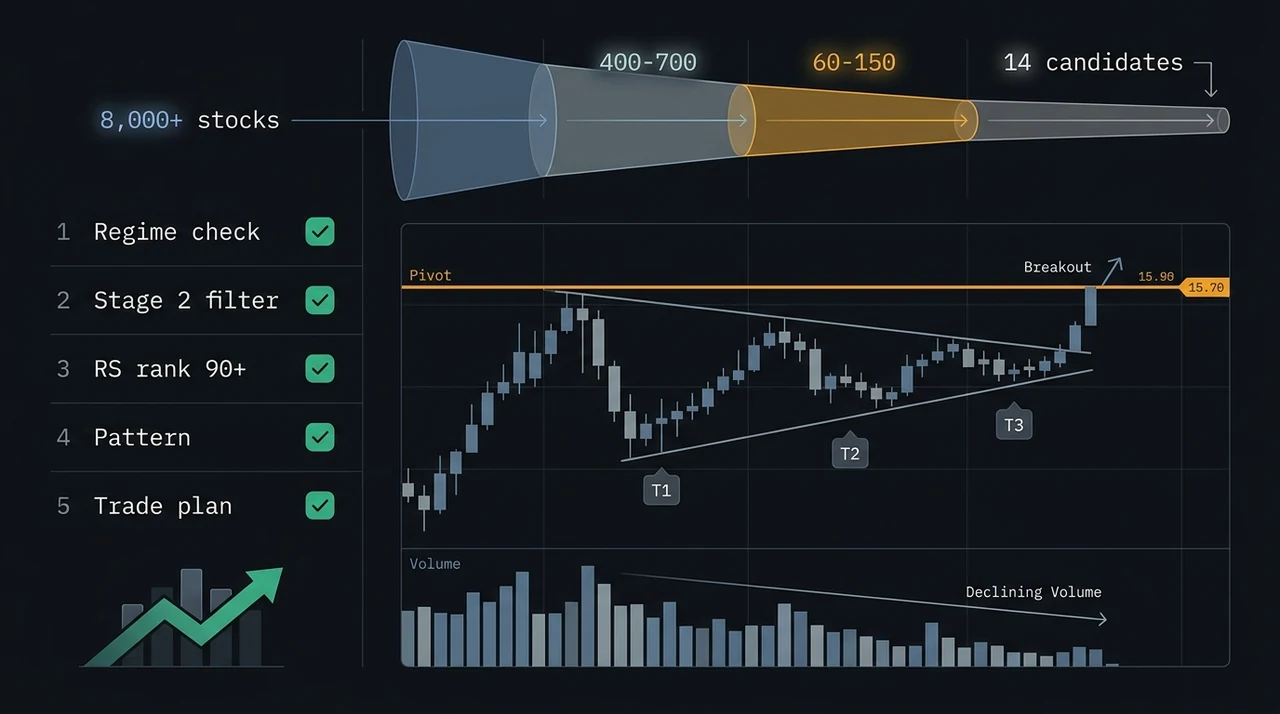
Barber and Odean's landmark 2000 study, Trading Is Hazardous to Your Wealth (Journal of Finance), found that the most active retail traders underperformed passive investors by 6.5 percentage points per year — largely because they acted on noise instead of defined signal. The best stock screener for swing trading eliminates that noise before you review a single chart. It filters a universe of 5,000+ equities to a shortlist of 10–20 high-conviction candidates each evening, each meeting your exact setup criteria.
This comparison covers the seven most capable screeners for swing traders in 2026, evaluated on how each tool detects setups, whether it accounts for market regime, and what pre-built risk structure it provides. For the full filter breakdown, see 5 Swing Trading Screener Filters That Separate Signal from Noise. A screener is one piece of a larger stack — for how it fits alongside charting, alerts, backtesting, and journaling, see Best Swing Trading Tools: The Complete Toolkit.
What Makes a Great Swing Trading Screener
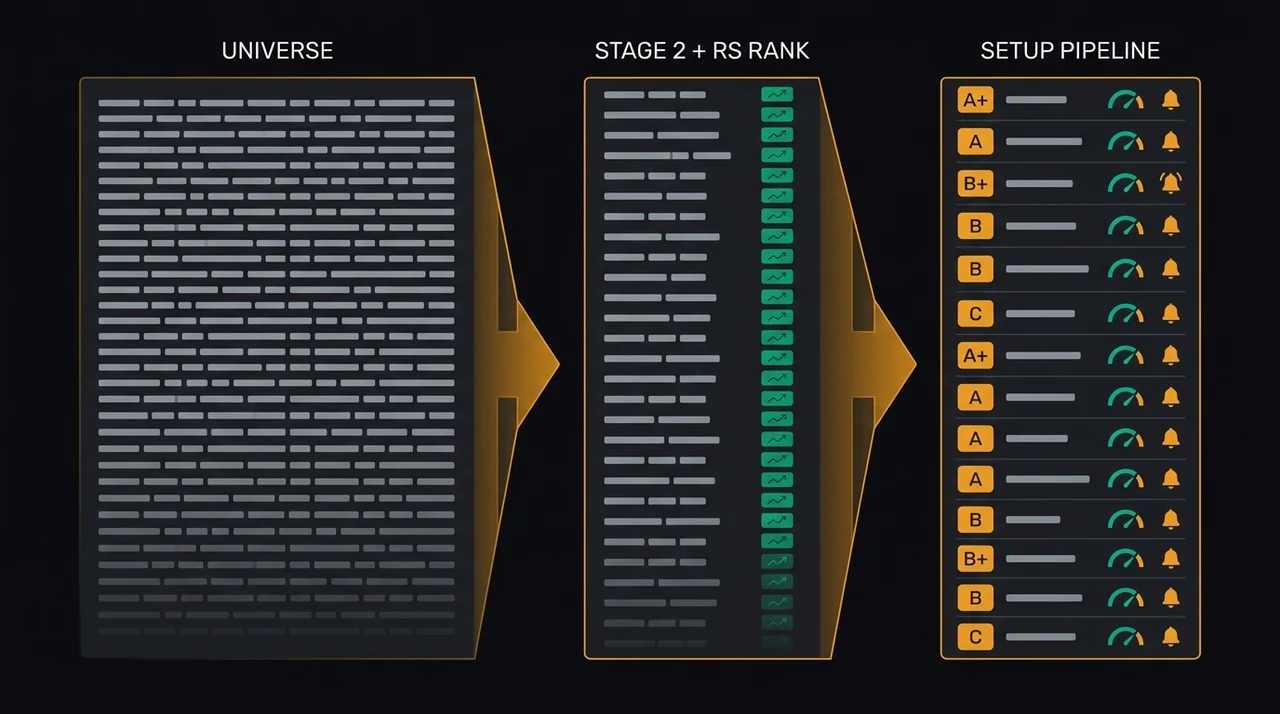
The best swing trading screener applies a defined hierarchy of technical filters — trend structure, relative strength, volume confirmation, and named pattern recognition — and hands you a pre-scored shortlist, not a spreadsheet of raw results. It applies market context: the filters for a bull-regime breakout strategy differ from those for a bear-regime short setup, and a quality screener applies that distinction automatically.
The core difference between screeners is where synthesis happens. Filter-based screeners return every stock that clears a threshold condition — RSI below 40, price above 200-day MA, volume above 500K — and leave pattern recognition to the trader. Strategy-based screeners evaluate stocks against a named setup definition, score each result by quality, and surface only the setups worth trading. Mark Minervini, in Trade Like a Stock Market Wizard (2013), describes the logic behind this approach: systematic filtering using relative strength rank as the primary gate narrows thousands of candidates to a short, workable list before any chart review begins.
The five capabilities that separate the best swing screeners from the rest:
- Named setup detection — pattern logic built into the engine, not replicated manually in filter stacks
- Relative strength ranking — identifies market leaders by 12-month price return vs. the full universe
- Volume confirmation — distinguishes institutional accumulation from low-conviction drifts
- Market regime awareness — applies different strategy logic in bull, bear, and choppy markets
- Pre-built risk framework — surfaces entry price, stop-loss, and targets alongside each setup
The 7 Best Stock Screeners for Swing Traders
1. EasySwing.trading — Purpose-Built for Swing Trading
EasySwing.trading scans 2,000+ US equities for 13 named swing trading strategies — see /strategies for the full list, which includes VCP Breakout, Cup and Handle, Trend Pullback, Swing Condor, Qullamaggie Breakout, and others. Each result carries a letter grade (A+/A/B+/B/C) and a composite score (0–100) weighted across relative strength rank, momentum, volume confirmation, pattern quality, and regime fit. Every result includes a pre-calculated entry price, stop-loss, and two profit targets — T1 at 1.5R and T2 at 3R.
A five-state market regime engine — Trending Up, Trending Down, Ranging, High Volatility, and Transitioning — gates each strategy against the current macro environment. Long-side breakouts only surface in Trending Up. Short-side strategies are promoted in Trending Down and High Volatility. This regime gating removes a systematic source of false positives during choppy or declining markets.
An integrated alert system fires when a stock transitions from setup-forming to setup-triggered. An AI assistant (Soren) can explain any setup, run conversational scans, and surface sector context on demand. Scans run twice daily: approximately 2pm ET (midday check) and after market close (end-of-day list).
- Best for: Systematic swing traders who want a complete workflow — screening, grading, alerts, and AI coaching — in a single purpose-built tool
- Price: $29/month — see /strategies for current plan details
2. Finviz — Fast and Free for Filter-Based Screening
Finviz is the most widely used free screener in retail. Its free tier provides 80+ filter parameters against the full US equity universe with delayed data. Finviz Elite (~$25/month) adds real-time quotes, alert triggers, portfolio correlation analysis, and additional saved screens.
Finviz does not detect named setups. You define the filter conditions and the screener returns every stock clearing each threshold. Pattern recognition and quality judgment happen after the screen, not inside it. Advanced users build complex Finviz filter stacks that approximate swing trading conditions, but synthesis remains manual. Finviz's strength is breadth, speed, and a free entry point — its limitation is that it lacks any concept of setup quality, regime context, or pre-calculated risk structure.
William O'Neil's research, documented in How to Make Money in Stocks (2009), identified that fewer than 2% of listed stocks produce the outsized moves swing traders target in any given market cycle. Finviz can surface that 2% — but requires the trader to identify and score them after the screen runs.
- Best for: Beginners building a manual screening methodology, traders who need a free first pass across a broad universe
- Price: Free / ~$25/month (Elite)
- For the detailed head-to-head: EasySwing vs Finviz
3. TradingView — Custom Screeners for Chart-First Traders
TradingView serves over 50 million registered users (TradingView, 2024) as a multi-asset charting and social analysis platform. Its screener provides 150+ filter conditions, and Pine Script — TradingView's scripting language — allows custom detection logic for traders who want to encode their own strategy rules.
The screener is a charting companion. Results link directly to TradingView charts, which are best-in-class for visual analysis. Experienced TradingView users build sophisticated Pine-based screeners that replicate many swing trading conditions — but this requires scripting knowledge and significant setup time. No built-in setup grading, regime awareness, or pre-calculated risk framework is provided.
- Best for: Chart-first traders who build custom Pine Script strategies; traders who want screener results integrated directly with charting
- Price: Free / approximately $14.95–$59.95/month (Pro to Premium)
- For the detailed head-to-head: EasySwing vs TradingView
4. ChartMill — Deep Pattern Recognition With Fundamentals
ChartMill, developed in Belgium, covers US, Canadian, and European exchanges with 180+ filters spanning technical and fundamental criteria. Its pattern recognition engine detects 59 chart formations — technical and candlestick — and rates each on a 0–10 quality scale based on how closely price action matches the formation definition.
ChartMill's strength is in the depth of its pattern library and its combination of fundamental quality screens alongside technical recognition. Swing traders who apply multi-factor analysis — requiring earnings quality or valuation criteria alongside chart patterns — find ChartMill's dual-axis approach valuable. European exchange coverage is a differentiator for traders scanning non-US markets.
- Best for: Multi-factor traders who want fundamental + technical pattern detection; traders covering US and European markets
- Price: Plans starting at $34.97/month
- For the detailed head-to-head: EasySwing vs ChartMill
5. TC2000 — Real-Time Scanning for Active Traders
TC2000, developed by Worden Brothers, is a real-time US equity scanner built for active traders. Its PCF (Personal Criteria Formulas) system and condition wizard allow complex custom scan logic, and alerts fire in real time as conditions are met during the trading day. TC2000 has a strong community of active traders who share and refine custom PCF scan formulas.
TC2000 does not provide named setup detection or a pre-built risk framework. Like Finviz, it returns stocks meeting your custom conditions and leaves synthesis to the trader. Its advantage is real-time scan speed, making it well-suited for intraday alert triggers alongside overnight swing setups.
- Best for: Active traders who need real-time intraday alert speed; comfortable writing custom PCF formulas
- Price: Plans starting around $9.99/month
- For the detailed head-to-head: EasySwing vs TC2000
6. Trade Ideas — AI-Powered for Higher-Budget Traders
Trade Ideas is an AI-powered scanning platform built for active traders. Its Holly AI system generates algorithmic trade ideas, and a streaming alert panel surfaces candidates in real time. The platform includes a backtesting module for validating scan conditions against historical data.
Trade Ideas is priced at the higher end of the market and primarily serves intraday and day-trading workflows, though swing setups can be configured. Holly generates algorithmic suggestions without natural-language explanations — a different model from a conversational AI assistant. The platform's strength is real-time breadth; the trade-off is cost and complexity.
- Best for: Higher-budget active traders who want real-time AI-generated alert flow alongside intraday scan capability
- Price: Plans starting approximately $84/month billed annually
- For the detailed head-to-head: EasySwing vs Trade Ideas
7. IBD MarketSmith — The CAN SLIM Specialist
Investor's Business Daily's MarketSmith is built around William O'Neil's CAN SLIM methodology — a seven-factor selection system weighting earnings growth, new products or management catalysts, supply and demand, leader vs. laggard status, institutional sponsorship, and market direction. It provides EPS rank, RS rating, and screen templates built from IBD's research.
For CAN SLIM practitioners, MarketSmith is the most complete native implementation available. O'Neil's research found that 75% of the biggest winning stocks had above-average earnings growth in the quarters before their major price advances. For traders using purely technical swing trading approaches, the earnings-forward emphasis may not align with their screening criteria.
- Best for: O'Neil/CAN SLIM traders who want a full-stack native implementation of the IBD methodology
- Price: Approximately $49.95/month
- For the detailed head-to-head: EasySwing vs IBD MarketSmith
Side-by-Side Comparison
| Tool | Strategy Detection | Market Regime | Quality Grading | Risk Framework | Price |
|---|---|---|---|---|---|
| EasySwing.trading | 13 named strategies | ✅ 5 states | A+/A/B+/B/C + 0–100 score | ✅ Entry/stop/T1/T2 | $39/mo |
| Finviz | None (filter-only) | ❌ | None | ❌ | Free / ~$25/mo |
| TradingView | Custom Pine Script | ❌ built-in | None | ❌ | Free / ~$15–60/mo |
| ChartMill | 59 pattern types | ❌ | 0–10 scale | ❌ | ~$35/mo |
| TC2000 | Custom PCF formulas | ❌ | None | ❌ | ~$10–50/mo |
| Trade Ideas | Holly AI (algorithmic) | Partial | AI score | Partial | ~$84+/mo |
| IBD MarketSmith | CAN SLIM system | Partial | EPS rank / RS | ❌ | ~$50/mo |
The regime column is the most consequential difference: EasySwing.trading is the only tool in this comparison with a built-in five-state regime engine that automatically adjusts which strategies surface based on the broad market environment.
How to Match a Screener to Your Trading Style
The right screener depends on how you actually trade — not on features you will never use.
Choose a strategy-based screener if you follow a defined approach — Minervini's SEPA, Weinstein's stage analysis, RSI mean reversion — and want the tool to apply that logic rather than requiring you to build and maintain a complex filter stack manually. A strategy-based screener is also the better fit for traders with limited time for daily market review.
Start with a free filter-based screener if you are still developing your methodology and want to practice manual chart review. Finviz's free tier handles the universe filtering and leaves the pattern recognition judgment with you while you build competence.
Prioritize real-time scanning if you mix intraday entries with swing setups, or need alert triggers to fire as conditions are met during the trading day. TC2000 and Trade Ideas are built for this use case; EasySwing's twice-daily scans are calibrated for end-of-day swing trading workflows.
Choose a multi-factor tool if your strategy requires fundamental quality criteria alongside technical patterns. ChartMill's 180+ filters and 59 pattern recognitions give the broadest dual-axis coverage; IBD MarketSmith is the stronger choice for O'Neil/CAN SLIM practitioners.
For the principles behind what any quality swing screener should filter for, the How to Use a Stock Screener for Swing Trading guide covers the full workflow.
Pre-Selection Checklist: Questions to Answer Before You Subscribe
Use these before committing to any screener subscription:
- ✅Does it detect the specific setup patterns your strategy requires, or only raw technical filters?
- ✅Does it account for market regime — adjusting results when the market shifts from trending to choppy?
- ✅Does it provide a pre-calculated entry price, stop-loss, and target, or do you build that framework manually?
- ✅Does it alert you when a setup triggers, or do you have to re-run the screen yourself each day?
- ✅Does it cover the right universe — the market cap range and exchange coverage that fits your strategy?
- ❌Do not subscribe to the most feature-rich tool if you will use fewer than 20% of its capabilities.
- ❌Do not choose based on price alone — a $10/month screener that requires 3 hours of manual chart review per day is more expensive than a $30/month tool that cuts that to 20 minutes.
- ❌Do not skip the free trial — most platforms offer 7–14 days of access before charging.
More EasySwing Comparisons
Beyond the 7 screeners ranked above, swing traders often ask how EasySwing stacks up against brokerage-native screeners and general charting platforms — tools that were not built specifically for swing trading but that many traders already have access to:
Brokerage screeners (already included in a brokerage account, general-purpose): EasySwing vs Schwab Stock Screener, EasySwing vs Fidelity, EasySwing vs Interactive Brokers, EasySwing vs Webull.
Charting and research platforms (strong for visual analysis, not built around named setups): EasySwing vs TrendSpider, EasySwing vs StockCharts, EasySwing vs Barchart, EasySwing vs Yahoo Finance Screener.
Alert and data platforms: EasySwing vs MarketBeat compares alert delivery and setup-specificity.
The primary competitor: EasySwing vs DeepVue covers the closest head-to-head — both tools serve methodology-driven swing traders, but DeepVue's strength is preset breadth while EasySwing's is a single opinionated, regime-gated workflow.
Frequently Asked Questions
What is the best free stock screener for swing trading?
Finviz's free tier is the strongest free option: it provides 80+ filter parameters against the full US equity universe with delayed data. The trade-off is the absence of named setup detection — pattern recognition is manual after the screen runs. Traders who want setup detection, quality grading, and pre-calculated risk levels will need a paid tool; the time savings typically justify the cost within a few weeks of active trading.
How is a swing trading screener different from a general stock screener?
A general screener filters by broad criteria — P/E ratio, market cap, moving average crossover. A swing trading screener applies criteria tuned to 5–30-day hold periods: Stage 2 trend structure, relative strength rank above 80, relative volume confirmation, and named setup patterns. The output is a shortlist of setups with defined entry logic — not a list of stocks that happen to clear arbitrary thresholds.
Do I need real-time data for swing trading?
Most swing traders do not need real-time intraday data for the initial screening step. End-of-day scans run after market close identify the next day's candidates with sufficient precision. Real-time data matters for execution timing — entries on intraday pullbacks, or immediate alert delivery when conditions trigger. It is a useful enhancement, not a prerequisite for an effective swing workflow.
Can I use multiple screeners simultaneously?
Yes, and many experienced traders do. A common combination is a free screener (Finviz, TradingView) for broad universe awareness and a strategy-specific tool for named setup detection. The risk is decision fatigue from too many overlapping signals — prioritize the tool whose output maps directly to your trading rules.
How many results should a well-calibrated swing screen return each day?
A well-calibrated screen returns 5–20 candidates per day in a typical bull market. More than 30 results usually means filters are too loose. Fewer than 3 in a bull market indicates over-filtering. In a bear or choppy regime, returning 0–5 candidates is itself useful information: few valid setups exist right now, which is a reason to stand aside or reduce position sizes.
EasySwing.trading automatically screens 2,000+ US equities for 13 named swing trading strategies twice each market day. If you specifically need a free-tier option, see Best Free Stock Screener for Swing Trading: 5 Tools Compared. For individual head-to-heads, see EasySwing vs Finviz, EasySwing vs TradingView, EasySwing vs ChartMill, EasySwing vs TC2000, EasySwing vs Trade Ideas, and EasySwing vs IBD MarketSmith. Scan results are for informational purposes only. See our Risk Disclaimer.
Disclaimer: This article is for educational purposes only and does not constitute investment advice. EasySwing is a stock screening tool, not a registered investment advisor. All trading involves risk. Read our full disclaimer →