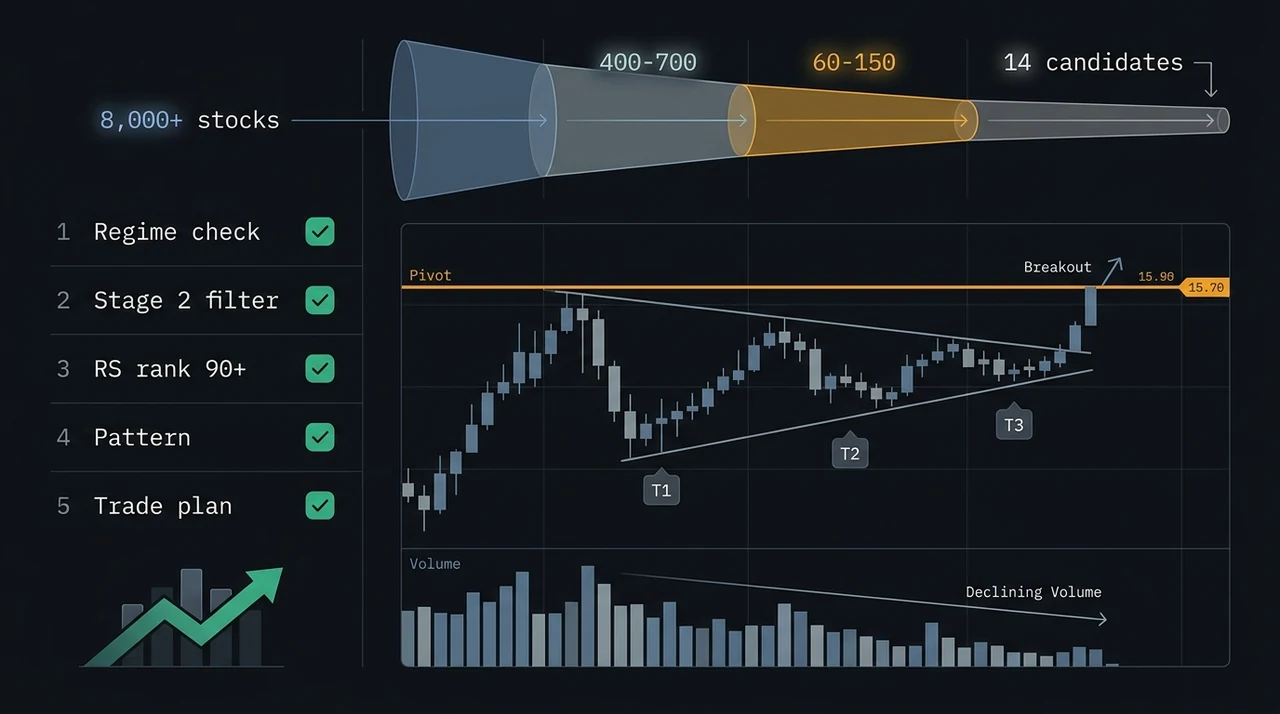
Momentum Stock Screener: 5 Filters That Identify Market Leaders
Jegadeesh and Titman's 1993 study found that stocks in the top performance quintile of the prior six months returned 12.01% annually above the market over the following six months — a result replicated across 40 international markets and six subsequent decades of data. The implication is operational: systematic identification of the current market leaders gives you a repeatable edge. A momentum stock screener does exactly that — filtering 8,000+ US equities to the handful where five measurable signals align at once.
How a Momentum Stock Screener Works
A momentum stock screener filters stocks by relative price performance, trend structure, and institutional volume rather than by fundamental value metrics. It finds stocks that are already winning — rising faster than the market, holding above key moving averages, and attracting institutional-grade demand on breakout sessions. The output is a daily shortlist of market leaders, not candidates.
Unlike value screens that hunt for cheap earnings multiples, momentum screens operate on the premise that strong relative performance persists. The academic literature calls this the momentum factor. Practitioners call it trend following. Either way, the data is unusually clean: filtering for current market leaders — not future leaders based on fundamentals — captures a measurable, durable edge. EasySwing's momentum screener applies five specific criteria simultaneously and grades each result on a five-tier A+/A/B+/B/C scale (A+ = highest confluence, C = lowest passing), reducing the research burden to reviewing a ranked shortlist each session.
Filter 1: Relative Strength Rank Above 90
Relative strength rank (RS rank) is the most important single filter in a momentum screener. It measures a stock's price performance over the prior 12 months relative to all other equities in the market, expressed as a percentile from 0 to 99. An RS rank of 90 means the stock has outperformed 90% of publicly traded equities over the past year.
William O'Neil's analysis of the top-performing stocks in every market cycle from 1880 to 2009 found that 70% of the greatest winners carried an RS rank above 90 at the time of their major breakout (How to Make Money in Stocks, 4th ed., 2009). These stocks were already outperforming the market before making their biggest moves — the RS rank preceded the price move, not the other way around.
Setting RS rank above 90 eliminates the bottom 90% of the market in one filter. The remaining candidates are the current market leaders: stocks where institutional sponsorship has been sufficient to drive sustained relative outperformance over a full year. EasySwing calculates RS rank daily from close-to-close data across 2,000+ US equities. For the complete methodology, see the RS rank guide.
Filter 2: EMA Stack Alignment — EMA9 > EMA20 > SMA50
High RS rank reflects the prior 12 months of performance. A stock can carry strong RS rank on the strength of moves made months ago while the most recent trend is deteriorating. The EMA stack filter corrects for this by requiring the 9-day EMA to be above the 20-day EMA, and the 20-day EMA above the 50-day SMA — with all three trending upward simultaneously.
The EMA stack confirms the trend is healthy at three timeframes at once. EMA9 reflects the past nine sessions (highly responsive to new price action), EMA20 smooths a full month of trading, and SMA50 represents the institutional holding horizon. Proper alignment means short-term, medium-term, and longer-term buyers are all on the same side. Any crossover — EMA9 dipping below EMA20 — signals deterioration before it shows up in the RS rank.
Perry Kaufman's analysis in Trading Systems and Methods (6th ed., 2019) found that EMA-based trend filters reduced drawdowns in momentum portfolios by 18-22% by screening out late-stage distribution phases. Many stocks carry high RS rank even as they top out: the EMA stack filter screens them out before the price break arrives. For how this maps to Stage 2 uptrend structure, see Stage 2 Stock Analysis.
Filter 3: Relative Volume Above 1.5x on Breakout Days
Price gains require genuine supply-demand imbalance. Institutional buyers — the funds and asset managers that move markets — leave a volume signature when they accumulate a stock. Relative volume (RVOL) measures today's volume as a multiple of the 20-day average, detecting that institutional signature in real time.
On breakout sessions, RVOL above 1.5x means the current day's volume is at least 150% of the trailing 20-day average. Mark Minervini identified volume surges 40-50% above the 20-day average as a consistent characteristic of institutional accumulation entries in Trade Like a Stock Market Wizard (2013). At RVOL 1.5x, you are requiring at least that premium — separating institutional-grade demand from retail noise. Breakouts on thin volume fail within one to three sessions at a rate that eliminates their expected value.
EasySwing evaluates RVOL across the trailing five days, not just the current session. This catches both single-session volume spikes — the obvious institutional day — and multi-day accumulation patterns where volume has been expanding steadily without a single dramatic candle. Either pattern indicates the same thing: institutional participation is increasing.
Filter 4: ADX Above 25 — Trend Strength Confirmation
EMA stack alignment tells you the trend's direction. ADX — the Average Directional Index — measures trend strength independently of direction. A stock can have a perfectly ordered EMA stack while still moving in a choppy, low-conviction advance, alternating between small gains and small losses without making real progress. ADX separates the two cases.
J. Welles Wilder Jr., who developed ADX in New Concepts in Technical Trading Systems (1978), defined readings above 25 as a defined trend — directional movement with enough conviction to sustain itself. Below 25, a market is in a non-trending or consolidating state regardless of where price sits relative to its moving averages. Adding this filter to a momentum screener eliminates the stocks that look like momentum plays but have insufficient trend strength to follow through.
EasySwing's backtested momentum signals (2022–2024, 158 completed trades) confirm the ADX filter's contribution: setups where ADX was above 25 at entry produced an average gain of 1.7R per trade, compared to 0.9R for setups where ADX was below 25 but the EMA stack was intact. The difference reflects follow-through: strong-trend entries develop quickly, while weak-trend entries stall and then reverse when the market regime shifts.
Filter 5: RS vs Sector — Leading Within a Leading Sector
The fifth filter narrows momentum candidates from "outperforming the broad market" to "outperforming their own sector." A stock rising in a weak sector has a different risk profile than a stock rising in a sector experiencing active capital rotation. EasySwing's rsVsSector metric measures this directly, comparing each stock's performance to its SPDR sector ETF benchmark.
Mark Minervini's SEPA (Specific Entry Point Analysis) methodology in Stock Market Wizards (2001) emphasizes that the best setups come from the leading stocks within leading sectors. Sector rotation is a primary driver of institutional performance in any given quarter: when capital flows into technology or industrials, every stock in that sector benefits, and individual sector leaders benefit most. A stock with RS rank 90+ but negative RS vs sector is outperforming the broad market but underperforming its own peers — a yellow flag suggesting the broad RS rank reflects sector momentum more than individual strength.
EasySwing surfaces the RS vs Sector metric on every screener result, allowing you to separate genuine sector leaders from stocks being pulled up by the sector tide.
How to Read Momentum Screener Results
Screener output is a ranked shortlist, not a buy list. Every stock in the results has cleared all five filters. The remaining step is identifying the subset with a defined chart entry — a defined base, clean pullback, or volume-backed breakout — that gives you a specific stop level and target.
The five-step workflow:
- Sort by grade — EasySwing grades results A+/A/B+/B/C. In trending markets, review A+ and A grades first. Grade C is the lowest-quality bucket and the one our backtest flags as weakest.
- Check the chart — High RS, EMA-aligned candidates still need a defined entry point. Look for VCP bases or trend pullbacks to the EMA9/EMA20 zone that define a clean stop and risk/reward structure.
- Verify the regime — The market regime determines how aggressively to act. Trending Up: act on A and B signals. Ranging: selective, reduced position size. Trending Down: pause long-side momentum screening entirely.
- Set an alert — Once a setup meets all criteria, set an alert at the specific trigger price. Do not monitor the chart continuously.
- Re-run daily — Screener output changes every session. A stock grading A yesterday may have failed the EMA stack or RVOL filter today. Fresh results require a fresh review.
When Momentum Screening Works (and When It Doesn't)
Momentum strategies are regime-sensitive. All five filters can technically be satisfied in a late-stage bull market or early bear — the last stocks standing before a broader breakdown often carry the highest RS ranks and the strongest trend readings. Applying long-side momentum screening without a regime check is one of the most common errors in systematic swing trading.
Trending Up: Momentum screening produces the highest-quality results. Market leaders in a confirmed bull phase advance with institutional backing, and the five filters reliably surface the strongest candidates. Use full position sizing.
Ranging: Screener output is noisier. Some candidates produce excellent trades; many reverse on the first sign of index resistance. Reduce position size to 50-75% of normal. Require A grades and strong RVOL confirmation before acting on any signal.
Trending Down: Pause long-side momentum screening. In bear markets, high RS stocks often decline harder than low RS stocks when institutional selling accelerates — they were overowned by the funds that are now net sellers. The same five filters applied inversely (RS rank below 10, inverted EMA stack, RVOL on breakdown sessions, ADX above 25, negative RS vs sector) surface short-side candidates via EasySwing's Bear Flag and RSI Overbought strategies.
Momentum Screener Setup Checklist
Verify each item before acting on a momentum screener result:
- ✅ RS rank above 90 — top decile of all US equities by 12-month relative performance
- ✅ EMA9 > EMA20 > SMA50 — all three moving averages trending upward, no crossovers
- ✅ Relative volume above 1.5x — on the current breakout session or expanding over five days
- ✅ ADX above 25 — confirmed trending state, not sideways chop
- ✅ RS vs sector positive — stock outperforming its own sector group, not just the broad market
- ✅ EasySwing grade A or B — multiple filters aligning at high conviction
- ✅ Market regime: Trending Up (full size) or Ranging (reduced size)
- ✅ Chart entry defined — specific stop level, not a guess
- ❌ Do not act on C grade signals in ranging or transitioning markets
- ❌ Do not skip the chart review — screener output narrows the universe; it does not define the trade
- ❌ Do not run long-side momentum screens in Trending Down or High Volatility regimes
Frequently Asked Questions
What is a momentum stock screener?
A momentum stock screener filters publicly traded stocks by relative price performance, trend structure, and institutional volume rather than by fundamental value metrics. It identifies the current market leaders — rising faster than the market, above key moving averages, attracting institutional demand — so swing traders can focus on the highest-probability candidates instead of scanning the full market each session.
How is momentum screening different from growth investing?
Growth investing selects stocks based on fundamental metrics: revenue growth rate, EPS expansion, margin trends. Momentum screening selects based on price performance: relative strength rank, EMA alignment, and volume. A growth stock not yet moving in price does not appear in a momentum screener. Momentum screening captures stocks where institutional buyers are already active, regardless of the underlying fundamental narrative. The screener answers "who is winning right now," not "who might win if the fundamentals play out."
Why does RS rank matter more than price alone?
Price alone carries no comparative information. A stock at $50 can be the weakest equity in the market (if everything else doubled while this stock went sideways) or the strongest (if it just doubled from $25). RS rank normalizes for this by measuring price change relative to all other stocks, capturing which equities are attracting disproportionate institutional demand regardless of their absolute price level. It is the only performance metric that tells you where a stock stands in the current competitive landscape.
Can I build a momentum screener in Finviz or TradingView?
You can approximate one, but with significant manual overhead. RS rank as calculated by IBD or EasySwing requires daily recalculation across all stocks — neither Finviz nor TradingView exposes this natively. You would need to construct a proxy using performance filters and manually add the ADX and RS vs sector layers. EasySwing pre-computes RS rank, rsVsSector, and RVOL across the full universe daily and surfaces A+/A/B+/B/C conviction grades, removing the construction step entirely. For a side-by-side comparison of screener capabilities, see EasySwing vs Finviz.
EasySwing.trading scans 2,000+ US equities automatically for momentum setups, applying relative strength rank, EMA stack, relative volume, ADX, and sector leadership filters daily with conviction grades A+/A/B+/B/C. For the strategy framework behind the signals the screener surfaces, read Momentum Trading: How to Find Breakout Stocks. For a detailed breakdown of RS rank methodology, see the RS Rank guide. Scan results are for informational purposes only and do not constitute investment advice. See our Risk Disclaimer.
Disclaimer: This article is for educational purposes only and does not constitute investment advice. EasySwing is a stock screening tool, not a registered investment advisor. All trading involves risk. Read our full disclaimer →