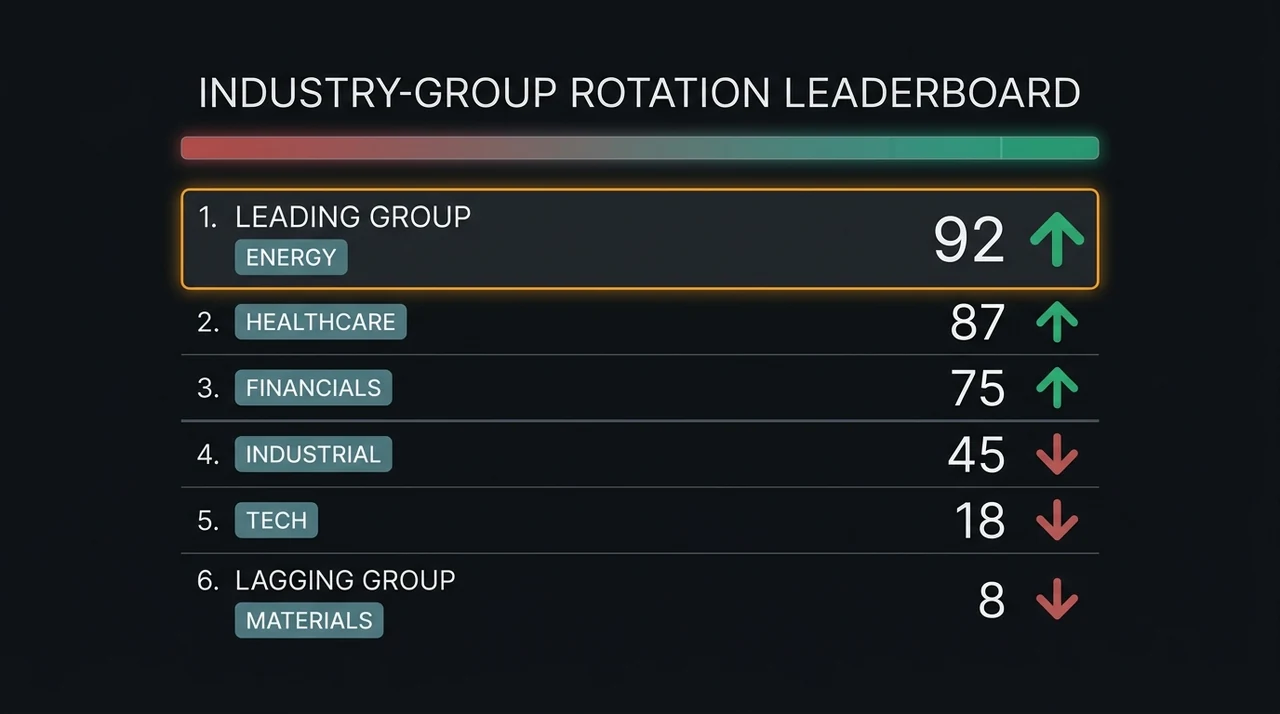
Relative Strength Rank: Why RS 90+ Matters for Swing Traders
Relative Strength (RS) Rank: The Basics
Relative Strength (RS) rank scores a stock's price performance against every other stock in the trading universe, expressed as a percentile from 0 to 99. William O'Neil's research on 600+ of the biggest stock market winners from 1953–2008 found their median RS rank was 87 before their major price advances began (How to Make Money in Stocks, 4th ed., 2009). A rank of 90 means the stock outperformed 90% of the comparison universe.
An RS rank of 99 places a stock in the top 1% of performers. IBD, which popularized the metric as the RS Rating, calculates it over a 12-month lookback with the most recent quarter weighted more heavily. Mark Minervini and other practitioners have validated the concept empirically: stocks with RS rank above 80–90 at the time of a major breakout have historically produced better returns than lower-ranked stocks.
That said, not every RS rank is calculated the same way. IBD's 12-month weighted formula and EasySwing's own calculation (covered in detail further down) measure different windows — the underlying idea is identical, but the numbers won't always match exactly across tools.
Why High RS Rank Matters
High RS rank works because stocks that are already outperforming tend to keep outperforming, at least over the swing-trading holding period of days to weeks. This is the momentum premium, one of the most well-documented anomalies in academic finance.
For swing traders specifically, high-RS stocks share three traits:
- They're already being accumulated by institutions — you're following, not leading, the smart money
- They tend to hold up better in weak markets, which is the literal definition of relative strength
- They're more likely to be leaders in the next bull cycle, not laggards playing catch-up
Jegadeesh and Titman's seminal 1993 paper "Returns to Buying Winners and Selling Losers" demonstrated that momentum-based strategies (buying high-RS stocks) generated excess returns of 12.01% per year over their study period — one of the most well-replicated findings in financial economics. Chan, Jegadeesh, and Lakonishok extended this in their 1996 follow-up ("Momentum Strategies," The Journal of Finance), finding that momentum profits persisted for 12 months and were only partly explained by earnings surprises — meaning price momentum itself carries information, not just the news driving it.
RS Rank vs RS Line vs RSI
These three terms get confused constantly because they all have "relative" or "strength" in the name, but they measure different things and none of them substitute for the others.
| Metric | What it measures | Scale | Comparison basis |
|---|---|---|---|
| RS Rank | Price performance vs. the whole universe | 0–99 percentile | Cross-sectional (stock vs. all stocks) |
| RS Line | Stock price ÷ benchmark index, over time | Trend line, no fixed scale | Stock vs. one benchmark (e.g., S&P 500) |
| RSI | Recent gains vs. recent losses, same stock | 0–100 oscillator | Internal only (stock vs. itself) |
RS Rank is a snapshot percentile score comparing one stock to every other stock in the universe. RS Line is a ratio line — the stock's price divided by a benchmark like the S&P 500 — plotted over time to show whether the stock is strengthening or weakening relative to the market. A rising RS line is bullish even if the stock's own price chart looks flat; a falling RS line is bearish even while the price is still rising. RSI (Relative Strength Index, despite the similar name) is an internal momentum oscillator comparing a stock's own gains to its own losses — it says nothing about how the stock is doing versus anything else.
EasySwing tracks both RS rank and RS line. The RS rank is shown as a badge (e.g., "RS 91") in scan results, and a rising RS line trend feeds into the momentum score.
The RS 90 Threshold in Practice
Research and practitioner experience converge on RS 90 as the line between "good" and "market leader." The threshold isn't arbitrary — it reflects where O'Neil's biggest winners historically clustered before their major advances.
| RS Rank Range | Interpretation | Badge Color |
|---|---|---|
| Below 70 | Underperforming the broad market | Not flagged |
| 70–79 | Broader-scan candidate, not yet a leader | Not flagged |
| 80–89 | Strong, but one tier below leadership | Amber |
| 90–95 | Top-tier market leader | Green |
| 96–99 | Current-cycle leader — biggest potential gains, highest reversal risk | Green |
For a balanced swing trading approach, EasySwing uses RS ≥ 90 as a filter for high-conviction setups and RS ≥ 70 for a broader scan. Stocks in the 96–99 band deserve extra scrutiny: they produce the largest wins in a bull cycle, but a stock already up 200–300% from its base also has the least room left before institutional profit-taking kicks in.
How EasySwing Calculates RS Rank
EasySwing's RS rank is not the classic IBD 12-month weighted formula — it's a straight percentile rank of each stock's 3-month (63 trading day) trailing price performance against every other eligible stock in the universe. The calculation, which runs as part of the enrichment pipeline refreshed twice daily (midday and after close):
- Compute each stock's 63-trading-day price return
- Sort every eligible stock in the universe (2,000+ US equities) from lowest to highest return
- Convert each stock's position in that sorted list to a percentile from roughly 0 to 99 — the top performer lands at 99, the bottom near 0
Two exclusions matter here: ETFs are removed from the ranking universe (SPY, QQQ, and similar benchmarks are tracked separately, not ranked against individual stocks), and stocks with insufficient price history are excluded from the percentile calculation entirely rather than defaulting to a misleading score of 0.
The practical difference versus IBD's methodology: EasySwing's rank reacts faster to recent price action (a pure 3-month window) but doesn't carry the longer 12-month memory that smooths out short-term volatility. A stock can show a high EasySwing RS rank on a sharp 6-week rally even if its 12-month IBD-style RS Rating would be more middling — a useful distinction when a comparison-shopping searcher checks both.
The shorter window is a deliberate fit for swing trading rather than a shortcut. A typical swing trade holds a position for 2 to 30 days, so a leadership signal built on the trailing 3 months is more relevant to right now than one smoothed over a full year — a stock that led the market a year ago but has since faded contributes little to a decision about entering this week. The tradeoff is that a 3-month window is noisier around earnings gaps and sharp single-stock moves, which is exactly why EasySwing pairs RS rank with Stage 2 structure and setup-pattern detection rather than ranking on it alone.
RS Rank at the Pivot: The "RS Before the Breakout" Concept
One nuance practitioners swear by: the RS line making a new high before or at the same time as the price breakout is a strong confirmation signal. It means the stock is showing relative strength before the obvious price breakout — a sign institutional buying is already underway, not chasing a move that's already visible to everyone else.
EasySwing's breakout alert checks whether the RS line is at a 52-week high (or trending toward one) when a stock approaches its pivot point, surfacing that confirmation automatically rather than requiring a manual chart overlay.
RS Rank in Context: Avoid RS Fade Traps
High RS rank alone isn't sufficient — treating it as a standalone buy signal is how new swing traders get caught holding yesterday's leader. Three specific traps to watch for:
- RS fade: A stock that had RS 95 six months ago but has drifted to RS 60 is losing momentum relative to the market, even if its own price chart still looks fine on the surface
- Sector concentration: Many high-RS stocks clustered in one narrow sector often signals a crowded, late-stage trade rather than broad market leadership
- Overextension: A stock at RS 99 that's already up 300% from its base may have limited near-term upside — the rank confirms strength, not remaining runway
EasySwing combines RS rank with Stage 2 analysis, VCP pattern detection, and EPS quality checks to reduce these false signals. A stock has to satisfy multiple criteria — not RS rank in isolation — before it's surfaced as a high-confidence setup, which is also why the ten structural rules for swing trading treat RS rank as one filter among several, not the whole decision.
Practical Checklist for Using RS Rank in Trade Selection
- ✅ RS rank ≥ 90 for high-conviction entries; ≥ 70 for a broader scan
- ✅ RS line trending up over the past 3 months (not fading)
- ✅ RS line at or near a 52-week high at time of breakout
- ✅ RS rank has been stable or rising for the past 4–8 weeks (not a one-week spike)
- ✅ Remember EasySwing's RS rank is a 3-month trailing percentile, refreshed twice daily — not IBD's 12-month weighted score
- ❌ Avoid stocks where RS rank has dropped 10+ points in the past month
- ❌ Avoid entries where RS line is below its own 50-day average
- ❌ Don't treat RS rank as a standalone entry trigger — confirm Stage 2 structure and a valid setup pattern first
EasySwing displays RS rank in real time for every stock in the scanner. Combine RS 90+ with Stage 2 analysis and VCP pattern detection for the highest-conviction setups. Learn how to size your positions with R-multiples. Scan results are for informational purposes only. See our Risk Disclaimer.
Frequently Asked Questions
What is RS Rank in stock trading?
RS Rank (Relative Strength Rank) measures a stock's price performance against all other stocks in a comparison universe, expressed as a percentile from 0 to 99. A rank of 90 means the stock has outperformed 90% of the universe. Popularized by William O'Neil and Investor's Business Daily as the RS Rating (a 12-month lookback weighted toward the most recent quarter), O'Neil's research on 600+ major market winners from 1953–2008 found their median RS rank was 87 before the start of their major price advances. Not every tool calculates the lookback window the same way — see the next question for how EasySwing does it.
Does EasySwing calculate RS Rank the same way as IBD's RS Rating?
No. IBD's RS Rating uses a roughly 12-month lookback weighted toward the most recent quarter. EasySwing's RS rank is a straight percentile rank of each stock's trailing 3-month (63 trading day) price performance against every other eligible stock in its 2,000+ stock universe, recalculated twice daily as part of the enrichment pipeline. ETFs and stocks with insufficient price history are excluded from the ranking. The shorter window reacts faster to recent price action, which fits a 2-to-30-day swing trading holding period better than a full year of history — the tradeoff is more noise around single-stock moves, which is why EasySwing pairs it with Stage 2 and setup-pattern checks.
What RS Rank score should swing traders target?
Target RS rank ≥ 90 for high-conviction entries — the top 10% of market leaders. RS ≥ 70 works for a broader scan. EasySwing displays RS rank as a colored badge: amber for 80–89 (strong), green for 90+ (market leader territory). Avoid stocks where RS rank has dropped 10+ points in the past month — that fade signals deteriorating institutional interest.
What is the difference between RS Rank and RSI?
RS Rank and RSI measure completely different things. RSI (Relative Strength Index) is a momentum oscillator comparing a stock's recent gains to its recent losses — purely internal to the stock, ranging from 0 to 100. RS Rank is cross-sectional: it compares a stock's performance to every other stock in the universe. A stock can have a high RS Rank while showing a low RSI reading, or vice versa — the two are complementary, not interchangeable.
Why does the RS line making a new high before a breakout matter?
When the RS line (a stock's price ratio versus the S&P 500) makes a new 52-week high before or at the same time as the price breakout, it confirms institutional buying is already underway. This early relative strength is a leading indicator — it shows the stock is being accumulated ahead of the obvious price signal, which is characteristic of the biggest market winners before their major advances begin.
Is a high RS Rank enough to justify a trade entry?
No. RS Rank is a filter, not an entry signal. A stock with RS 95 that has broken its MA stack or is forming a Stage 3 top is still a deteriorating setup. EasySwing combines RS rank with Stage 2 analysis, named pattern detection (VCP, pullback, etc.), and a composite strategy grade to confirm multiple signals are aligned. RS Rank ≥ 90 narrows the field to leaders; the strategy grade confirms the setup is ready.
Disclaimer: This article is for educational purposes only and does not constitute investment advice. EasySwing is a stock screening tool, not a registered investment advisor. All trading involves risk. Read our full disclaimer →