Swing Trading Rules: 10 Non-Negotiables for Consistent Results
In a study of 66,465 household brokerage accounts, Barber and Odean found that the most active retail traders earned 11.4% annually while the market returned 17.9% — a 6.5-percentage-point gap driven almost entirely by poor timing and rule-breaking (The Journal of Finance, 2000). Ten non-negotiable rules separate systematic swing traders from the losing majority — and every one maps to a concrete decision made before, during, or after a trade.
The Market Regime Check Comes First
Check the broad market before checking any individual stock. When the market is Trending Down or in a High Volatility regime, long setups fail at a substantially higher rate regardless of individual setup quality. No stock-level pattern overrides broad distribution. Apply the regime filter before every scan, every session, without exception.
Stan Weinstein's research across four complete market cycles, documented in Secrets for Profiting in Bull and Bear Markets (1988), established the foundational rule: "The most important thing I've learned is to always know what stage the market itself is in." EasySwing's market regime gate classifies the tape as Trending Up, Ranging, Trending Down, or High Volatility each session. Long setups surface only in Trending Up markets. The gate is binary — not a probability weight — because the regime classification exists to remove setup-level discretion on the question of whether the tape supports longs at all.
Trade Only Stage 2 Stocks in a Primary Uptrend
Stage 2 is the structural prerequisite for every long swing trade: price above the 50-day SMA, 50-day above the 150-day, 150-day above the 200-day, and all three slopes positive. Stocks in Stage 1 are building a base. Stage 3 stocks are topping. Stage 4 stocks are in active downtrends. Buying outside Stage 2 is trading against institutional momentum.
William O'Neil's study of 600 market-leading stocks from 1952–2001 found that every one made its most explosive advance from a Stage 2 base (How to Make Money in Stocks, 4th ed., 2009). The Stage 2 filter eliminates roughly 80–90% of listed equities on any given session. That is the filter working as designed — not a bug in the signal, but the selection mechanism itself. Stocks outside Stage 2 present risk without the structural tailwind that makes breakouts extend.
Require Relative Strength Rank 80 or Above
Relative strength rank measures a stock's price performance against all listed equities over the prior 52 weeks. O'Neil found that virtually every major winner was in the top decile of relative performance before its largest advance — not after the breakout, but before it. RS rank functions as a proxy for institutional accumulation: when large buyers are building positions, a stock climbs relative to the tape before the public notices.
EasySwing computes RS rank for every stock and weights it heavily in the grade — the breakout and momentum setups demand high relative strength, with the strongest leaders clustering at RS 90+ (mean-reversion setups intentionally run a lower RS floor). The relative strength guide explains the calculation and why RS rank 90+ setups produce the highest-quality breakout extensions in historical backtests. As a rule of thumb, require RS 80 as the floor for breakout longs and prefer RS 90+ for A-grade setups. Below RS 80, even technically clean breakout patterns carry disproportionate failure rates.
Risk No More Than 1% of Capital on Any Single Trade
Risk no more than 1% of total account capital on any single trade. At 1% risk, ten consecutive losing trades — an extreme but survivable streak — reduce the account by approximately 10% through compounding. At 5% risk per trade, the same streak removes 40% of capital, and recovery requires a 67% gain just to break even. Position sizing is the rule that keeps all the others relevant.
Mark Minervini's Think and Trade Like a Champion (2017) documents the framework precisely: determine the stop price first, then calculate shares so the dollar distance from entry to stop equals 1% of account size. If a $50 stock has a stop at $47.50 (a $2.50 stop), and the account is $50,000, the 1% budget is $500, meaning 200 shares. The position sizing guide covers the full R-multiple calculation with worked examples. EasySwing calculates the implied share count automatically on each setup card.
Define the Stop Loss Before Entry
The stop is a structural invalidation level, not a loss threshold. For a VCP, the stop goes below the low of the final contraction. For a Bull Flag, the stop goes below the low of the flag channel. For a pullback-to-MA entry, the stop goes below the moving average being tested. In each case, the stop marks the price at which the setup's thesis is demonstrably wrong — sellers have reasserted control.
Most retail traders set stops as a percentage threshold ("I'll exit if I'm down 8%"). The correct method anchors the stop to the pattern's invalidation level, then adjusts position size so that level equals a 1% capital loss. The stop loss guide covers placement logic for every major setup type. Writing the stop into the trade plan before entering removes the most common execution error: moving the stop lower after entry to avoid realizing a loss. When the stop moves, the thesis changes retroactively — which is not analysis, it is rationalization.
Buy at the Pivot — Never Chase Extended Breakouts
Every breakout pattern has a defined pivot: the resistance level at the top of the most recent consolidation. A valid entry is within 5% of that pivot on the breakout day or the day immediately following. Beyond 5% above the pivot, the risk/reward ratio deteriorates because the logical stop — below the base — is now farther from entry. The position size shrinks to compensate, and any subsequent pullback that validates the pattern becomes a missed add rather than an initial entry.
Chasing extended breakouts is the most expensive version of FOMO in swing trading. The entry rule exists not to protect pride but to protect the mathematical structure of the trade. A missed entry is a missed trade; a chased entry is a bad trade. If the pivot is more than 5% behind the current price, the setup has passed for this cycle. Wait for a pullback entry with a tighter stop or find a fresher pattern.
Write a Trade Plan Before Every Entry
A trade plan documents: the setup type and grade, the entry trigger, the stop price and invalidation rationale, the first target and the reward-to-risk ratio, and the share count based on 1% risk. Writing it before entry forces three decisions in advance — confirming the stop is defined, verifying the reward-to-risk ratio meets the minimum threshold, and establishing an exit rule before emotions are involved.
Mark Minervini's requirement is precise: "If you don't know why you're in a trade, you won't know when to get out." Without a written plan, every mid-trade fluctuation prompts a fresh decision under pressure. With a plan, the only question is whether the trade's behavior matches or violates the documented thesis. Post-session comparison of planned versus actual execution is the primary mechanism by which trading discipline compounds over time.
Cut Losses Without Hesitation
When a trade reaches the stop price, close the position immediately. The stop was placed at the structural invalidation level — the point at which the setup is wrong. Staying in the trade past that level is not patience; it is overriding the rule that defines the edge. This override rarely produces recovery and is expensive when it does not.
Shefrin and Statman named this the "disposition effect" (The Journal of Finance, 1985), and Odean's account-level study (The Journal of Finance, 1998) confirmed it empirically: investors are markedly more reluctant to sell losers than winners — the exact opposite of what systematic rules require. The stop loss is the mechanical fix. It overrides the psychological pull toward hope and denial at the moment when the analytical judgment (placing the stop) is being challenged by the emotional response (not wanting to realize the loss). Trust the analytical judgment made before the trade over the emotional one made during it.
Hold Winners Until the Trade Gives a Signal to Exit
The counterpart to cutting losers fast is holding winners long enough to justify the asymmetry. A minimum 2:1 reward-to-risk ratio means the first profit target is twice the distance of the stop from entry. At a 40% win rate with consistent 2:1 R:R, the expected value per trade is +0.2R — profitable. At 2:1 with a 35% win rate, expected value is +0.05R — marginally positive. The ratio keeps the system viable across wide win-rate variability.
The exit rule for winning trades: hold as long as the stock does not close below the rising 10-day EMA and does not produce a distribution-day cluster (three or more high-volume down days within two weeks). A close below the 10-day EMA is the first structural warning. At that point, either tighten the trailing stop to the 21-day EMA or exit half. The goal is not to hold forever; it is to not exit early because of discomfort with an open gain.
Review Every Trade in a Journal
A journal entry for every trade — entry price, exit price, setup type and grade, planned stop versus actual stop, planned target versus actual exit, and the single biggest execution error — is the data source for improving the system. Without a journal, losses are noise. With one, patterns in execution errors surface within 20–30 trades and provide specific, correctable signals.
The swing trading journal guide covers the specific fields that matter most for systematic review. The critical discipline is weekly review, not just individual trade entries. Weekly review reveals whether losses cluster in a specific regime, a specific setup type, or a specific execution error — each requiring a different corrective response. A journal that is written but never reviewed is bookkeeping. A journal that drives weekly adjustments is a compounding asset.
Rules Summary
| Rule | Non-Negotiable Threshold |
|---|---|
| Market regime | Trending Up only for longs |
| Stock structure | Stage 2 (price above SMA50 > SMA150 > SMA200) |
| Relative strength | RS rank 80 minimum; prefer 90+ |
| Position risk | ≤1% of account capital per trade |
| Stop placement | At pattern's structural invalidation level |
| Entry discipline | Within 5% of pivot — no chasing |
| Trade plan | Written before entry, filed after |
| Loss execution | Exit at stop without adjustment |
| Profit target | First target at minimum 2:1 R:R |
| Post-trade review | Every trade logged; reviewed weekly |
Pre-Trade Checklist
Use this before entering any position:
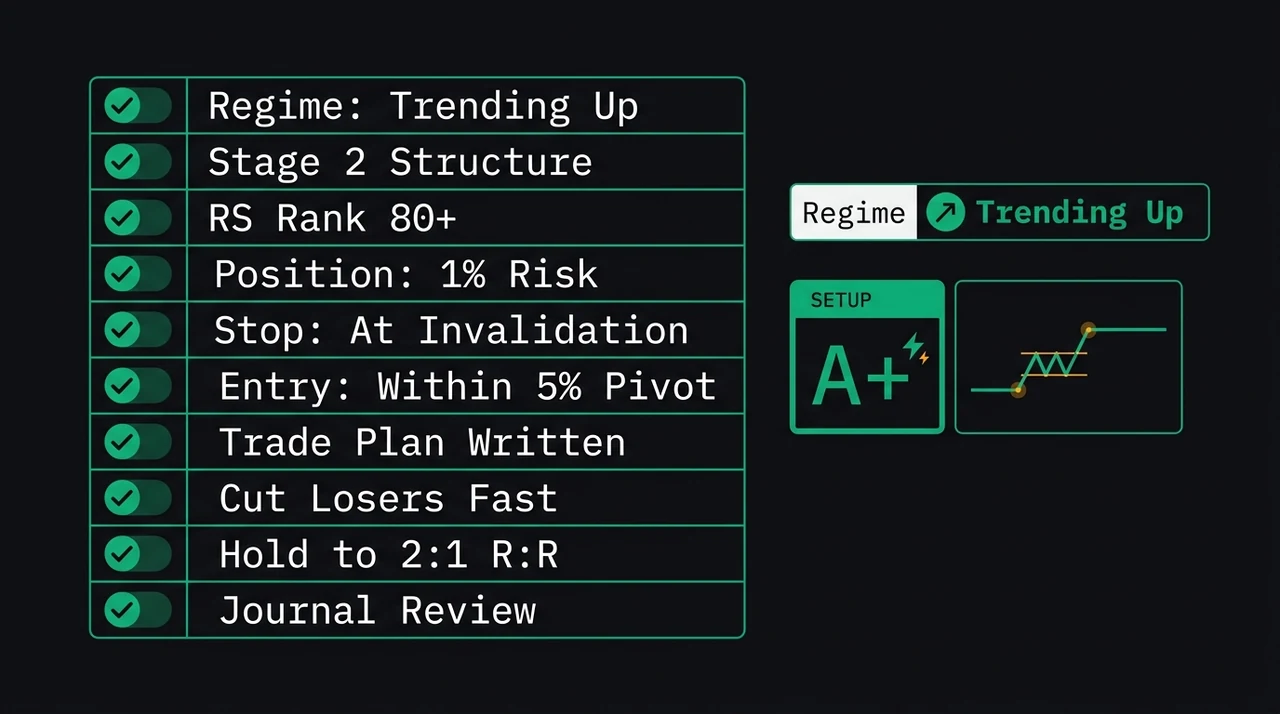
- ✅Market regime is confirmed Trending Up
- ✅Stock is in Stage 2 (price above SMA50 > SMA150 > SMA200, all slopes up)
- ✅RS rank is 80 or above
- ✅Setup grade is B or better
- ✅Entry price is within 5% of the defined pivot
- ✅Stop is placed at the structural invalidation level before entry
- ✅Position is sized so the stop equals ≤1% of total account capital
- ✅Reward-to-risk ratio is at least 2:1 to the first target
- ✅Trade plan is written with entry, stop, target, and share count
- ❌Do NOT enter if regime is Ranging, Trending Down, or High Volatility
- ❌Do NOT enter if the stock is already more than 5% above the pivot
- ❌Do NOT move the stop lower after entry to avoid realizing a loss
- ❌Do NOT exit a winning trade before it signals — exit on structure, not emotion
Rules for Specific Situations
The ten rules above are the daily baseline. Three recurring situations warrant their own dedicated rule sets:
- Swing Trading with a Small Account — how the 1% risk rule interacts with position sizing when capital itself is the binding constraint.
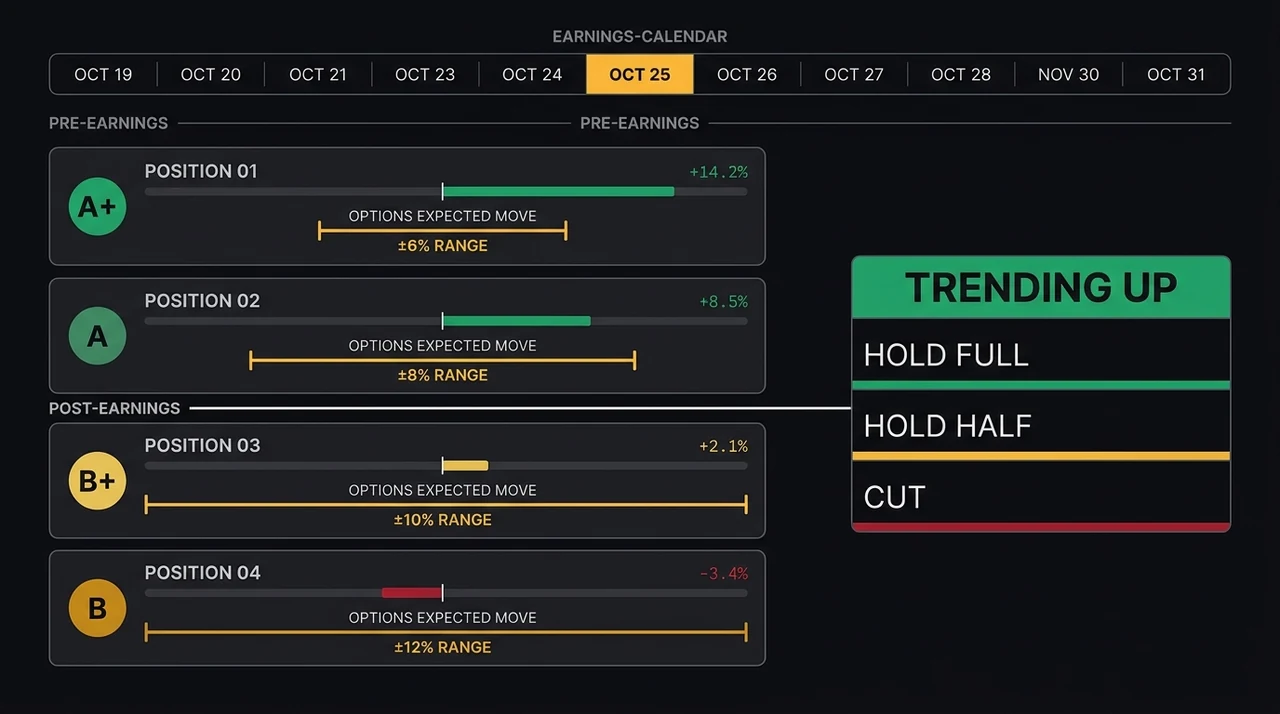
- Swing Trading Earnings Season — the hold/cut/enter framework for positions with an earnings date on the calendar.
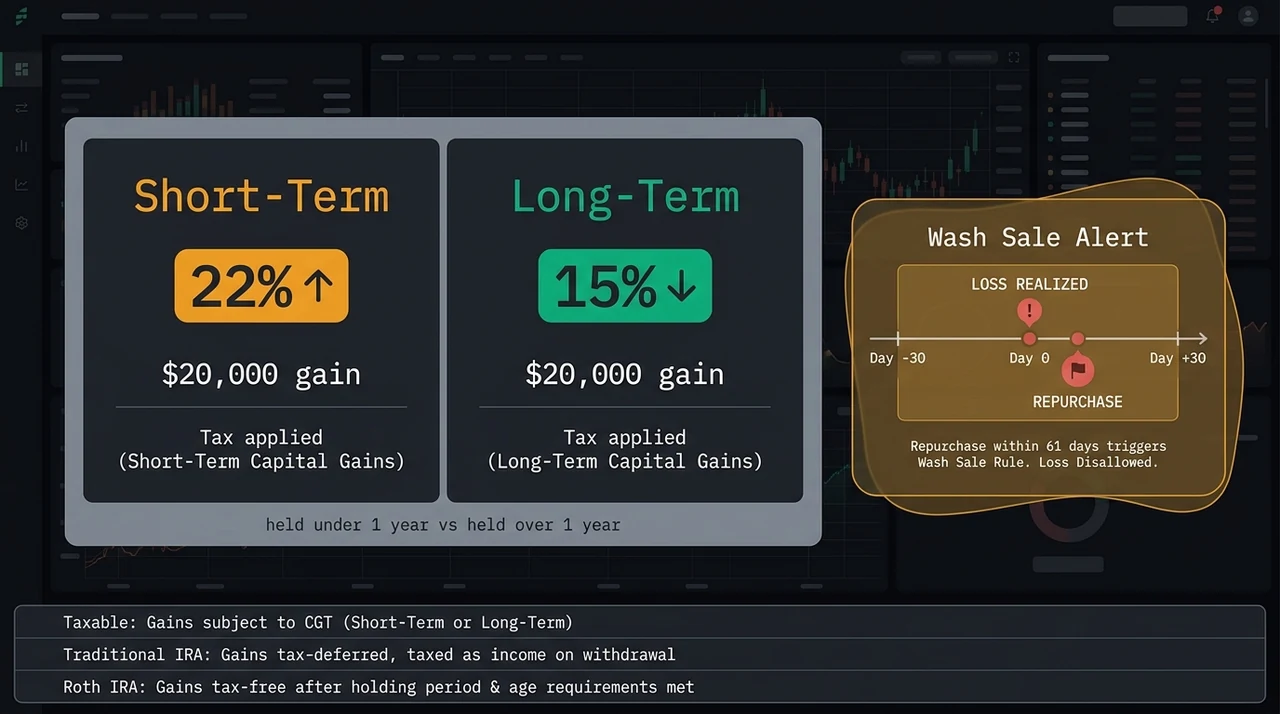
- Swing Trading Taxes — short-term capital gains treatment and the wash sale rule every active trader needs to track.
EasySwing.trading automatically applies the regime gate, RS rank threshold, and A+/A/B+/B/C grade filter to 2,000+ US equities each session — surfacing only the setups that pass the structural rules above. Cross-reference your plan against the checklist before every entry. See also: position sizing, stop loss placement, swing trading journal. Scan results are for informational purposes only. See our Risk Disclaimer.
Frequently Asked Questions
What are the most important rules for swing trading?
The three highest-impact rules are: (1) confirm the market regime is Trending Up before entering any long, (2) require RS rank 80 or above on every stock, and (3) define the stop loss at the pattern's structural invalidation level before entry and never move it lower. These three rules filter out the majority of failed swing trades by removing unfavorable conditions before they cost capital.
What is the 1% rule in swing trading?
The 1% rule means risking no more than 1% of total account capital on any single trade. Position size is derived from the stop distance: if a $50,000 account holds a trade with a $2 stop, maximum position size is 250 shares ($500 risk). This rule keeps any single loss manageable even in consecutive losing streaks and preserves capital for recovery.
Should swing trading rules be rigid or flexible?
Structural rules — regime gate, RS rank threshold, position sizing, and stop placement — must be rigid. They exist to override the emotional biases that systematically destroy trading results, primarily the tendency to hold losers too long and enter extended breakouts. Flexibility is permitted only in profit management: trailing a stop rather than taking a fixed exit is appropriate when a position shows extended momentum.
How do swing trading rules differ from day trading rules?
Swing trading rules emphasize overnight risk management, regime-level market context, and multi-day holding discipline — concepts that are less relevant intraday. The position sizing rule (1% risk), stop placement at structural levels, and exit discipline are shared across both disciplines, but the regime gate and Stage 2 filter are specific to swing trading, where broader market structure determines whether multi-day positions extend or reverse.
What is the biggest rule swing traders break most often?
Moving the stop loss lower after entry to avoid realizing a loss is the most commonly broken rule and the most destructive. Odean's account-level study (The Journal of Finance, 1998) found investors are consistently more reluctant to realize losses than gains — the disposition effect named by Shefrin and Statman (1985). The stop was placed at the structural invalidation point before the trade. Moving it retroactively replaces analytical judgment with emotional avoidance.
Disclaimer: This article is for educational purposes only and does not constitute investment advice. EasySwing is a stock screening tool, not a registered investment advisor. All trading involves risk. Read our full disclaimer →