Minervini Trend Template: The 8-Criteria Screen That Identifies Market Leaders
Mark Minervini analyzed the 100+ stock trades behind his two US Investing Championship wins and identified a structural condition every winner shared: before any chart pattern formed, the stock had already cleared an eight-point moving average and price-level filter that eliminated more than 90% of the equity universe. That filter is the Minervini Trend Template — the prerequisite that separates institutional-grade leadership candidates from everything else.
Eight criteria. Applied simultaneously. A stock that passes all eight is a candidate for a pattern-based entry. A stock that fails even one is not — regardless of how clean its chart looks.
Short answer: The Minervini Trend Template is an eight-criteria moving average and price-position screen. A stock qualifies only when (1) price trades above the 50-, 150-, and 200-day SMAs in ascending stack order, (2) the 200-day SMA has been rising for at least 20 sessions, (3) price sits at least 30% above its 52-week low, and (4) price is within 25% of its 52-week high. Roughly 5–8% of US equities qualify during a bull market — about 250–400 stocks from a 5,000-equity universe.
What Is the Minervini Trend Template
The Trend Template is Minervini's systematic method for confirming that a stock occupies a Stage 2 uptrend — the sustained markup phase where institutional demand has accumulated enough to drive a persistent price advance. It quantifies, in eight objective conditions, what Minervini described in Trade Like a Stock Market Wizard (2013): "Before I consider any stock for purchase, I require it to be in a Stage 2 uptrend. That standard alone eliminates the vast majority of stocks in any market." The template is the measured implementation of that standard.
The eight criteria, as published in Think and Trade Like a Champion (2017):
- Price above the 150-day simple moving average
- Price above the 200-day simple moving average
- The 150-day SMA above the 200-day SMA
- The 200-day SMA has been trending upward for at least 20 sessions (approximately one calendar month)
- The 50-day SMA above both the 150-day and 200-day SMAs
- Price above the 50-day SMA
- Price at least 30% above the 52-week low
- Price within 25% of the 52-week high
EasySwing's Trend Template Fresh-Pass strategy adds two supplemental gates: RS rank ≥ 75 (top 25% of all US equities by trailing 12-month price performance) and volume confirmation on the session the criteria are first met (≥ 1.2× the 50-day average).
The SMA Stack: What Moving Average Order Signals About Institutional Demand
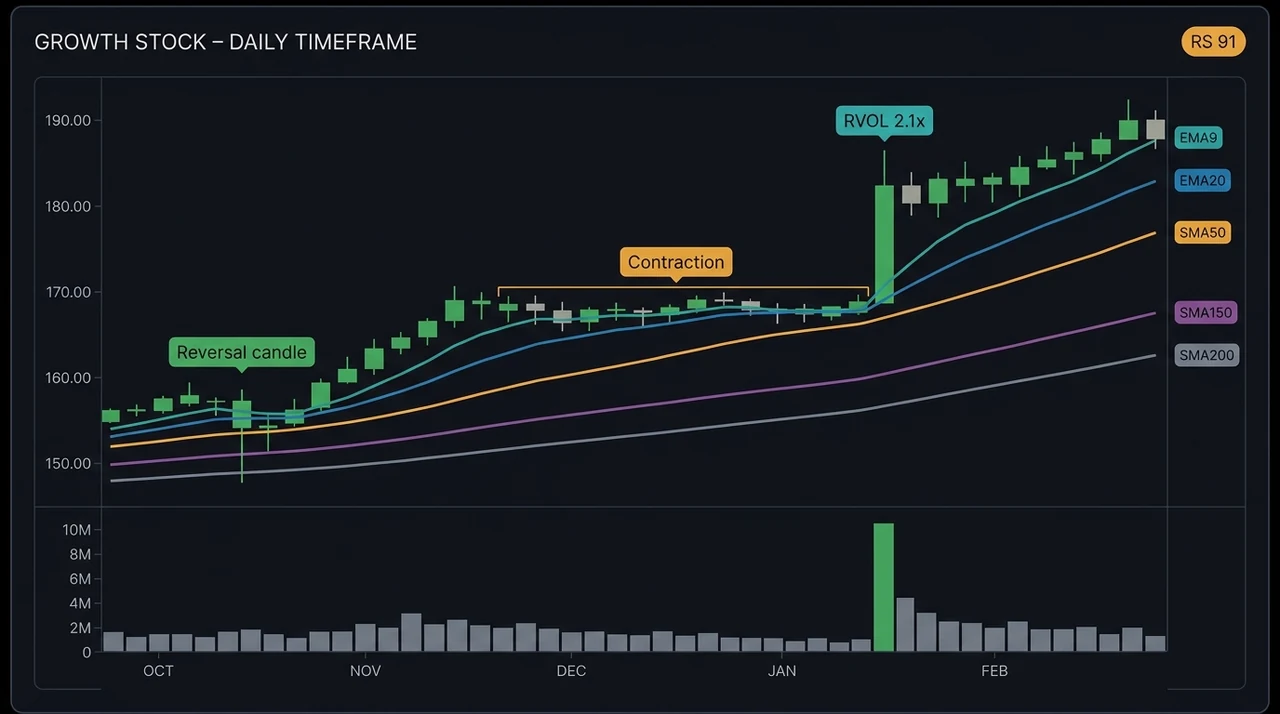
Criteria 3, 4, and 5 form the structural core of the Trend Template. Together they require that the 50-day SMA > 150-day SMA > 200-day SMA, with the 200-day still rising — the configuration known as a bullish moving average stack. This hierarchy is not arbitrary.
A bullish stack means that the average cost basis of buyers over the short-term (50-day) period is higher than the average cost basis over the medium-term (150-day), which is in turn higher than the long-term (200-day). When all three timeframes of institutional participation are aligned in the same direction, the supply of sellers at each price level has been steadily absorbed. Demand is persistent, not temporary. That structure historically filters out distribution phases, sector-rotation recoveries, and technical rallies that stall at overhead resistance.
Criterion 4 adds a minimum slope requirement to the 200-day: it must have been rising for at least 20 sessions. A stock can satisfy criteria 3 and 5 in absolute terms — short-term averages above long-term averages — while the 200-day is still declining from a prior downtrend. A declining 200-day signals that long-term institutional demand has not yet recovered. Criterion 4 catches this case. The moving averages guide covers the underlying logic of each MA period in depth.
The 50-day SMA above the 150-day SMA above the 200-day SMA, all rising, represents approximately 130 trading sessions of sustained net buying pressure confirming that the primary trend belongs to the buyers.
The 30% and 25% Price Rules
Criteria 7 and 8 define the price position the stock must occupy. Together they ensure the stock has already demonstrated meaningful appreciation off its lows (the 30% threshold) while not being so extended from its annual high that entry risk/reward is unfavorable (the 25% ceiling).
The minimum 30% advance above the 52-week low eliminates the earliest stage of a new uptrend, where a base is forming but institutional followthrough buying has not yet materialized. A stock trading at $22 off a $20 low — only 10% off its bottom — fails this criterion correctly. The move has not confirmed institutional commitment; it may be a brief technical bounce in a longer downtrend.
William O'Neil reinforced the logic in How to Make Money in Stocks (2009): "The best time to buy is as close to the start of the major move as possible, when it is only 5–15% above a sound base." The Trend Template's 25% from-high ceiling positions entries near enough to the annual high to capture the continuation, far enough from an overextended peak to maintain manageable risk.
The two criteria work together. A stock 30% above its 52-week low but 60% below its 52-week high has almost certainly violated the SMA stack criteria — confirming the price-level checks are internally consistent with the MA requirements.
Fresh-Pass Detection: Catching the Leadership State Transition
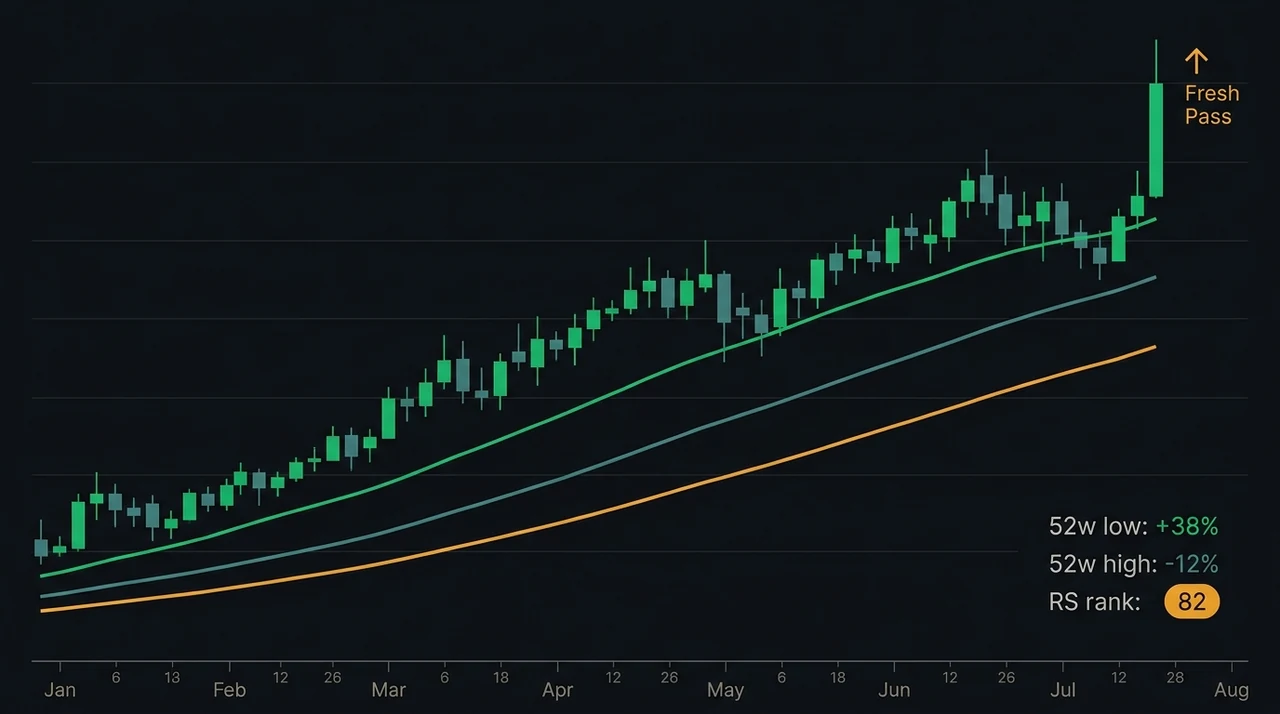
The EasySwing Trend Template Fresh-Pass strategy adds a dimension that Minervini's published criteria alone do not capture: the first time a stock passes all eight criteria within the prior 60 sessions. A stock that has satisfied the Trend Template for six consecutive months is a confirmed leader. A stock that passes it today for the first time since a prior corrective phase is a transitioning leader — potentially earlier in its next institutional accumulation cycle.
The fresh-pass signal identifies that state transition. Jegadeesh and Titman (Journal of Finance, 1993) — the foundational momentum research — found that stocks entering the top performance quintile over 3–12 month lookback periods produced significantly stronger forward returns than stocks already residing in it. The rate of change of the momentum signal, not just the level, carries the alpha. The fresh-pass logic is a structural implementation of that finding within the Trend Template framework.
In practice, a fresh-pass candidate is a stock that has just re-entered the institutional leadership cohort after a period of correction, consolidation, or macro-driven drawdown. Its SMA stack has just re-aligned. Its price position has recovered. The institutional accumulation that drives the stack ordering is still forming — and that is where the forward return distribution is most favorable.
Combining the Trend Template With Pattern Setups
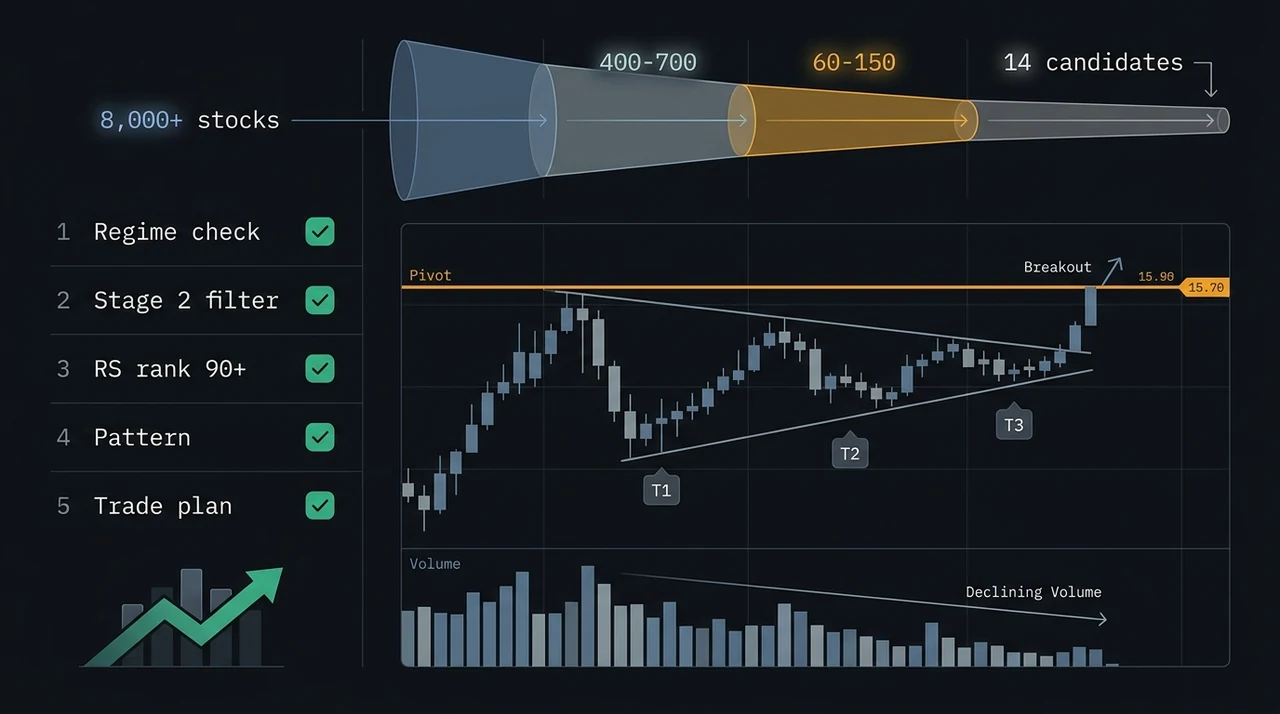
The Trend Template is a prerequisite for a trade, not the trade itself. A stock that passes all eight criteria — including RS rank and volume — is a candidate for a pattern-based entry, not an immediate buy. The two highest-probability patterns to layer on top of a confirmed Trend Template pass are the VCP (Volatility Contraction Pattern) and the pullback to a rising moving average.
A VCP in a Trend Template stock means institutional accumulation has tightened into a defined compression base — volume has contracted on each successive pullback, and the breakout pivot is a clearly identifiable price level. A Stage 2 pullback to the EMA20 or SMA50 in a Trend Template stock means the primary structure is intact and the dip represents a lower-risk re-entry point relative to the prior swing high.
The market regime gate is equally critical. EasySwing's Trend Template Fresh-Pass strategy is valid only in TRENDING_UP regimes. Even a technically perfect 8-criteria pass in a HIGH_VOLATILITY or TRENDING_DOWN regime produces a fundamentally different trade. The institutional demand that a bullish SMA stack represents is being overwhelmed by macro selling pressure. The template's criteria can remain technically satisfied while the stock distributes. Regime first, pattern second, template as the baseline.
Four Trend Template Errors That Cost Swing Traders Money
Most Trend Template errors share a common root: treating the template as a screener output rather than an active condition to monitor. The eight criteria are not static once confirmed — any of them can fail on a subsequent session, and that failure invalidates the setup.
Skipping the 200-day slope check. Criterion 4 — the 200-day SMA trending upward for at least 20 sessions — is the most commonly overlooked. A stock can display the correct SMA ordering (50 above 150 above 200) in absolute terms while the 200-day is still declining from a prior downtrend. The declining 200-day signals that long-term demand has not recovered. Always check slope explicitly, not just ordering.
Misreading the 30% threshold as a buying zone. The template requires at least 30% above the 52-week low. Some traders interpret this as a signal to buy near the 30% mark — the opposite of the intent. The threshold is a minimum, not a target. A stock 100% above its 52-week low and within 25% of its annual high is a stronger Trend Template pass, not a weaker one.
Ignoring [RS rank](/blog/relative-strength-rank-rs-90-swing-trading) as a supplemental gate. The eight published criteria do not explicitly include relative strength versus the broader market. A stock can satisfy all eight SMA and price-level criteria while underperforming the S&P 500 over the trailing year — signaling sector or fundamental weakness that offsets the technical structure. EasySwing adds RS ≥ 75 as a ninth gate. Any Trend Template candidate with RS below 60 warrants extra caution.
Entering without a pattern trigger. A Trend Template confirmation builds a watchlist. Trading the confirmation day itself — buying the moment all eight criteria are simultaneously met — produces lower-quality entry risk/reward than waiting for a VCP, a pullback, or another pattern setup to provide a specific, low-risk entry level. The template defines the candidate; the pattern defines the trade.
Trend Template Entry Checklist
Structural prerequisites:
- ✅Price above the 150-day SMA
- ✅Price above the 200-day SMA
- ✅150-day SMA above the 200-day SMA
- ✅200-day SMA has been rising for at least 20 sessions
- ✅50-day SMA above both the 150-day and 200-day SMAs
- ✅Price above the 50-day SMA
- ✅Price at least 30% above the 52-week low
- ✅Price within 25% of the 52-week high
EasySwing additional gates:
- ✅RS rank ≥ 75 (top 25% of US equity universe)
- ✅Volume ≥ 1.2× 50-day average on the first fresh-pass session
- ✅Market regime confirmed as TRENDING_UP
Conditions that invalidate an otherwise passing setup:
- ❌The 200-day SMA is flat or declining — long-term demand has not yet recovered
- ❌The stock passed all criteria months ago and is now extended far above the SMA stack
- ❌The market regime is HIGH_VOLATILITY or TRENDING_DOWN
- ❌No identifiable pattern setup (VCP, pullback, base) provides a specific entry level
- ❌RS rank below 60 without a clear leadership reason in the relevant sector
Frequently Asked Questions
What are the eight criteria of the Minervini Trend Template?
The eight criteria require: (1) price above the 150-day SMA, (2) price above the 200-day SMA, (3) the 150-day SMA above the 200-day SMA, (4) the 200-day SMA trending up for at least 20 sessions, (5) the 50-day SMA above both the 150-day and 200-day SMAs, (6) price above the 50-day SMA, (7) price at least 30% above the 52-week low, and (8) price within 25% of the 52-week high. All eight must be simultaneously true.
What is the Trend Template Fresh-Pass signal?
The Fresh-Pass signal detects the first time a stock passes all eight Minervini Trend Template criteria within the prior 60 sessions — the moment of re-entry into the institutional leadership cohort after a period of correction or base formation. EasySwing adds two supplemental gates: RS rank ≥ 75 and volume ≥ 1.2× the 50-day average on the confirmation session.
What RS rank does the Trend Template require?
Minervini's published template does not specify a minimum RS rank. EasySwing's Trend Template Fresh-Pass strategy adds RS ≥ 75 as a supplemental filter — the top 25% of US equities by trailing 12-month price performance. This screens out Trend Template passes in stocks that are building a moving average stack through fundamental recovery rather than true institutional-demand leadership.
Can the Trend Template be used in a bear market?
The eight criteria can be technically satisfied in a bear market for individual stocks even as the broader index is declining — typically in defensive sectors or commodity-linked equities. However, the EasySwing Trend Template Fresh-Pass strategy gates on TRENDING_UP regime only. In a TRENDING_DOWN or HIGH_VOLATILITY regime, the base rate for pattern continuation is materially lower regardless of how well the template criteria are met.
How does the Trend Template differ from Stage 2 analysis?
Stage 2 analysis (Stan Weinstein's framework) requires price above a rising 30-week moving average with the average itself sloping upward. The Minervini Trend Template is a stricter, multi-layer version: it adds the 150-day / 200-day SMA stack ordering, the 200-day slope check, and the 30%/25% price-position gates. All Trend Template stocks are Stage 2; not all Stage 2 stocks pass the full Trend Template.
EasySwing.trading automatically detects stocks passing all eight Minervini Trend Template criteria for the first time in the prior 60 sessions, filtering for RS rank ≥ 75 and above-average volume confirmation. Each fresh-pass candidate is graded on a five-tier A+/A/B+/B/C scale on pattern quality with pre-calculated entry, stop, and target levels. For broader context on how this fits a complete setup methodology, see our guide to best indicators for swing trading and the full swing trading strategies guide. Scan results are for informational purposes only. See our Risk Disclaimer.
Disclaimer: This article is for educational purposes only and does not constitute investment advice. EasySwing is a stock screening tool, not a registered investment advisor. All trading involves risk. Read our full disclaimer →