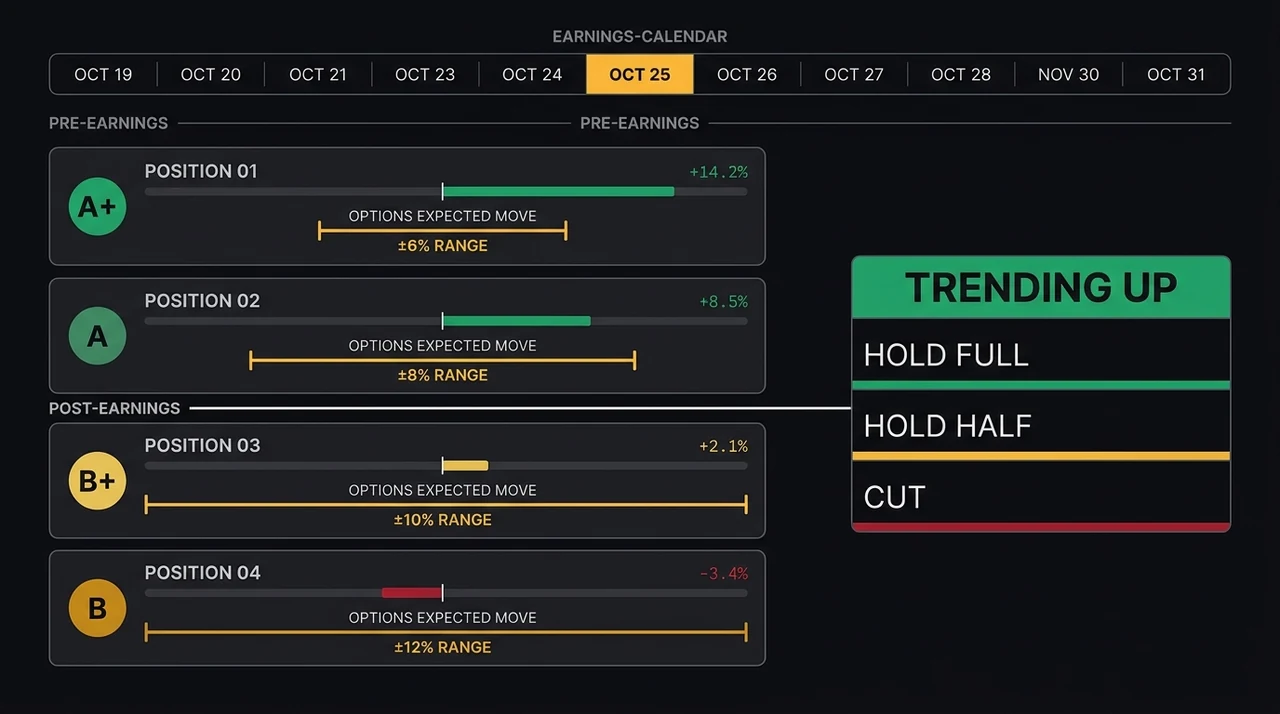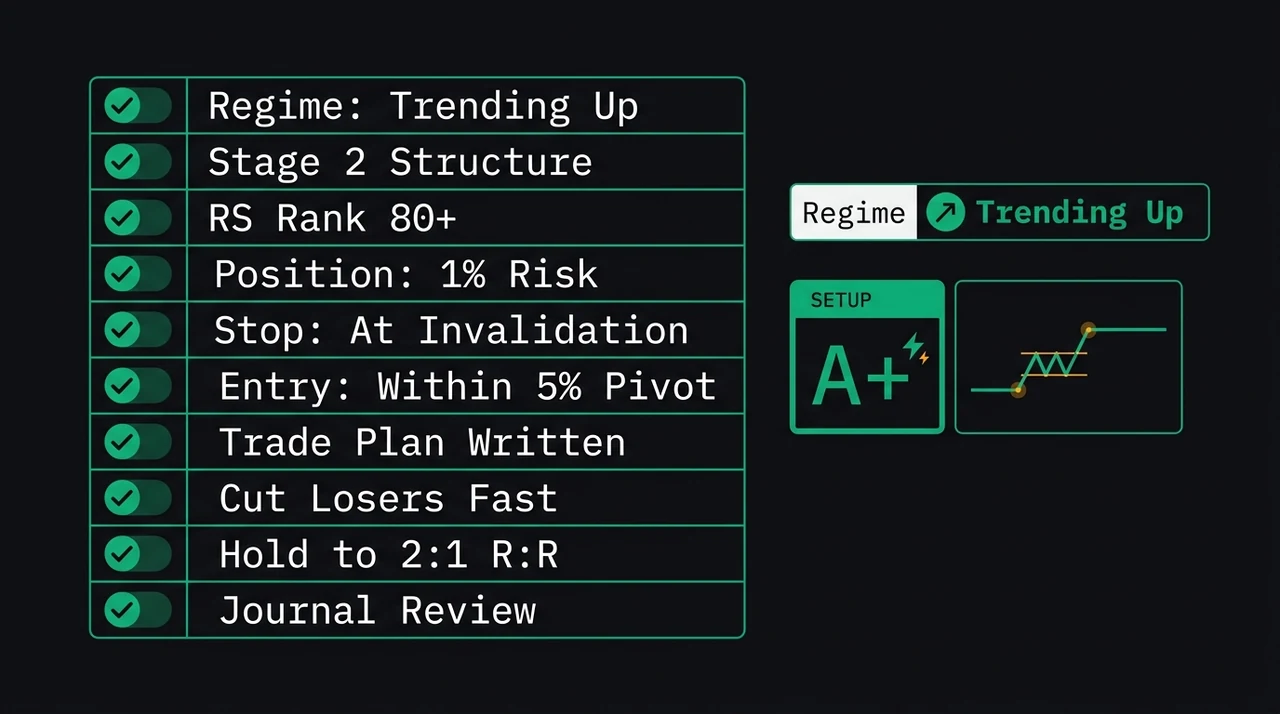
Swing Trading Psychology: Rules Over Reactions
Loss aversion — the cognitive bias where losses feel roughly twice as painful as equivalent gains — costs active traders an estimated 1–4% in risk-adjusted returns annually (Odean, 1998, Journal of Finance). Most of that underperformance isn't caused by bad strategy. It comes from decisions made under emotional pressure that override the rules a trader already knows to follow.
The short answer: swing trading psychology is the discipline of following your rules when market pressure is highest. The four biases that most frequently break rules are loss aversion, the disposition effect, overconfidence, and FOMO. Each has a behavioral fix — and a rules-based screening system removes most of them by making systematic selection non-negotiable before positions are placed.
Loss Aversion and the Breakeven Trap
Kahneman and Tversky's prospect theory (Econometrica, 1979) established that losses register roughly 2× more painfully than equivalent gains. For swing traders, that asymmetry creates one specific failure mode: holding losing positions past the stop level to avoid realizing a loss that "feels" larger than the position size actually justifies.
The result is the breakeven trap — the trader holds a position that has invalidated its thesis because selling locks in a loss that feels disproportionately large. A manageable 3% loss becomes a 7% loss, then a 12% loss, each held while the emotional cost of exiting continues to compound.
The behavioral fix is mechanical: place your stop order before the market opens on the session you enter. Once the order is live, the exit decision is already made. You're not managing the emotional cost of a loss in real time — the rule is already in execution.
A second fix: reframe the stop as the pre-paid cost of finding out whether the thesis was right. If your stop is $0.60 per share, that $0.60 is the information fee — not a failure. Mark Douglas framed this precisely in Trading in the Zone (2000): "The best traders aren't afraid because they've developed a relationship with the market where being wrong is just information, not a judgment about their intelligence."
For mechanics on setting stops at structurally valid levels rather than arbitrary percentages, see swing trading stop-loss placement.
The Disposition Effect — Cutting Winners Too Early, Holding Losers Too Long
The disposition effect, documented by Shefrin and Statman (Journal of Finance, 1985), is the behavioral pattern of selling winners too quickly and holding losers too long. It is the mirror of loss aversion in portfolio form. Odean's 1998 analysis of 10,000 retail brokerage accounts confirmed the pattern: traders sold winning positions at a significantly higher rate than losing ones, even after controlling for tax-loss harvesting.
For swing traders, the disposition effect manifests as premature profit-taking: a stock breaks out on volume, moves 1R in your favor, and the emotional pressure to "book a win" causes an exit at 1.2R when the plan called for a 3R target based on chart resistance. The position is profitable — but the trade underperformed its plan by 60%.
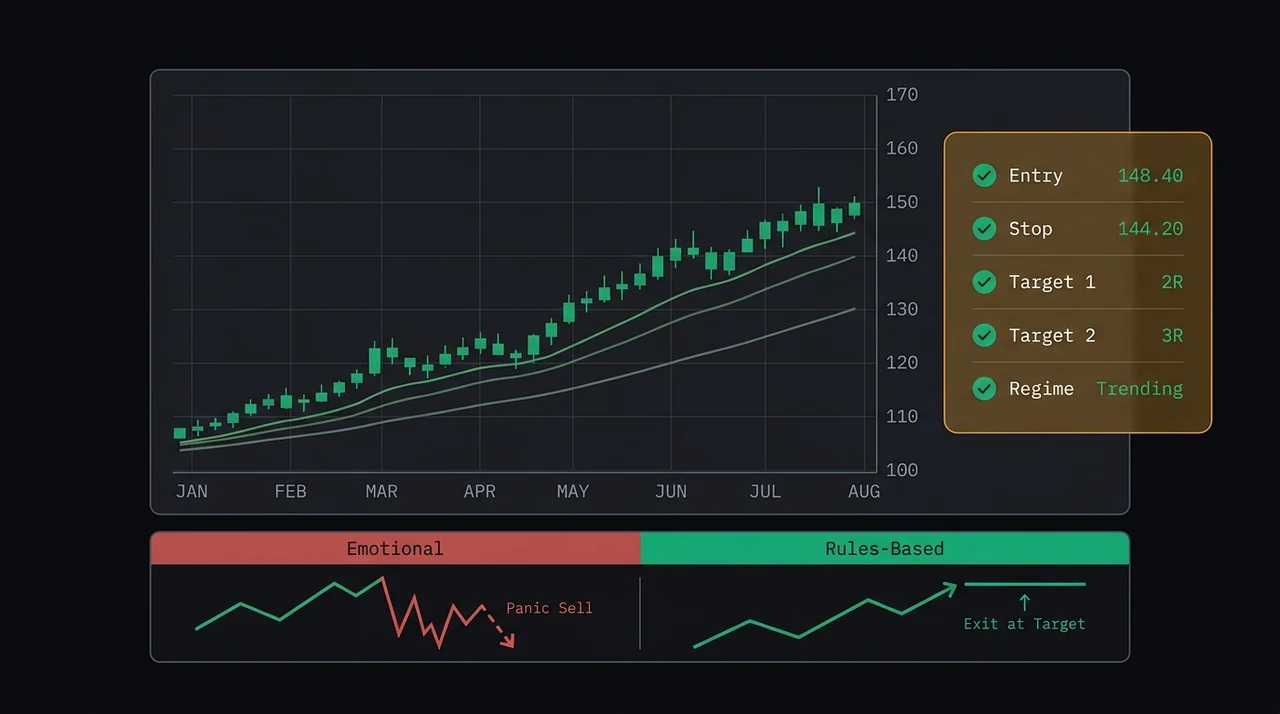
The fix is a pre-written trade plan for each position: entry, stop, Target 1, and Target 2 recorded in your journal before the order is placed. When a trade is open, the question is no longer "should I take profit now?" — it is "has price reached my Target 1?" Those are different questions. The first is an emotional prompt; the second is a rule check.
For tracking how your exits compare to the original plan over time, the swing trading journal framework captures MAE/MFE data that reveals whether you're consistently leaving money on the table by exiting too early.
Overconfidence Bias — The Recency Effect After a Win Streak
Overconfidence in traders is typically driven by recency bias: a recent stretch of winning trades produces the subjective sense that current market conditions are favorable, that your edge is sharper than usual, and that larger position sizes are justified.
Barber and Odean (Quarterly Journal of Economics, 2001) found that overconfident traders — the most active quintile — turned over their portfolios 45% more than less confident traders. The most active quintile earned 6.5% per year less than the least active quintile, after accounting for transaction costs. Overconfidence isn't harmless conviction — it directly increases decision frequency and position size at exactly the wrong moments.
The pattern plays out in three stages. First, a trader has a 4–6 trade winning streak during a trending market. Second, the trader increases position size on the next trade based on the subjective sense that conditions are favorable. Third, the market regime shifts, the trade fails, and the oversized loss erases much of the prior run.
Two specific fixes:
Formula-driven sizing: Risk no more than 1% of account equity on any single trade, regardless of conviction level. For the math on calculating shares from stop distance, see position sizing with R-multiples. The rule applies equally during win streaks and loss streaks — the formula doesn't know your recent P&L.
Regime-aware selection: EasySwing's five-state regime classification — Trending Up, Trending Down, Ranging, High Volatility, and Transitioning — is independent of your recent results. During a High Volatility or Trending Down regime, grade thresholds tighten automatically regardless of how your last five trades went. The system applies structural discipline when the trader's overconfidence suggests everything is fine.
FOMO and the Impulse Entry Problem
FOMO (fear of missing out) is the impulse to enter a position because price is moving, not because the setup meets your criteria. A stock runs 8% in a single session. You didn't own it. Social media shows other traders discussing it. The urgency to participate feels acute — and the natural response is to chase.
The data on chasing is consistent. Jegadeesh and Titman (Journal of Finance, 1993) documented that momentum strategies based on structured entry rules generated 12.01% annualized excess returns. The framework required entering stocks at defined pivot points after systematic screening — not chasing in-progress moves after a stock had already run. The return came from disciplined entry at calculated levels, not from the emotional urgency to participate.
FOMO is most dangerous during strong trending markets. When the regime is Trending Up and the broad market is producing multiple gap-up sessions, the base rate of "stocks going up" is temporarily elevated. A few successful impulse entries reinforce the behavior — which is exactly when the reinforcement is most misleading. The regime always ends; the habits built during it don't.
| Situation | Emotional Response | Rules-Based Response |
|---|---|---|
| Stock up 8% — missed it | Chase at current price | Wait for next setup meeting all criteria |
| Position down 4%, stop not hit | Hold — "it'll bounce" | Check stop: if not hit, hold per plan |
| Position up 1.5R, target is 3R | Exit to "lock in the gain" | Hold per Target 1 plan unless trail hit |
| Three-trade losing streak | Double next position to recover | 1% rule regardless of recent results |
| Broad market up 2% | Enter more setups while sentiment is good | Only enter stocks with pre-written plans |
Two specific fixes for FOMO: First, commit to only entering setups where all screening criteria are simultaneously met — pattern, RS rank, regime, grade — and where a specific entry trigger has been documented before price reaches that level. The plan is written the night before, not in the session.
Second, use a swing trading watchlist to pre-populate entry candidates after session close, when FOMO pressure is absent. The morning after is when the trade plan is written; the trading session is when the plan is executed or skipped.
How a Rules-Based System Replaces Subjective Judgment
Loss aversion, the disposition effect, overconfidence, and FOMO all distort subjective decisions made under emotional pressure. They don't distort rules. A rule applied consistently doesn't have a session-to-session emotional state.
The practical implication: reduce the number of real-time, in-session subjective decisions to as few as possible. Brett Steenbarger, a performance psychologist who has worked with institutional traders and documented the pattern in The Psychology of Trading (2002), observed that the most consistent traders he studied had systematized the majority of their decision-making — not because they lacked skill, but because they recognized that emotional pressure during live trading degrades even skilled judgment.
Pre-market (systematic decisions):
- Run screener filters on the full universe
- Identify setups meeting all criteria simultaneously
- Record entry, stop, Target 1, Target 2 in the journal
- Size the position using the 1% risk rule
- Place entry orders if within trigger range
In-session (rule-checking only):
- Monitor open positions against stop levels
- Monitor pending entries against trigger levels
- Adjust trail stops when rules explicitly permit
- No additions, new positions, or plan changes during market hours
The only in-session decisions are whether price has hit a pre-defined level. Everything else was settled the previous evening. For capturing post-session data that improves future decision-making, the when to sell a swing trade guide covers MAE/MFE tracking — the tool that reveals whether your exits are systematically early or systematically late over a large sample of trades.
The Swing Trading Psychology Checklist
Apply this at session close, before any orders are placed for the next trading day.
Pre-position setup:
- ✅Screener filters run on the full universe; candidates identified by systematic criteria, not gut feel
- ✅Every open position has a documented stop, Target 1, and Target 2 in the journal
- ✅Position sizes follow the 1% risk rule — no position sized by conviction or recent results
- ✅Market regime classification reviewed — grade thresholds adjusted if regime has changed
- ✅Entry orders placed for tomorrow's triggers; no "watch and decide in session" positions
Behavioral guardrails:
- ✅No new positions added to yesterday's winners because they "feel good"
- ✅No stops widened because a losing position might recover
- ✅All planned exits for tomorrow written down before sleep
- ✅Win/loss streak awareness: recent outcome does not affect position sizing
Post-session review:
- ✅Any exit that deviated from the plan is documented with the specific reason
- ✅Impulse trades logged and reviewed for pattern
- ✅One-sentence statement of today's market regime recorded
Red flags — review these in your journal:
- ❌Stopped out, then re-entered the same position without a new written plan
- ❌Held a position past the stop level because the target was close
- ❌Added to a losing position to reduce average cost
- ❌Exited a winner at 0.8R because the market "felt uncertain"
- ❌Entered a stock that ran 10%+ on the day without a pre-written entry plan
EasySwing.trading screens for swing trading setups automatically across 2,000+ US equities each session, grading each result A+ to C and applying a five-state regime gate — so entry levels, stops, and targets are pre-calculated before the market opens. For the systematic process that replaces in-session judgment calls, read about position sizing with R-multiples, the swing trading journal framework, and building a swing trading watchlist. Scan results are for informational purposes only. See our Risk Disclaimer.
Frequently Asked Questions
What is trading psychology and why does it matter for swing traders?
Trading psychology is the study of how cognitive biases and emotional responses affect trading decisions. For swing traders, it matters because the same four biases — loss aversion, the disposition effect, overconfidence, and FOMO — consistently cause traders to deviate from systematic rules at exactly the moments when following those rules matters most. Odean (1998) found the behavioral pattern costs active traders 1–4% annually in risk-adjusted returns.
How do I stop second-guessing my stops?
Write the stop price and the condition that validates it in your journal before placing the order — for example: "stop if daily close below $47.82, the VCP handle low." The stop is an argument. When you're tempted to move it, you need a written counter-argument that explains why the invalidation condition no longer applies. Most traders find that requiring the written rebuttal breaks the emotional override reflex.
Is swing trading better for psychology than day trading?
For most systematic traders, yes. Fewer decisions means fewer opportunities for emotional error. Barber and Odean (2001) found that more active traders performed worse specifically because higher decision frequency amplified cognitive and emotional biases. Swing traders make 2–5 decisions per week; day traders make 20–50 per session. Lower decision load reduces cumulative emotional exposure significantly.
How long does it take to develop real trading discipline?
Brett Steenbarger's work with institutional traders suggests rule-following becomes reflexive after roughly 300–500 deliberate trade repetitions with explicit post-trade review. For a trader doing 2–3 trades per week with consistent journaling, that is 6–12 months. Progress is not linear — discipline often breaks down in new market regimes before restoring at a higher level, so the post-trade review is the mechanism that converts repetitions into skill.
What is the biggest psychology mistake new swing traders make?
Treating losses as evidence of a broken strategy after 5–10 trades. A strategy with a 55% win rate will produce stretches of 5–8 consecutive losses through normal statistical variance. Changing the strategy after those losing runs — rather than evaluating whether rules were followed — destroys edge and prevents learning. Operate a strategy for at least 30 trades before evaluating performance, and use the journal to confirm rules were followed during the run.
Disclaimer: This article is for educational purposes only and does not constitute investment advice. EasySwing is a stock screening tool, not a registered investment advisor. All trading involves risk. Read our full disclaimer →