EasySwing vs Webull Stock Screener: What Swing Traders Need to Know
Hendrik Bessembinder's analysis of nearly 26,000 US stocks (Journal of Financial Economics, 2018) found that just 4% of publicly traded companies account for the entire net wealth created by the US stock market since 1926. The other 96% collectively delivered returns no better than Treasury bills. That finding defines the screening problem precisely: a general-purpose filter that returns 200 candidates still leaves you sorting through a pile where 192 are statistically irrelevant to your session.
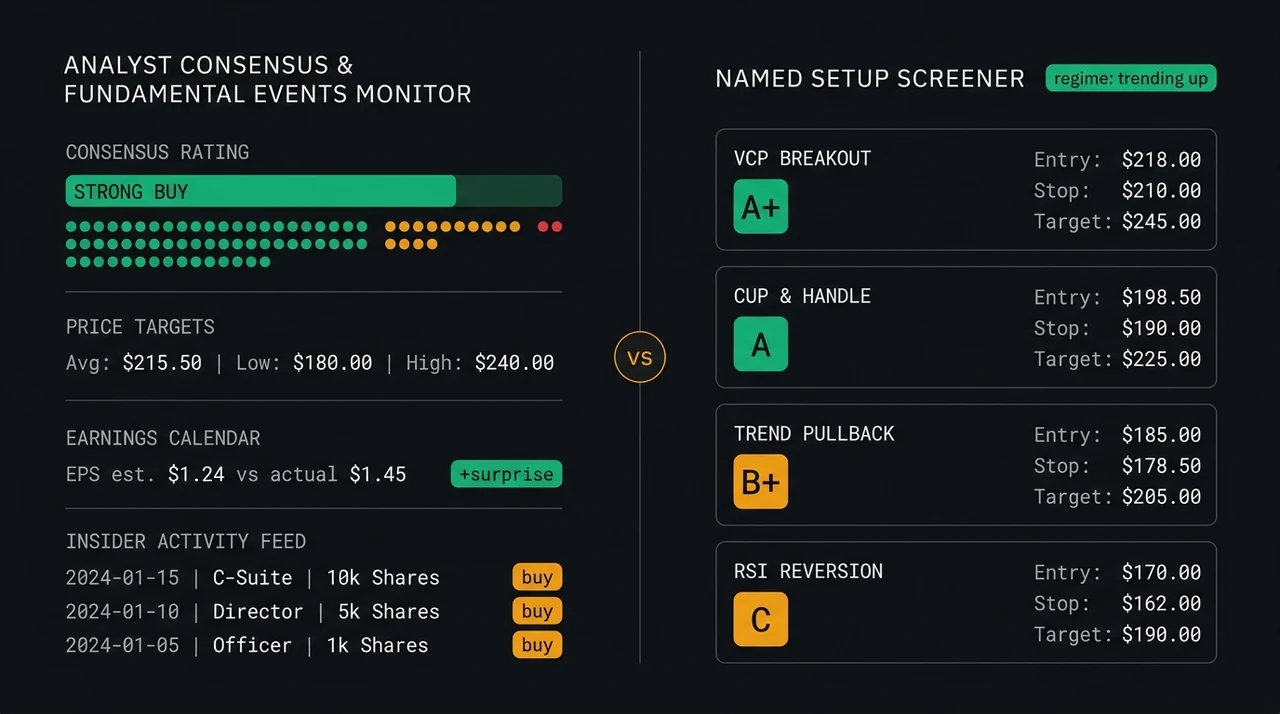
Webull is a commission-free broker with a built-in stock screener used by millions of active retail traders in the US. EasySwing.trading is a purpose-built swing trading screener that detects 13 named setup patterns — VCP, Cup & Handle, Trend Pullback, and others — grades each result A+/A/B+/B/C by quality, and applies a five-state market regime filter automatically after each session close. Both tools scan stocks. They serve different workflows.
The Short Answer
Webull's screener provides technical and fundamental filters at no cost to any brokerage account holder. EasySwing.trading identifies named swing trading setups, assigns a letter grade (A+/A/B+/B/C) to each result by quality score, and gates every strategy against the current market regime. For general-purpose screening integrated with a commission-free broker, Webull. For a pre-graded swing setup shortlist with pre-calculated entry, stop, and target levels ready before the open, EasySwing.
| Feature | Webull | EasySwing.trading |
|---|---|---|
| Cost | Free (included with account) | $49/mo ($39/mo annual) |
| Named setup detection | Partial (geometric patterns only) | Yes (13 strategies, multi-layer) |
| Setup quality grading | No | Yes (A+/A/B+/B/C) |
| Market regime filter | No | Yes (5 states, updated daily) |
| Filter criteria | 100+ (technical + fundamental) | No raw filter mode |
| Real-time Level 2 data | Yes (free) | No |
| Paper trading | Yes | No |
| Pre-calculated risk framework | No | Yes (entry, stop, T1 at 1.5R, T2 at 3R) |
| AI coaching per setup | No | Yes (Soren, per-candidate) |
| Strategy-specific alerts | No (price alerts only) | Yes (Telegram, email, setup-gated) |
| Order execution | Yes (commission-free) | No |
What Webull's Screener Offers
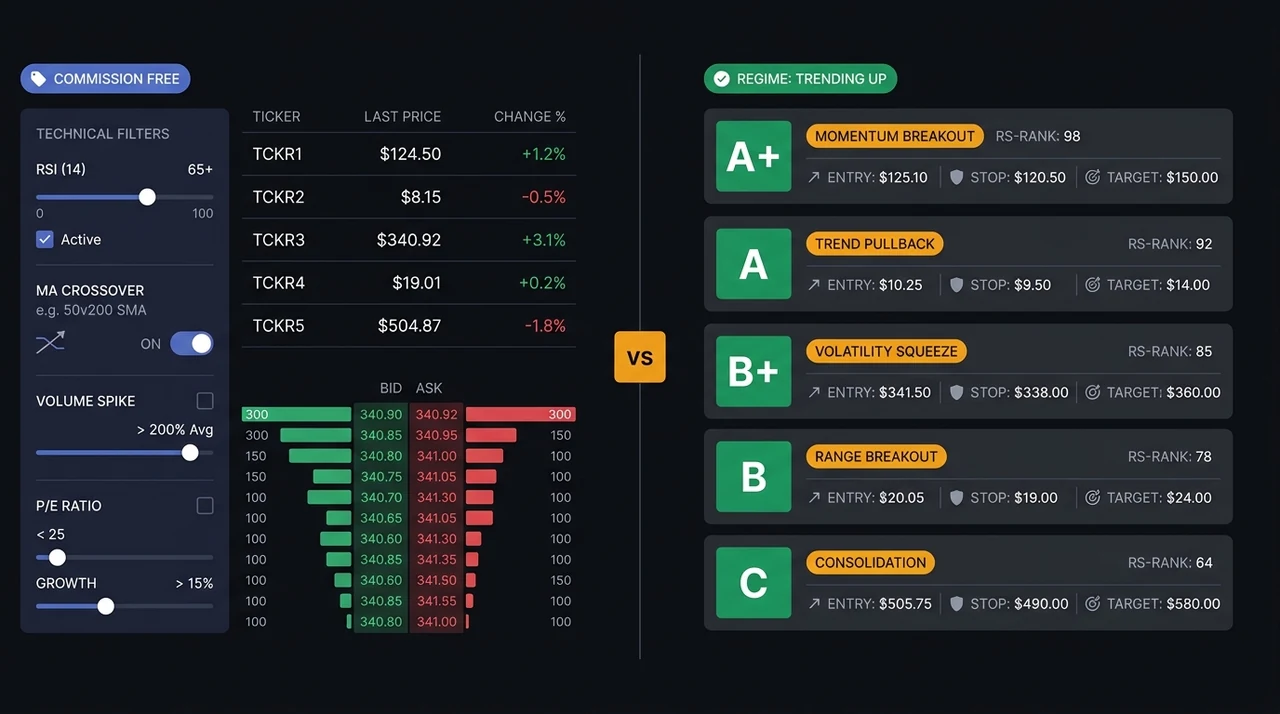
Webull's built-in screener provides 100+ filter criteria across technical and fundamental dimensions at no additional cost for account holders. Technical filters cover RSI, MACD, moving averages (5, 10, 20, 50, 200-day), Bollinger Bands, ADX, CCI, Williams %R, Stochastic, and 52-week range proximity. Fundamental filters include P/E ratio, EPS growth, revenue, market cap, and dividend yield.
Technical filter coverage reaches the standard indicators most swing traders use for a first pass. RSI below 40 in a stock above its 50-day moving average, combined with above-average relative volume, is a reasonable starting screen for an oversold bounce candidate. Webull returns every stock clearing those conditions. It does not evaluate whether the combination constitutes a valid named setup — pattern recognition and quality judgment remain the trader's job after the screen runs.
Basic pattern alerts are available in Webull for a subset of chart formations: ascending triangle, descending triangle, head and shoulders, double top, double bottom, bullish flag, and bearish flag. These alerts fire when price action approximates the geometric shape of the pattern. They do not evaluate the confluence conditions — relative strength rank, Stage 2 trend structure, volume confirmation during the base, or regime alignment — that separate a high-probability named setup from a geometric look-alike. Two stocks can display identical flag geometry but carry entirely different follow-through probabilities based on RS rank, market cap, sector context, and current regime.
Access without fees. Webull's screener is included with any Webull brokerage account at no additional cost. For active traders who already hold a Webull account for commission-free execution, the screener represents a zero-incremental-cost first pass for generating a candidate list.
Where Webull's Screener Falls Short for Systematic Swing Trading
Webull's screener returns every stock clearing your filter thresholds. Compound named-setup detection — evaluating whether a stock is in a specific, defined setup with all confluence conditions simultaneously met — is outside the screener's architecture. Market regime filtering does not exist. Quality grading does not exist. Pre-calculated entry, stop, and target levels are not provided on screener results.
No compound pattern logic. Webull's Bull Flag alert fires when price action looks like a flag geometrically. It does not check whether the stock carries an RS rank above 70, whether volume contracted appropriately during the consolidation pole, whether the stock is above its 50-day moving average in Stage 2 structure, or whether the current market regime supports a breakout strategy. Each of those conditions materially affects follow-through probability. Mark Minervini documented in Trade Like a Stock Market Wizard (2013) that false breakouts during non-trending markets are one of the primary sources of systematic losses for traders who run technical pattern screens without regime context.
No setup quality scoring. Every stock clearing Webull's filter criteria ranks identically — there is no mechanism to separate an A+ candidate (RS rank 92, tight 8-week base, expanding volume on breakout day, regime Trending Up) from a C candidate (RS rank 55, wide choppy base, lukewarm volume, regime Ranging). The trader reviews every result manually and applies their own quality judgment. Starting from an unranked 200-result list increases both the time cost and the variance of candidate selection across sessions.
No pre-built risk framework. Webull's screener does not surface an entry price, stop-loss level, or profit targets on screener results. The trader builds the risk/reward framework independently from the chart. For the mechanics of how entry, stop, and target levels translate into position size, see position sizing with R-multiples.
What EasySwing.trading Does Differently
EasySwing.trading detects 13 named swing trading setups using a multi-layer signal engine that simultaneously checks Stage 2 trend structure, relative strength rank, relative volume pattern, named pattern formation, and market regime compatibility. Each result that clears every condition receives a letter grade (A+/A/B+/B/C), a composite score (0–100), and pre-calculated entry price, stop-loss, and two profit targets.
The screening model evaluates conditions in sequence, not independently. A stock appears in the VCP Breakout results not because it passed an RSI filter and a volume filter separately — but because the engine confirmed Stage 2 trend structure intact, RS rank above the threshold, volume contracted correctly over the multi-week base, breakout volume expanding relative to the 50-day average, and the current market regime is Trending Up or Ranging (the two states where VCP follow-through has historically been favorable). All conditions must pass simultaneously.
The five-tier grade (A+/A/B+/B/C) summarizes a composite score weighted across five dimensions:
| Metric | Weight |
|---|---|
| Regime alignment | 30% |
| Pattern confirmation (setup match) | 25% |
| Confluence (supporting conditions) | 20% |
| Relative strength rank | 15% |
| Volume confirmation | 10% |
Every result includes a pre-calculated entry price, a stop-loss placed below the pattern's defining low, and two targets: Target 1 at 1.5R and Target 2 at 3R. For a session's worth of candidates, the trader reviews a pre-sorted, pre-scored shortlist of 10–20 setups rather than a 200-result unranked output.
Market Regime Awareness
Market regime is the filtering variable most absent from broker-native screening tools. Andreas Clenow built that principle directly into his momentum system in Stocks on the Move (2015): new long positions are taken only when the S&P 500 trades above its 200-day moving average, because momentum strategies that ignore the index trend take their largest losses during corrections and bear markets. The macro environment, not the individual setup, drives that difference.
Webull's screener applies no regime filter. In a high-volatility correction or confirmed downtrend, Webull returns the same volume of bull flag and VCP breakout results as it does in a confirmed uptrend — because the filter conditions for each are identical regardless of the market environment. The trader must assess regime context manually after the screen runs.
EasySwing.trading classifies the current market into five states — Trending Up, Trending Down, Ranging, High Volatility, and Transitioning — based on index breadth, VIX level, ADX reading, and index price structure. Each strategy is gated against that state:
- In Trending Up: VCP, Cup and Handle, and Trend Pullback setups are actively promoted
- In Trending Down or High Volatility: short-side strategies are surfaced; long breakout signals carry reduced conviction grades
For the full breakdown of the five-regime framework and how it determines which EasySwing strategies are promoted each session, see Market Regime: Bull, Bear, and Choppy Markets Explained.
Where Webull Has the Advantage
EasySwing.trading is a screener-only platform. Webull is a full-service brokerage with screening as one component, and across broker-specific features, the comparison is not close — Webull provides services EasySwing.trading does not compete with.
Commission-free order execution. Webull offers commission-free stock, ETF, and options trading. EasySwing.trading does not execute orders — it is a screening and coaching platform only. If execution cost, margin rates, or brokerage platform quality are your primary concern, Webull's brokerage offering has no equivalent in EasySwing.
Real-time Level 2 market data, free. Webull provides real-time Level 2 quotes — bid/ask size, depth-of-book — at no charge to account holders. EasySwing.trading provides screener results updated after each session close, with a mid-session update at approximately 2pm ET. For traders who actively manage intraday entries and need live order flow data, Webull's Level 2 feed is a practical advantage.
Paper trading. Webull includes a full-featured paper trading simulator that mirrors the live platform. For traders developing their setup process or testing a new strategy, practicing in the same environment as live trading is a meaningful advantage. EasySwing.trading does not provide an order simulation feature.
Extended hours and crypto access. Webull offers pre-market and after-hours trading from 4am to 8pm ET, plus commission-free crypto trading. EasySwing.trading screens US equities in the $200M–$20B market cap range during standard session hours. Traders with multi-asset or extended-session exposure need Webull's broader coverage.
Which Tool Fits Your Workflow
The right tool depends on where your primary unmet need lies — broker functionality or swing trading screening precision.
Webull is the stronger choice for traders who:
- ✅Need a commission-free broker and want screening capability in the same platform
- ✅Use real-time Level 2 data as part of their intraday entry workflow
- ✅Practice with a paper trading simulator before committing live capital
- ✅Trade options, crypto, or require extended-hours coverage alongside equities
- ✅Already have a defined screening framework and want a free first-pass filter
- ❌Not optimal for traders who need named-setup detection with compound confluence logic
- ❌Not optimal for traders who want a pre-scored, regime-gated shortlist sorted by quality
- ❌Not optimal for traders who want pre-calculated entry, stop, and target levels on results
EasySwing.trading is the stronger choice for traders who:
- ✅Follow Minervini, O'Neil, or Weinstein methodology and want a tool that encodes those criteria
- ✅Want a ranked list of pre-scored named setups to review before the session open
- ✅Use swing trading alerts tied to specific setup conditions, not just price triggers
- ✅Want regime gating applied automatically — no separate market context assessment required
- ✅Want pre-calculated entry, stop, and target levels on every screener result
- ❌Not the right tool for traders who need order execution or broker features in the same platform
- ❌Not the right tool if raw filter construction is part of your established workflow
Many systematic swing traders use both: Webull for commission-free execution, Level 2 data, and live order management; EasySwing.trading for pre-session setup identification, quality scoring, and strategy-specific alerts before the open. They serve different parts of the workflow rather than competing directly.
For the broader screener landscape across seven platforms, see Best Stock Screeners for Swing Trading.
EasySwing.trading screens for named swing trading setups automatically across 2,000+ US equities each session — VCP breakouts, bear flags, trend pullbacks, and eight more — and grades each result A+/A/B+/B/C by regime-adjusted quality. Comparing other tools? See EasySwing vs Schwab and EasySwing vs Fidelity. Scan results are for informational purposes only. See our Risk Disclaimer.
Frequently Asked Questions
Does Webull have a good stock screener?
Webull's stock screener provides 100+ filters for technical and fundamental criteria at no cost to account holders. It returns stocks meeting your filter conditions and includes basic geometric pattern alerts. It does not detect named swing trading setups with compound confluence logic, assign quality grades, or apply market regime gating. For general-purpose filtering, Webull is a capable free tool. For systematic swing trading with pre-scored named setups, a purpose-built screener adds precision Webull's screener does not provide.
Can you use Webull for swing trading?
Yes — Webull's commission-free execution, real-time Level 2 data, and extended hours trading make it a viable platform for executing swing trades. Its built-in screener can surface candidates meeting basic technical criteria. The gap for systematic swing traders is that Webull does not detect named setups with compound confluence logic, does not grade results by quality, and does not apply a market regime gate. Those functions require a purpose-built swing trading screener used alongside Webull as the execution platform.
What is the difference between Webull and EasySwing?
Webull is a commission-free broker with a general-purpose screener. EasySwing.trading is a specialized swing trading screener — no order execution, no broker features — focused on detecting and grading 13 named setup patterns. Webull serves traders who need an all-in-one brokerage platform. EasySwing.trading serves traders who want a precise pre-session candidate list with quality scoring and regime gating, then execute orders through their broker of choice.
Is EasySwing better than Webull for swing trading screeners?
They serve different needs. Webull is better for commission-free execution, Level 2 data, paper trading, and multi-asset coverage. EasySwing.trading is better for named swing trading setup detection, quality grading (A+/A/B+/B/C), regime-aware strategy gating, and pre-built risk frameworks with entry, stop, and target levels. Most systematic swing traders who use EasySwing execute their orders through a separate broker — Webull, Schwab, IBKR, or Fidelity — rather than replacing it.
What screener does Webull have?
Webull's screener supports technical filters (RSI, MACD, moving averages, Bollinger Bands, ADX, CCI, Williams %R, Stochastic, volume patterns), fundamental filters (P/E, EPS, revenue, market cap, dividend yield), and basic pattern alerts (bull flag, head and shoulders, double top, double bottom, ascending/descending triangle). It does not evaluate compound confluence logic for named setups, assign quality grades, or apply a market regime gate. Results sort by your chosen criteria rather than by setup quality.
Disclaimer: This article is for educational purposes only and does not constitute investment advice. EasySwing is a stock screening tool, not a registered investment advisor. All trading involves risk. Read our full disclaimer →