EasySwing vs MarketBeat: Swing Trading Alerts Compared
Narasimhan Jegadeesh and Sheridan Titman's momentum study (Journal of Finance, 1993) found that stocks in the top decile of prior-year price performance delivered 12.01% annualized excess returns in the following year — a persistent, quantifiable edge. A complementary line of academic work documented that analyst consensus ratings systematically follow price appreciation: upgrades concentrate after large prior moves, capturing momentum that has already expressed rather than identifying setups before they develop. For a swing trader deciding which alerting and screening tool to pay for, that sequencing is load-bearing.
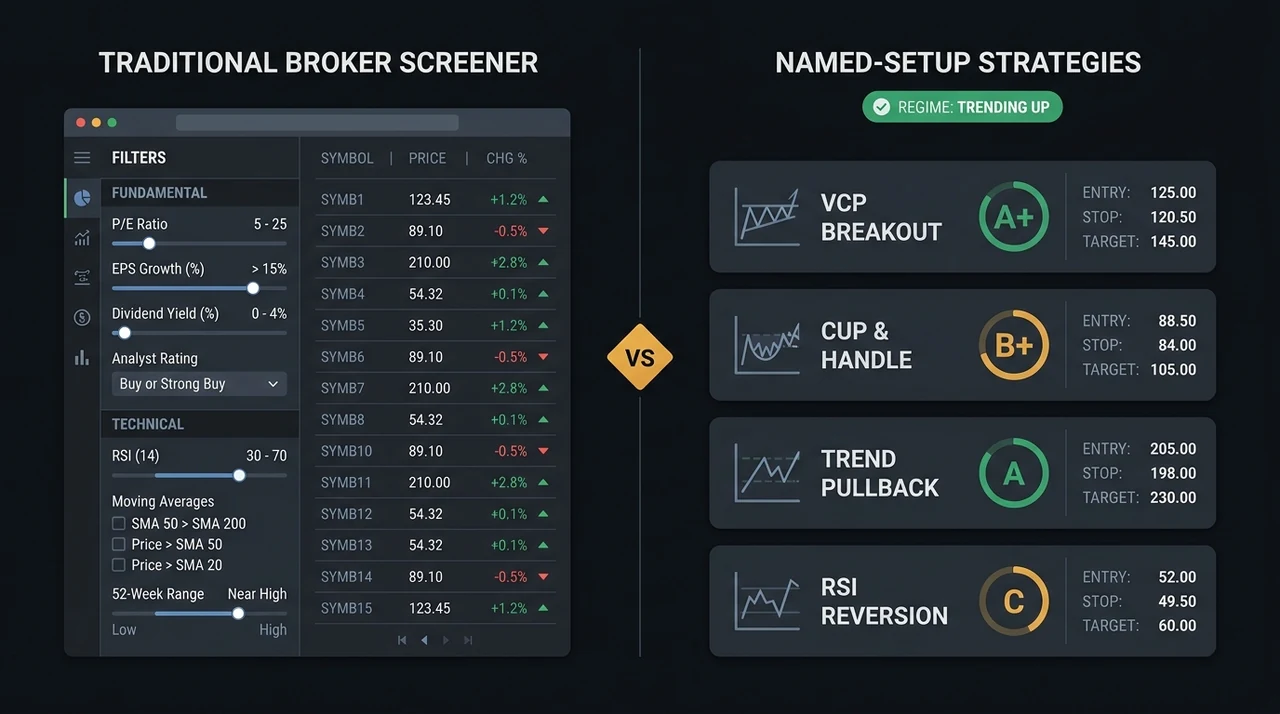
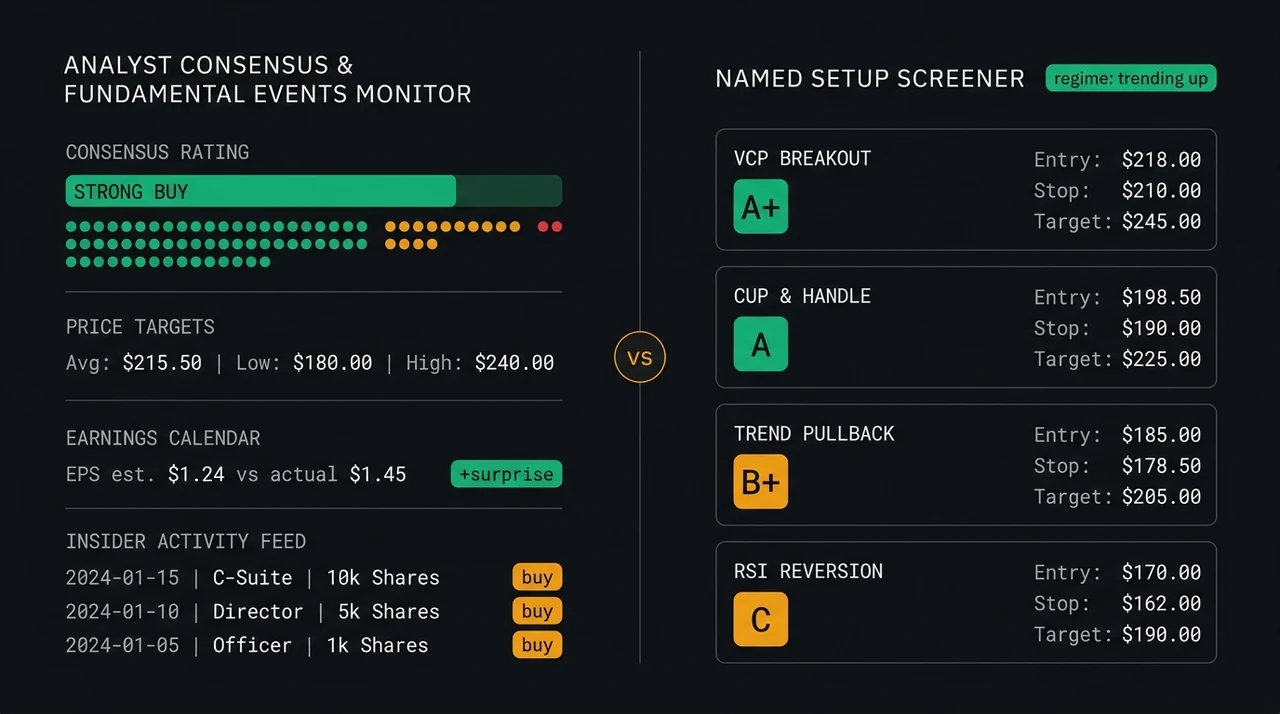
MarketBeat is a financial data and alerts platform covering analyst consensus ratings, earnings estimates, price targets, dividend data, insider transactions, and short interest for US equities — with a Premium tier adding real-time alerts and an expanded screener. EasySwing.trading is a specialized swing trading screener that runs 13 named setup algorithms across 2,000+ US equities after each session close, grades each result A+–C by quality score, and gates every strategy against the current market regime. Both tools surface market information. They are designed for different primary tasks.
The Short Answer
MarketBeat tracks analyst consensus, earnings estimates, dividend yields, and insider activity — alerting subscribers when these change. EasySwing.trading detects named swing trading setups using compound technical pattern analysis, grades each result A+–C by setup quality, and filters every strategy through a five-state market regime engine updated daily. For event-driven fundamental monitoring and consensus alerts, MarketBeat. For pre-calculated technical swing setup shortlists with entry, stop, and target levels, EasySwing.
| Feature | MarketBeat | EasySwing.trading |
|---|---|---|
| Cost | Free (core) / All Access ~$249/yr ($29/mo) | $49/mo ($39/mo annual) |
| Focus | Analyst consensus, earnings, dividends | Swing trading setup detection |
| Named setup detection | No | Yes (13 strategies, multi-layer) |
| Setup quality grading | No | Yes (A+/A/B+/B/C) |
| Market regime filter | No | Yes (5 states, updated daily) |
| Analyst consensus ratings | Yes | No |
| Earnings estimates and surprises | Yes | No |
| Dividend data and alerts | Yes | No |
| Insider transaction tracking | Yes | No |
| Short interest data | Yes | No |
| Pre-calculated risk levels | No | Yes (entry, stop, T1 1.5R, T2 3R) |
| AI coaching per setup | No | Yes (Soren, per-candidate) |
| Alert triggers | Price, analyst change, earnings event | Pattern-triggered (Telegram + email) |
What MarketBeat Offers
MarketBeat aggregates analyst ratings and financial data for thousands of US equities. For any ticker, the platform shows the current consensus rating (Strong Buy through Strong Sell), the distribution of individual analyst ratings, and the change history over the prior 12 months. Premium subscribers receive an alert when a covered analyst upgrades or downgrades a stock.
Earnings coverage. MarketBeat tracks earnings release dates, consensus EPS estimates, and the historical record of how each company has beaten or missed those estimates. The earnings calendar highlights upcoming reports, letting traders check whether a candidate has a scheduled release inside their intended holding period. Post-release, MarketBeat surfaces the reported figure against consensus and the stock's immediate price reaction.
Dividend data. MarketBeat covers yield, ex-dividend date, payment frequency, and multi-year dividend history for income-paying equities. Traders who avoid holding through ex-dates — or who screen specifically for dividend growth — can filter on those fields in the Premium screener.
Insider transactions. MarketBeat aggregates SEC Form 4 filings to surface insider buying and selling at the executive and board level. Cluster buying by multiple insiders, particularly following a price decline, has documented informational content in the academic record. MarketBeat makes this data searchable without manual SEC EDGAR queries.
Short interest data. Short interest as a percentage of float and days-to-cover are updated on MarketBeat's standard reporting cadence, with alerts for significant changes on the Premium tier. Traders tracking heavily shorted names — where a catalyst can produce a rapid squeeze — have a direct data source in one dashboard.
Where MarketBeat Falls Short for Systematic Swing Traders
MarketBeat's primary value is event-driven monitoring: it tracks when an analyst changes their rating, when earnings are imminent, when an insider buys, or when short interest shifts. These are retrospective signals — they document decisions already made by institutional researchers, company insiders, and short sellers. Three structural gaps emerge for traders whose edge is identifying technical setups before momentum extends.
No compound named-setup detection. MarketBeat's screener evaluates filter conditions independently. A stock either shows analyst consensus of Buy or it does not. It either trades above its 50-day moving average or it does not. What the screener cannot evaluate is whether those conditions converge into a specific named setup — a VCP contraction completing at the third pivot, a Cup & Handle base breaking above the prior high, a Trend Pullback to a rising 21-day EMA with RVOL expansion — where the simultaneous convergence of price structure, volume behavior, and relative strength is what defines a high-probability entry point. Mark Minervini documented in Trade Like a Stock Market Wizard (2013) that false breakouts during non-trending markets are one of the primary sources of systematic losses for traders running pattern screens without regime context. Independent filter thresholds cannot capture that distinction.
No quality grading. Every MarketBeat screener result carries equal weight in the output. A stock with an RS rank of 94 in a tight 10-week Stage 2 base with 2.1× RVOL on the entry bar occupies the same list as a stock with an RS rank of 51 in a wide, choppy range on average volume. Both may show a consensus rating of Buy. Which candidate represents a genuinely elevated-probability setup requires individual evaluation of each result — adding time cost and inconsistency across sessions.
No market regime filter. MarketBeat returns analyst ratings and screener results independent of the current index environment. In a confirmed correction or high-volatility period, the same analyst upgrades and breakout screener results appear as during a confirmed uptrend — because neither index breadth, VIX, nor trend structure affect the screener's output. Assessing regime context falls entirely to the trader before acting on any result.
For a systematic framework on incorporating regime context into setup selection, see Market Regime: Bull, Bear, and Choppy Markets Explained.
What EasySwing.trading Does Differently
EasySwing.trading runs 13 named strategy algorithms across 2,000+ US equities after each session close. Each algorithm evaluates conditions in sequence — Stage 2 trend structure, relative strength rank above the strategy's minimum threshold, volume behavior during base formation, named pattern formation confirmed, and market regime compatibility — and surfaces a result only when all conditions are simultaneously met. Passing candidates receive a letter grade (A+–C), a composite score, and pre-calculated entry price, stop-loss, and two profit targets.
The five-tier grade reflects a composite score weighted across five quality dimensions:
| Dimension | Weight |
|---|---|
| Regime alignment | 30% |
| Pattern confirmation | 25% |
| Multi-condition confluence | 20% |
| Relative strength rank | 15% |
| Volume confirmation | 10% |
A result graded A+ means regime is Trending Up, the named pattern is confirmed at the formation level, all supporting confluence conditions pass, RS rank exceeds the strategy's minimum (typically RS 85+), and volume behavior matches the historical pattern associated with high-probability follow-through. A result graded C cleared the entry criteria but carries partial regime alignment, softer confluence, or below-expected volume confirmation.
Every result includes a pre-calculated entry price (the trigger level for the specific setup), a stop-loss placed below the pattern's defining low, and two profit targets: Target 1 at 1.5R and Target 2 at 3R derived from the entry-to-stop distance. For how that risk framework converts into position size, see position sizing with R-multiples.
Market Regime Filtering
EasySwing.trading classifies the current market into five states — Trending Up, Trending Down, Ranging, High Volatility, and Transitioning — based on index breadth, VIX level, ADX reading, and S&P 500 price structure. That classification is updated after each session close, and each of the 13 strategies is gated against the current state. Breakout strategies surface with full conviction in Trending Up; mean reversion setups are promoted in Ranging; conviction grades compress in High Volatility and Trending Down environments where breakout follow-through is historically weak.
Jegadeesh and Titman (Journal of Finance, 1993) documented that price momentum edge is not unconditional — it compresses in adverse market environments and requires quality filtering to sustain. Andreas Clenow reinforced this directly in Stocks on the Move (2015): his momentum framework takes new long positions only when the S&P 500 trades above its 200-day moving average, because momentum systems that ignore the index environment record their largest drawdowns during corrections and bear markets.
MarketBeat has no equivalent gate. It surfaces analyst ratings and screener results regardless of whether the S&P 500 is trending, ranging, or correcting. EasySwing.trading makes that regime judgment automatic, applying it to every strategy's output before each session's candidates are finalized.
Where MarketBeat Has the Advantage
MarketBeat covers areas outside EasySwing.trading's scope and handles them at a depth few tools match.
Analyst consensus and price targets. MarketBeat aggregates individual analyst ratings and price targets from major research firms into a consensus view updated in real time. Traders who cross-reference technical setups against institutional opinion — checking whether consensus is a tailwind before adding to a watchlist — have a direct, clean source in MarketBeat. EasySwing.trading does not include analyst data.
Earnings and event coverage. MarketBeat's earnings calendar, EPS surprise tracking, and pre-earnings sentiment have no equivalent in EasySwing.trading. Traders who check whether a setup candidate has a scheduled earnings release inside the intended 5–20 day holding period need a dedicated earnings calendar. MarketBeat provides it on the free tier.
Dividend and income screening. MarketBeat's dividend data depth — yield, growth rate, coverage ratio, ex-date, and 10-year payout history — is a genuine advantage for traders who run an income portfolio alongside swing positions. EasySwing.trading is designed for technical price-based swing setups and does not include dividend screens.
Insider activity tracking. Cluster buying by company insiders following a price decline is a signal documented in the academic literature; MarketBeat surfaces it cleanly without requiring manual Form 4 tracking. EasySwing.trading does not aggregate insider transaction data.
Free-tier access. MarketBeat's core features — analyst consensus, earnings calendar, insider transactions, and basic screener — are available free to any registered user. For traders not ready to pay for a specialized swing setup tool, MarketBeat's free tier provides meaningful analytical value.
Which Tool Fits Your Session
MarketBeat and EasySwing.trading solve adjacent but different problems. MarketBeat monitors the fundamental and news environment around existing positions and watchlist names. EasySwing.trading generates the shortlist of technically confirmed setup candidates for the session, graded and regime-filtered before the open. The choice depends on where your primary unmet need sits.
Use MarketBeat when you:
- ✅Need analyst consensus ratings and upgrade/downgrade alerts before the move
- ✅Track earnings release dates, EPS estimates, and surprise history in one view
- ✅Screen for dividend income, coverage ratios, or avoid stocks going ex-dividend
- ✅Monitor insider buying as a secondary confirmation signal
- ✅Track short interest data on existing or watchlisted names
- ✅Want a free-tier starting point for fundamental context without subscription cost
Consider EasySwing.trading when you:
- ❌Want pre-identified named setups — VCP, Cup & Handle, Trend Pullback — rather than independent filter results or analyst aggregates
- ❌Need quality ranking (A+/A/B+/B/C) to prioritize candidates without reviewing 100+ results each session
- ❌Rely on a five-state market regime filter to avoid running breakout screens during corrections
- ❌Want pre-calculated entry price, stop-loss, and two profit targets on every result
- ❌Use Soren's per-candidate coaching to understand pattern context before adding to your watchlist
| Use Case | MarketBeat | EasySwing.trading |
|---|---|---|
| Analyst consensus and price targets | ✅ | ❌ |
| Earnings calendar and EPS surprise | ✅ | ❌ |
| Dividend and income screening | ✅ | ❌ |
| Insider transaction monitoring | ✅ | ❌ |
| Named swing setup detection | ❌ | ✅ |
| Quality grading (A+–C) | ❌ | ✅ |
| Five-state market regime filter | ❌ | ✅ |
| Pre-calculated entry, stop, and targets | ❌ | ✅ |
| Free core access | ✅ | ❌ |
Many systematic traders run both sequentially: MarketBeat to check analyst consensus and scheduled earnings on existing watchlist names, then EasySwing.trading to generate the session's technically confirmed A+/A-graded setup candidates. MarketBeat provides the fundamental context; EasySwing.trading provides the technical timing. For the full list of named strategies EasySwing.trading detects and grades each session, see the swing trading strategies guide.
EasySwing.trading screens for named swing trading setups automatically across 2,000+ US equities each session. For more on how the five-state regime engine gates strategy selection, see Market Regime: Bull, Bear, and Choppy Markets. For the setup library and grading criteria, see the swing trading strategies guide. Comparing other tools? See EasySwing vs Barchart and EasySwing vs Webull. Scan results are for informational purposes only. See our Risk Disclaimer.
Frequently Asked Questions
Does MarketBeat have a stock screener?
MarketBeat includes a stock screener on its Premium (All Access) tier with filters for fundamental metrics (P/E, EPS growth, dividend yield, market cap), technical conditions (moving average position, RSI range), analyst consensus, and short interest. The free tier provides limited screener access. However, MarketBeat's screener does not detect named swing trading setups (VCP, Cup & Handle, Trend Pullback) or apply a market regime filter to adjust which strategies are active based on the current index environment.
Can MarketBeat detect VCP or Bull Flag patterns?
MarketBeat does not include named swing trading setup detection for VCP (Volatility Contraction Pattern) or Bull Flag patterns as defined by Minervini or O'Neil. It can filter for stocks near 52-week highs with above-average volume — conditions that may accompany those setups — but it does not evaluate the multi-condition convergence (Stage 2 structure, RS rank, volume contraction during base, regime compatibility) that defines a high-probability named setup.
How does MarketBeat compare to EasySwing.trading for swing trading?
MarketBeat is primarily an analyst consensus, earnings, and dividend monitoring platform with screening capabilities. EasySwing.trading is a purpose-built swing trading screener that detects 13 named setup patterns with A+–C quality grading and five-state market regime filtering. If your primary need is pre-sorted, pre-graded swing setup candidates with entry/stop/target levels, EasySwing.trading provides that output directly. If you also need analyst consensus, earnings dates, or dividend data, MarketBeat covers those adjacent needs.
What is MarketBeat All Access and how much does it cost?
MarketBeat All Access is the premium subscription tier that adds real-time analyst rating alerts, full historical earnings data, advanced screener filters, short interest data, and ad-free access. Pricing is approximately $249 per year (or $29 per month). The free tier covers analyst consensus ratings, basic earnings data, dividend information, and limited screener access — providing meaningful value before committing to a paid plan.
Can I use MarketBeat and EasySwing.trading together?
Yes — the two tools complement each other at different stages of the workflow. Many traders use MarketBeat to check analyst consensus, upcoming earnings dates, and insider activity on names already in their watchlist, then cross-reference with EasySwing.trading to see whether any of those names also appear as A+/A-graded named setups in the current market regime. MarketBeat provides fundamental context; EasySwing.trading provides technical entry timing.
Disclaimer: This article is for educational purposes only and does not constitute investment advice. EasySwing is a stock screening tool, not a registered investment advisor. All trading involves risk. Read our full disclaimer →