EasySwing vs Barchart: Which Screener Fits Swing Traders?
Narasimhan Jegadeesh and Sheridan Titman's landmark study (Journal of Finance, 1993) found that stocks in the top decile of prior-year price performance delivered 12.01% annualized excess returns in the following year — but that edge was not unconditional. It compressed in adverse market environments and disappeared almost entirely when applied without any quality filter. The implication: momentum-based selection depends as much on the conditions under which you act as on the signal itself.
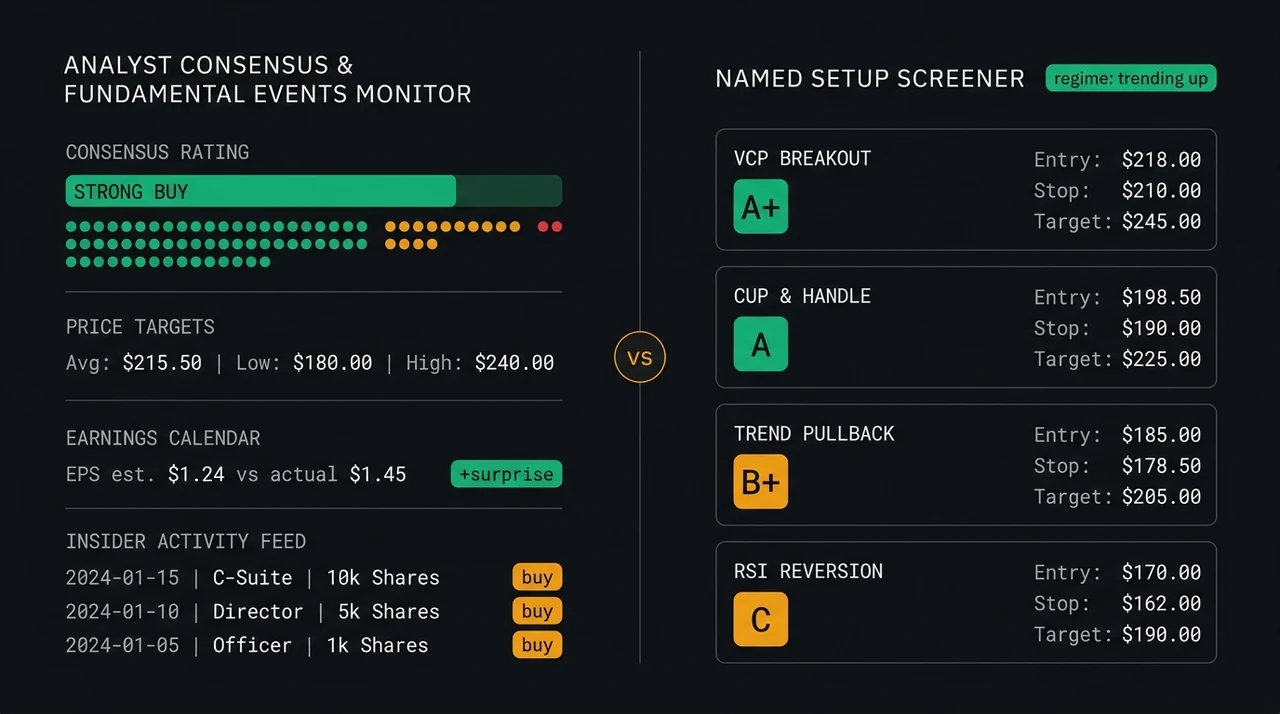
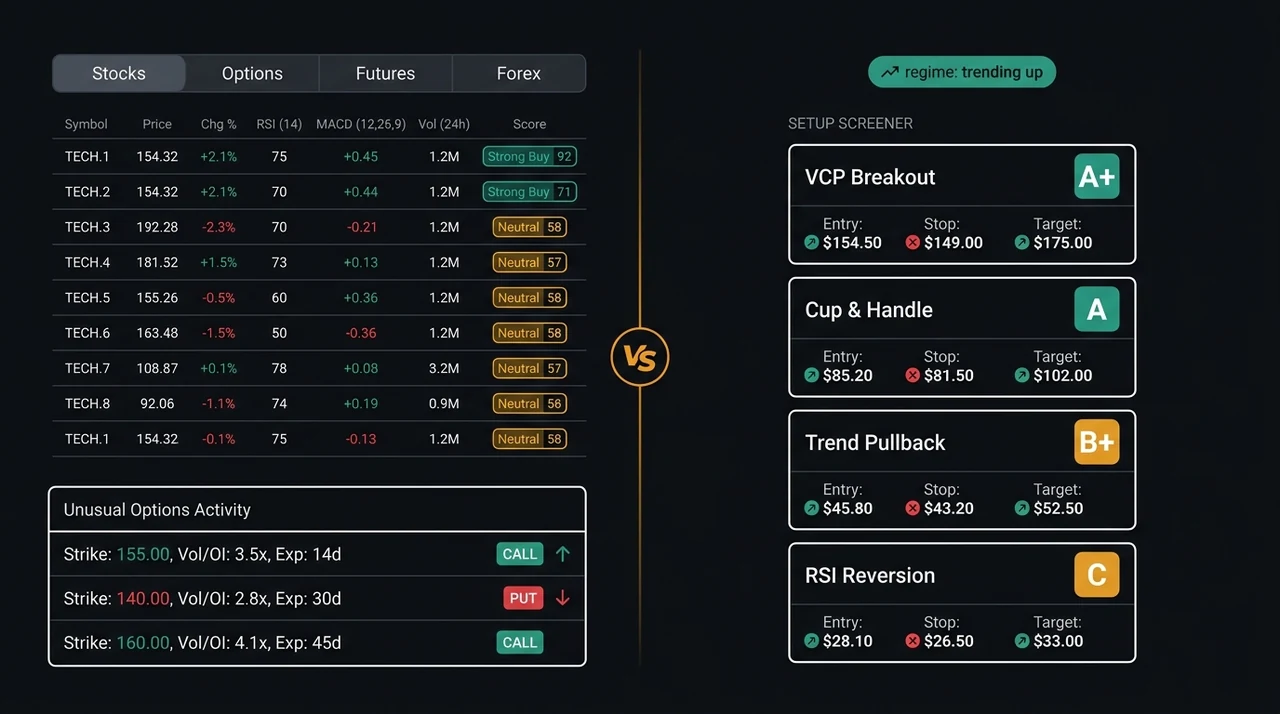
Barchart.com is a widely used market data platform offering real-time quotes, charts, and a technical screener for US stocks, ETFs, options, equity futures, commodity futures, and forex — with a free-tier account covering the core features. EasySwing.trading is a specialized swing trading screener that detects 13 named setup patterns across US equities, grades each result A+/A/B+/B/C by quality score, and applies a five-state market regime filter automatically after each session close. Both tools surface market data. They are designed for different tasks.
The Short Answer
Barchart provides free technical screening across stocks, options, futures, and forex — with 100+ filter criteria and proprietary Barchart Opinions ratings aggregating 13 directional signals into a 0–100 composite. EasySwing.trading detects 13 named swing trading setups, grades each result A+–C by quality, and gates every strategy against the current market regime. For broad multi-asset data coverage, Barchart. For a pre-sorted swing setup shortlist with entry, stop, and target levels ready before the open, EasySwing.
| Feature | Barchart | EasySwing.trading |
|---|---|---|
| Cost | Free (core) / $19.99–$99.99/mo (premium) | $49/mo ($39/mo annual) |
| Asset classes | Stocks, ETFs, options, futures, forex | US equities ($200M–$20B market cap) |
| Named setup detection | No | Yes (13 strategies, multi-layer) |
| Setup quality grading | No | Yes (A+/A/B+/B/C) |
| Market regime filter | No | Yes (5 states, updated daily) |
| Filter criteria | 100+ technical + fundamental | No raw filter mode |
| Options flow and OI data | Yes (premium tier) | No |
| Real-time streaming | Yes (premium tier) | No (EOD scan + 2pm ET update) |
| Pre-calculated risk levels | No | Yes (entry, stop, T1 1.5R, T2 3R) |
| AI coaching per setup | No | Yes (Soren, per-candidate) |
| Strategy-specific alerts | Basic price/indicator alerts | Yes (Telegram, email, setup-gated) |
| Barchart Opinions composite | Yes (0–100) | No |
What Barchart's Screener Offers
Barchart's screener filters stocks by technical indicators, fundamental metrics, and its proprietary Barchart Opinions rating — a 0–100 score aggregating 13 directional signals across short-, medium-, and long-term timeframes. Free-account users access the core screener for US stocks, ETFs, and a subset of options and futures contracts. Premium subscriptions ($19.99–$99.99/month) add real-time data feeds, unusual options activity alerts, and extended historical coverage.
Technical filter depth. Barchart's screener covers the indicators most swing traders use for a first pass: RSI (14-day), MACD signal-line crossovers, Bollinger Band width and position, ATR-adjusted range, relative volume against the 30-day average, EMA crossovers at standard periods (5, 10, 20, 50, 200-day), and 52-week high/low proximity. Fundamental filters include P/E, P/B, P/S, forward EPS estimates, revenue growth, and market cap tiers. The combination supports a standard two-step process: filter by technical condition, then apply a fundamental check.
Barchart Opinions. Barchart's proprietary composite aggregates 13 short-, medium-, and long-term technical indicators into a single 0–100 score. Each indicator votes Buy, Hold, or Sell, and the consensus across all 13 produces a rating: Strong Sell (0–24), Sell (25–49), Hold (50–74), Buy (75–89), or Strong Buy (90–100). Traders use the Opinion as a speed filter — a "Strong Buy with above-average volume" screen produces technically confirming names without building each condition from scratch. It is a directional composite, not a compound setup evaluator.
Multi-asset breadth. Barchart covers US equities and ETFs alongside equity index futures (ES, NQ, RTY), commodity futures (crude oil, gold, natural gas, agricultural contracts), forex pairs, and cryptocurrency. For traders who monitor crude oil or bond futures as macro context for equity setups — or who run options strategies alongside swing trades — a single platform covering multiple asset classes reduces tool-switching across a session.
Where Barchart Falls Short for Systematic Swing Traders
Barchart returns every stock clearing selected filter thresholds. It does not evaluate whether those conditions converge into a specific named setup with historically favorable follow-through probability. There is no compound pattern logic, no quality ranking by relative strength and setup tightness, and no market regime filter that adjusts which strategies are active based on the current index environment.
No compound named-setup logic. Barchart's screener evaluates filter conditions independently. A stock either has RSI below 40 or it does not. It either trades above its 50-day moving average or it does not. What the screener cannot evaluate is whether those conditions converge into a specific named setup — a VCP, Cup & Handle base, or Trend Pullback to a rising 21-day EMA — where the simultaneous convergence of conditions is what produces the edge. Mark Minervini documented in Trade Like a Stock Market Wizard (2013) that false breakouts during non-trending markets are one of the primary sources of systematic losses for traders who run pattern screens without regime context. A screener returning any stock that clears three filters independently cannot catch that distinction.
No quality grading. Every Barchart screener result appears equally in the output. A stock with an RS rank of 95 in a tight 7-week Stage 2 base with 1.8× RVOL on the breakout bar occupies the same unranked list as a stock with an RS rank of 48 in a wide, choppy consolidation with average volume. Both cleared the same filter thresholds. Which candidate represents a high-probability setup requires the trader to evaluate each result individually — adding time cost and inconsistency to the selection process across sessions.
No market regime filter. Barchart displays market data. It does not classify the current index environment or adjust which strategy signals it surfaces based on whether the S&P 500 is trending up, ranging, or correcting. In a high-volatility correction, Barchart returns the same volume of breakout and continuation screens as it does during a confirmed uptrend — because the filter conditions are unchanged by the market environment. The trader must assess regime context independently before acting on any result.
For a systematic framework for applying regime awareness to your setup selection process, see Market Regime: Bull, Bear, and Choppy Markets Explained.
What EasySwing.trading Does Differently
EasySwing.trading runs 13 named strategy algorithms across 2,000+ US equities after each session close. Each algorithm evaluates conditions in sequence — Stage 2 trend structure, relative strength rank above the strategy's minimum threshold, volume behavior during base formation, named pattern formation confirmed, and market regime compatibility — and surfaces a result only when all conditions are simultaneously met. Passing candidates receive a letter grade (A+–C), a composite score, and pre-calculated entry price, stop-loss, and two profit targets.
The five-tier grade reflects a composite score weighted across five quality dimensions:
| Dimension | Weight |
|---|---|
| Regime alignment | 30% |
| Pattern confirmation | 25% |
| Multi-condition confluence | 20% |
| Relative strength rank | 15% |
| Volume confirmation | 10% |
A result graded A+ means regime is Trending Up, the named pattern is confirmed at the formation level, all supporting confluence conditions pass, RS rank exceeds the strategy's minimum (typically RS 85+), and volume behavior matches the historical pattern associated with high-probability follow-through. A result graded C cleared the entry criteria but carries partial regime alignment, softer confluence, or below-expected volume confirmation.
Every result includes a pre-calculated entry price (the trigger level for the specific setup), a stop-loss placed below the pattern's defining low, and two profit targets: Target 1 at 1.5R and Target 2 at 3R derived from the entry-to-stop distance. For how that risk framework translates into position size, see position sizing with R-multiples.
Market Regime Filtering
EasySwing.trading classifies the current market into five states — Trending Up, Trending Down, Ranging, High Volatility, and Transitioning — based on index breadth, VIX level, ADX reading, and S&P 500 price structure. That classification is updated after each session close, and each of the 13 strategies is gated against the current state. Breakout strategies surface with full conviction in Trending Up; mean reversion setups are promoted in Ranging; conviction grades compress in High Volatility and Trending Down environments where breakout follow-through is historically weak.
Andreas Clenow documented this principle directly in Stocks on the Move (2015): his momentum framework takes new long positions only when the S&P 500 trades above its 200-day moving average, because momentum systems that ignore the index environment record their largest drawdowns during corrections and bear markets. The macro environment, not the individual setup, drives that variance.
Barchart has no equivalent. In a confirmed correction, Barchart returns the same volume of breakout screens as it does in a bull phase — because the filter conditions do not change with market environment. EasySwing.trading makes that regime judgment automatic: each post-session update re-classifies the environment, re-applies the strategy gates, and adjusts conviction grades before the candidate list is finalized. The session output reflects both setup quality and current market context in a single view.
Where Barchart Has the Advantage
For multi-asset data access, Barchart provides capabilities outside EasySwing.trading's scope. Traders who overlay unusual options activity onto equity selections, monitor commodity futures for macro context, or need real-time intraday streaming for active management will find Barchart's broader coverage and free-tier access genuinely useful for those specific tasks.
Options flow and open interest. Barchart's premium tier surfaces real-time unusual options activity: large block trades by strike and expiration, volume-to-open-interest anomalies, and put/call flow by contract. For traders who use options order flow as a secondary signal on equity setups — a large call sweep at a specific strike before a breakout, for example — Barchart's options data is a distinct advantage. EasySwing.trading does not include options data.
Futures and forex coverage. Barchart provides real-time and historical data for equity index futures (ES, NQ), commodity futures (crude oil, gold, natural gas), and forex pairs. Traders who track crude oil or bond futures as macro context for equity sector rotation can access those feeds in the same platform as their equity screens. EasySwing.trading operates exclusively on US equities and does not cover futures, forex, or commodities.
Free-tier access. Barchart's core screener is free to any account holder. For traders who want a broad initial pass at zero incremental cost — before applying a specialized tool to a smaller shortlist — Barchart fills that role without requiring a paid subscription. Premium tiers also include real-time streaming, which matters for traders managing intraday entries rather than working from end-of-day data.
Which Tool Fits Your Session
Barchart and EasySwing.trading solve adjacent problems in the systematic trading workflow. Barchart surfaces raw data across asset classes; EasySwing.trading synthesizes equities data into pre-qualified swing trading candidates with quality grades and regime context built in. The right choice depends on where your primary unmet need sits.
Use Barchart when you:
- ✅Need options flow, unusual activity, or open interest data alongside equity screening
- ✅Run multi-asset analysis — equities, futures, forex in one dashboard
- ✅Want real-time streaming quotes or intraday scanning capability
- ✅Prefer a free starting point for broad technical screening across US equities
- ✅Use Barchart Opinions as a quick directional composite for momentum or event-driven plays
Consider EasySwing.trading when you:
- ❌Want pre-identified named setups — VCP, Cup & Handle, Trend Pullback — rather than a list of stocks clearing independent filter thresholds
- ❌Need quality ranking (A+/A/B+/B/C) to prioritize candidates without reviewing 100+ results manually each session
- ❌Rely on a five-state market regime filter to avoid running breakout screens during corrections
- ❌Want pre-calculated entry price, stop-loss, and two profit targets on every result
- ❌Use Soren's per-candidate coaching to understand context and position sizing before adding to your watchlist
| Use Case | Barchart | EasySwing.trading |
|---|---|---|
| Broad technical + fundamental filtering | ✅ | ❌ |
| Options flow and unusual activity | ✅ | ❌ |
| Futures and forex data | ✅ | ❌ |
| Named swing setup detection | ❌ | ✅ |
| Quality grading (A+–C) | ❌ | ✅ |
| Five-state market regime filter | ❌ | ✅ |
| Pre-calculated entry, stop, and targets | ❌ | ✅ |
| Free core access | ✅ | ❌ |
Many systematic traders run both sequentially: a Barchart broad screen to surface technically active names and assess sector context, followed by an EasySwing check to see whether any overlap with current A+/A-graded named setups in the right regime. For the full list of named strategies EasySwing detects and grades each session, see the swing trading strategies guide.
EasySwing.trading screens for named swing trading setups automatically across 2,000+ US equities each session. For more on how the five-state regime engine gates strategy selection, see Market Regime: Bull, Bear, and Choppy Markets. For the setup library and grading criteria, see the swing trading strategies guide. Comparing other tools? See EasySwing vs Webull and EasySwing vs Schwab. Scan results are for informational purposes only. See our Risk Disclaimer.
Frequently Asked Questions
Does Barchart have a swing trading screener?
Barchart includes a technical screener with 100+ filter criteria covering RSI, MACD, moving averages, volume, and fundamental metrics. It also offers a proprietary Barchart Opinions composite (0–100) aggregating 13 technical signals. However, Barchart does not detect named swing trading setups (VCP, Cup & Handle, Trend Pullback) or apply a market regime filter to adjust which strategies are active based on the current index environment.
How does Barchart Opinions compare to EasySwing's grading system?
Barchart Opinions aggregates 13 technical indicators into a directional composite score (0–100) for any single ticker. EasySwing's A+/A/B+/B/C grade reflects a compound evaluation of a specific named setup: regime alignment (30%), pattern confirmation (25%), multi-condition confluence (20%), RS rank (15%), and volume confirmation (10%). Barchart Opinions is a quick directional filter; EasySwing's grade is a setup quality score within a defined strategy context.
Can Barchart detect VCP or Bull Flag patterns?
Barchart's screener does not include named swing trading setup detection for VCP (Volatility Contraction Pattern) or Bull Flag patterns as defined by Minervini or O'Neil. It can filter for stocks near 52-week highs with above-average volume — conditions that may accompany those setups — but it does not evaluate the multi-condition convergence (Stage 2 structure, RS rank, volume contraction during base, regime compatibility) that defines a high-probability named setup.
Is EasySwing.trading better than Barchart for swing trading?
For detecting specific named swing trading setups with quality grading and market regime filtering, EasySwing.trading is purpose-built for that workflow in a way Barchart is not. Barchart's advantage is its multi-asset coverage (options flow, futures, forex) and free-tier access. If your primary need is a pre-sorted, pre-graded daily swing setup shortlist with entry/stop/target levels, EasySwing.trading provides that output directly. If you also need options data or futures feeds, Barchart fills those adjacent needs.
Can I use Barchart and EasySwing.trading together?
Yes — the two tools complement each other at different stages of the workflow. Many traders use Barchart for a broad technical first pass, options flow context, and macro data (futures, VIX), then cross-reference with EasySwing to see whether any names that surfaced in Barchart also appear as A+/A-graded named setups in the current regime. EasySwing's named-setup detection and Barchart's multi-asset coverage address non-overlapping parts of the research process.
Disclaimer: This article is for educational purposes only and does not constitute investment advice. EasySwing is a stock screening tool, not a registered investment advisor. All trading involves risk. Read our full disclaimer →