Swing Trading with a Small Account: Position Sizing
Barber and Odean (The Journal of Finance, 2000) found that the most active quintile of retail traders underperformed the market by 6.5% annually — partly from transaction costs that compound faster in smaller accounts where each round trip represents a larger percentage of capital. The position sizing math is where small accounts either survive or erode.
The practical minimum for systematic swing trading with proper risk management is $10,000. Below this threshold, the 1% risk rule produces positions too concentrated to diversify and too small to trade most quality setups without excessive concentration risk. Above it, the capital constraint shapes your setup selection — which is the right framework for any systematic trader.
How Position Sizing Math Defines Your Stock Universe
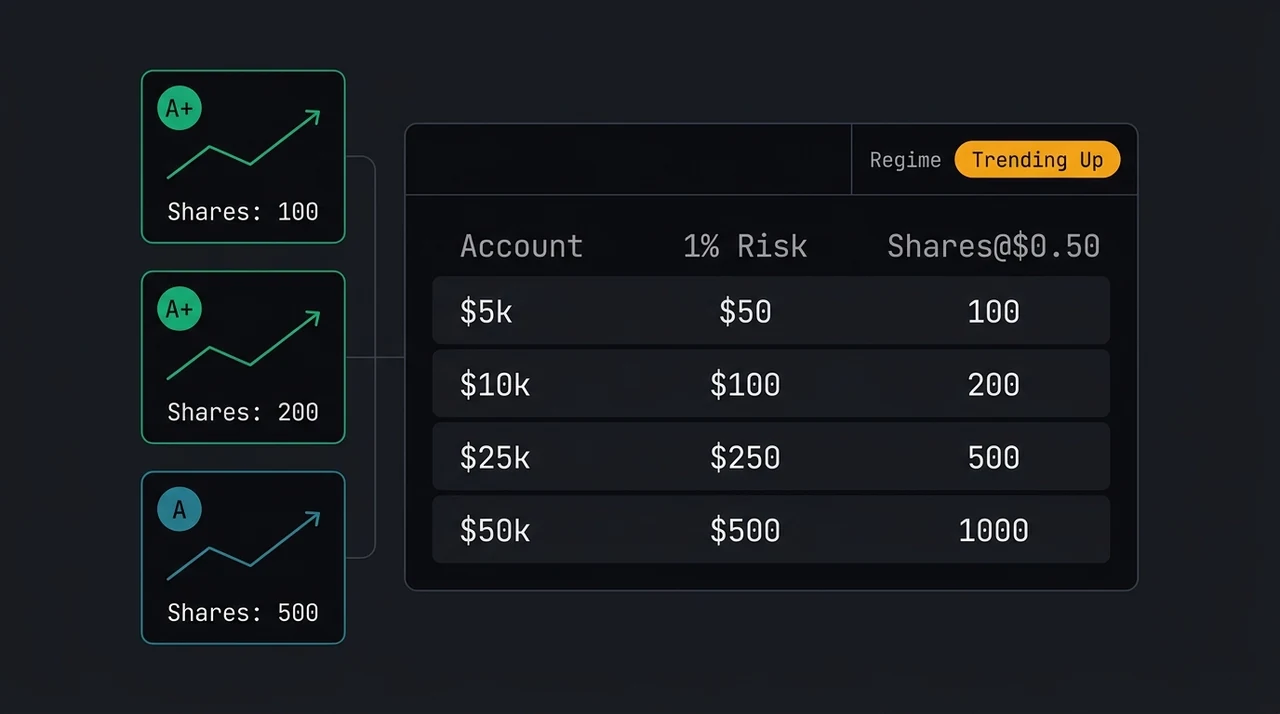
The 1% risk rule limits each position to 1% of total account value as maximum potential loss. At a $0.50 stop, a $10,000 account allows 200 shares per position. That position math — not the chart pattern — defines which stocks you can trade, making position sizing the first filter, not the last.
Van Tharp, in Trade Your Way to Financial Freedom (2006), identified position sizing as the primary determinant of long-term trading results after reviewing hundreds of trader accounts: "Position sizing — how much you put on each trade — is the most crucial factor determining your overall results. More traders have been ruined by poor position sizing than by bad market judgment."
At different account sizes, the 1% risk constraint produces dramatically different position structures:
| Account Size | 1% Risk ($) | Shares at $0.25 Stop | Shares at $0.50 Stop | Shares at $1.00 Stop |
|---|---|---|---|---|
| $5,000 | $50 | 200 | 100 | 50 |
| $10,000 | $100 | 400 | 200 | 100 |
| $25,000 | $250 | 1,000 | 500 | 250 |
| $50,000 | $500 | 2,000 | 1,000 | 500 |
The implications appear immediately. A $5,000 account with a $50 risk budget can hold 100 shares at a $0.50 stop. In a $20 stock, 100 shares is a $2,000 position — 40% of the entire account in one trade. Add two more positions and the account is fully deployed with zero buffer for adverse moves. At a $10,000 account, the same $0.50 stop produces 200 shares in a $20 stock — $4,000 per position, or 40% of account. Still concentrated, but workable with stock selection that keeps position sizes in the 20%–25% range per trade.
The practical upshot: your stock selection universe for a $10,000 account is stocks priced $5–$25 with stop distances of $0.25–$1.00. Everything outside that range either requires too much risk per trade or produces positions too small to compound meaningfully.
The Three-Position Rule: Why $10,000 Is the Practical Floor
Holding 3 simultaneous positions at 1% risk each places 3% of capital at risk at any moment. For a $10,000 account, three positions at 1% risk requires each position to be $1,500–$2,500 in market value — achievable in stocks priced $5–$25 with stops of $0.25–$0.75.
The three-position model provides enough diversification to absorb one losing position without catastrophic drawdown while keeping capital concentrated enough to generate meaningful returns. Spreading a $10,000 account across seven or eight positions reduces each to irrelevance — positions too small to compound into significant gains even when right.
For a $5,000 account, three simultaneous positions at these constraints becomes near-impossible. At $50 risk per trade, each position at a $0.50 stop is 100 shares — $1,000–$1,500 per position, already 20%–30% of account in one trade. The math allows two positions at most, not three. A $5,000 account realistically holds one position at a time with full risk discipline.
That is the practical floor argument. A $10,000 account can hold three positions while maintaining 1% risk and keeping each position below 25% of capital. A $5,000 account cannot do both simultaneously. The $10,000 threshold is not arbitrary — it is where the three-position rule becomes executable.
Stock Selection Criteria for Small Accounts
Small account stock selection requires matching the technical stop distance to the position size math. A stock priced $8–$25 with a $0.25–$0.75 stop produces a 100–400-share position in a $10,000 account at 1% risk — the practical universe for accounts under $25,000.
Three selection parameters apply specifically to small accounts:
Price range $5–$30. Stocks below $5 carry elevated spread costs, fragmented share structure, and liquidity gaps that magnify entry and exit slippage. At 200 shares, a $0.05 bid-ask spread costs $10 per round trip — already 10% of the $100 risk budget on a $10,000 account. Stocks above $30 produce positions too concentrated for accounts under $15,000 without violating the three-position rule.
ATR as a volatility pre-filter. After identifying a setup, calculate the 14-day average true range. A VCP setup with a 2.00 ATR may require a $1.50–$2.00 stop below the pivot. At a $2.00 stop and $100 risk, the math allows only 50 shares — a $1,000 position in a $20 stock, or 10% of account. Positions that small fail to compound at meaningful rates even when correct. For $10,000 accounts, avoid setups where the correct technical stop requires more than $1.00 in distance.
Volume floor. A 200-share position in a stock with average daily volume of 100,000 shares represents 0.2% of daily turnover — manageable for fills. The real constraint is spread cost. A $0.05 spread on 200 shares is $10 per round trip — an invisible 10% drag on the risk budget that erodes edge over time. Stocks with average daily volume above 400,000 shares and typical spreads below $0.03 avoid this drag.
Stan Weinstein, in Secrets for Profiting in Bull and Bear Markets (1988), addressed the underlying principle: "The size of your positions must be determined by your risk tolerance and account size, not by the number of shares you want to own. Greed is what makes traders size up past what their account can safely absorb."
The EasySwing.trading screener surfaces stocks with elevated relative strength (RS rank 90+), Stage 2 trend structure, and confirmed setup patterns. The A+/A/B+/B/C quality grading allows small-account traders to concentrate only on the highest-grade setups — where risk/reward is most favorable and probability is highest. For a $10,000 account where each position counts, filtering to A+ and A setups only removes the marginal plays that consume capital without compensating edge.
How Market Regime Protects Small Accounts More Than Large Ones
A 20% drawdown in a $10,000 account leaves $8,000 requiring a 25% gain to recover — not 20%. This asymmetry makes regime filtering more critical for small accounts than large ones. Trading momentum setups during Ranging, Trending Down, or High Volatility regimes compounds losses faster than any individual bad setup decision.
Jegadeesh and Titman (Journal of Finance, 1993) documented that momentum-based strategies generate approximately 12% annualized excess returns in favorable market conditions, but underperform in non-trending regimes. For systematic swing traders, entering during unfavorable regimes does not just reduce returns — it accelerates drawdown toward the minimum where the account loses the ability to diversify across three positions.
Clenow, in Stocks on the Move (2015), showed that momentum systems taking new longs only when the S&P 500 is above its 200-day moving average substantially reduce drawdown while preserving the majority of upside returns. The regime gate is not an optional enhancement for small accounts — it is drawdown insurance the account cannot afford to skip.
The practical rule for accounts under $25,000: in Ranging, Trending Down, or High Volatility regimes, move to cash or hold the single best existing position only. No new entries. The compounding math from losses avoided outweighs the gains missed from entry timing in all but exceptional markets. For a deeper look at regime identification, see market regime: how to read bull, bear, and choppy markets.
The Compounding Path: From Small to Sustainable Capital
At 15% annual returns, a $10,000 account doubles to $20,000 in roughly 5 years and reaches $50,000 in approximately 12 years. The first objective for small accounts is not income extraction — it is capital growth. Withdrawing profits from a $10,000 account removes the compounding power needed to reach the capital tier where income becomes realistic.
Realistic compounding projections for systematic swing traders:
| Starting Capital | Annual Return | Years to $25k | Years to $50k | Years to $100k |
|---|---|---|---|---|
| $5,000 | 15% | 11 | 18 | 25 |
| $10,000 | 15% | 6.5 | 12 | 18 |
| $10,000 | 20% | 5 | 9 | 13 |
| $25,000 | 20% | — | 4.5 | 8 |
Two conclusions emerge immediately. Starting with $25,000 instead of $10,000 compresses the timeline dramatically — primarily because larger accounts can hold more simultaneous positions, which compounds faster when a strategy has positive expectancy. Increasing annual returns from 15% to 20% saves several years, but that improvement must come from better setup selection or execution consistency, not from increasing risk per trade.
Minervini addressed the early capital-building phase in Trade Like a Stock Market Wizard (2013): "In my early years, I focused entirely on building methodology and the capital base. Trying to extract income from a small account is how most traders remain small. The compounding story does not start until the account reaches critical mass."
The practical implication: treat years one and two as a tuition period. Capital preservation — staying near breakeven while building consistent execution — is a genuine success in the first year. A 10% gain in a difficult market is a better performance metric than absolute dollars for small accounts.
For the full R-multiple framework and expectancy calculations, see position sizing with R-multiples. For the capital requirements needed to generate sustainable income, see can you make a living swing trading.
Small Account Setup Checklist
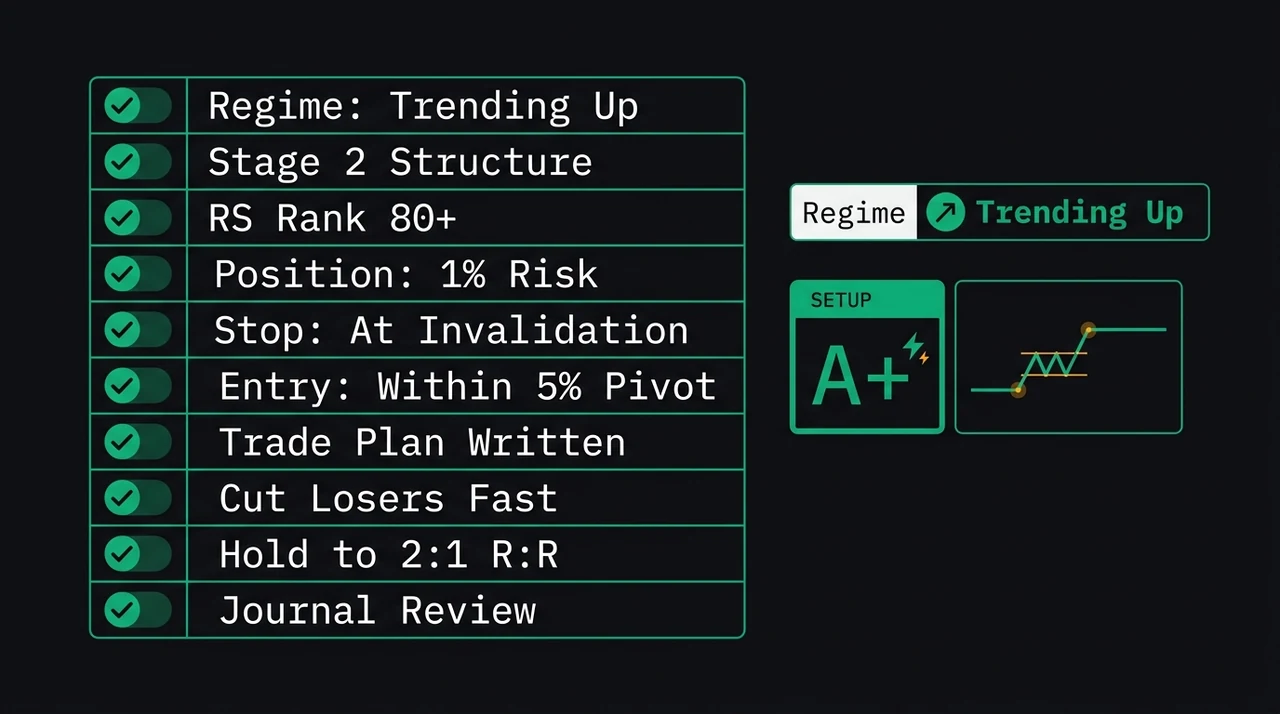
Before entering any position from a $5,000–$25,000 account, verify all of the following:
- ✅1% risk verified: (stop distance in $) × (shares) ≤ 1% of account value
- ✅Position size: 15%–25% of account value per trade (not more)
- ✅Stock price: $5–$30 range for $10k–$25k accounts; $5–$15 for $5k accounts
- ✅ATR check: stop distance ≥ 0.5× ATR14 (not smaller than one day's typical noise)
- ✅Volume: average daily volume above 400,000 shares, spread below $0.04
- ✅Regime gate: Trending Up only — no new longs in Ranging, Trending Down, or High Volatility
- ✅Grade filter: A+ or A setups only — small accounts absorb B-setup losses poorly
- ❌Do not size based on conviction — position size is math, not confidence
- ❌Do not hold more than 3 positions simultaneously in accounts under $15,000
- ❌Do not average down into losing positions — each additional share changes the risk math
- ❌Do not skip the regime check for "high-conviction" setups — regime overrides setup quality
- ❌Do not extract profits in the first two years — compounding requires retained capital
For the detailed stop-loss placement framework, see swing trading stop loss strategies.
EasySwing.trading screens for named swing setups — VCP, Trend Pullback, Cup & Handle, Stage 2 breakouts — automatically across 2,000+ US equities each session. The A+/A/B+/B/C quality grading helps small-account traders focus limited capital on the highest-probability setups, and the five-state regime filter pauses new signals during unfavorable market conditions. For the R-multiple risk management framework, see position sizing with R-multiples. For the regime gating explanation, see market regime: how to read bull, bear, and choppy markets. Scan results are for informational purposes only. See our Risk Disclaimer.
Frequently Asked Questions
What is the minimum amount of money to start swing trading?
The practical minimum for systematic swing trading with proper risk management is $10,000. This allows 1% risk per trade while holding 2–3 simultaneous positions without excessive concentration. Accounts at $5,000 can swing trade but realistically hold only one position at a time, limiting the diversification that protects against single-trade drawdowns.
Can you swing trade with $5,000?
Yes, but with strict constraints. A $5,000 account using 1% risk per trade has a $50 maximum loss ceiling per position. At a $0.50 stop, that is 100 shares — in a $15 stock, a $1,500 position consuming 30% of the account. Limit to one position at a time and focus on stocks priced $5–$15 with clean, tight setups graded A+ or A.
How many positions should a $10,000 trading account hold?
Three simultaneous positions is the recommended ceiling for $10,000 accounts using 1% risk per trade. Three positions at 1% each places 3% of total capital at risk simultaneously — within professional portfolio management norms. Holding more positions requires either exceeding the 1% risk rule or taking positions too small to compound meaningfully.
Does the PDT rule affect small account swing traders?
The Pattern Day Trader rule, which historically required $25,000 minimum for accounts making 4+ day trades in a 5-day window, was eliminated by the SEC effective June 4, 2026. Swing trading — holding positions overnight for 2–30 days — was always exempt from the PDT rule regardless of account size. For the full breakdown, see PDT Rule Eliminated: Should Swing Traders Care?.
When should a small account expand to more simultaneous positions?
Once an account reaches $25,000, the 1% risk rule produces $250 per trade — enough to hold a 250-share position at a $1.00 stop in a $25 stock with only 25% concentration. At that capital level, holding 4–5 simultaneous positions becomes comfortable. Expand the number of positions as capital grows, not by increasing per-trade risk percentage.
Disclaimer: This article is for educational purposes only and does not constitute investment advice. EasySwing is a stock screening tool, not a registered investment advisor. All trading involves risk. Read our full disclaimer →