Can You Make a Living Swing Trading? The Honest Math
Barber and Odean (The Journal of Finance, 2000) tracked 66,465 household brokerage accounts over six years and found that the most active quintile of traders underperformed the market by 6.5% annually after transaction costs. That is the average for active retail traders. Swing trading — holding positions for two to thirty days — is structurally different from the high-frequency behavior in that study, and the data on disciplined systematic approaches is considerably more favorable.
The short answer: swing trading can generate meaningful income, but doing so requires at minimum $150,000–$300,000 in dedicated trading capital, a positive-expectancy strategy, and the behavioral discipline to execute it consistently. Most traders who attempt full-time income from swing trading make one of two errors — they overestimate their achievable annual return, or they underestimate how much their own execution inconsistency will reduce their theoretical edge. The honest math follows.
The Capital Requirement for Swing Trading Income
Generating $70,000 per year from swing trading requires roughly $350,000–$500,000 in trading capital at sustainable return rates. The capital requirement, not the return percentage, is the binding constraint. Most traders who fail at full-time trading underestimate how much capital is needed, not how difficult the trading itself is.
The income equation is arithmetic: annual income = capital × annual return rate. At a disciplined return of 15%, $100,000 generates $15,000 per year — supplemental income for many households, but not a primary living wage in most US cities. The same 15% return on $300,000 generates $45,000, and on $500,000 it generates $75,000.
| Capital | 12% Annual Return | 18% Annual Return | 25% Annual Return |
|---|---|---|---|
| $50,000 | $6,000 | $9,000 | $12,500 |
| $100,000 | $12,000 | $18,000 | $25,000 |
| $250,000 | $30,000 | $45,000 | $62,500 |
| $500,000 | $60,000 | $90,000 | $125,000 |
The practical path for most swing traders is to start with a smaller capital base — $25,000–$75,000 — and treat the early years as a performance-building period, not an income-extraction period. Capital compounds when gains are retained. A trader who consistently grows their account at 18% annually doubles their capital every four years, which doubles their income potential at the same return rate without requiring higher percentage gains.
Realistic Annual Return Targets for Systematic Swing Traders
For most systematic swing traders in years three and beyond, 12–20% annual returns are achievable with documented methodology. Returns above 25% are possible in strong trending markets but are not reliable year over year for most traders. The early-year benchmark should be capital preservation — a 10% gain in a difficult market represents genuine edge.
The academic evidence on momentum investing gives a useful baseline. Jegadeesh and Titman (Journal of Finance, 1993) documented 12% annualized excess returns for top-decile momentum strategies in favorable conditions. "Excess returns" means above the market average — not total returns. In a year when the S&P 500 returns 10%, a 12% excess return implies roughly 22% total. In a flat or declining year, that excess may not materialize.
Mark Minervini, winner of the US Investing Championship in 1997 and again in 2021, reported averaging roughly 220% annually over a five-year span — his worst year still up 128%, compounding to a cumulative return near 33,500% (Trade Like a Stock Market Wizard, 2013). Those figures reflect exceptional talent and specific market conditions. Using them as a personal planning baseline is the equivalent of projecting a professional sports career on an Olympic athlete's statistics.
Realistic phase-by-phase targets:
- Year 1–2 (learning curve): Capital preservation is the goal. Positive but modest returns of 0–10% are a success.
- Year 3–4 (developing edge): Consistent returns of 10–20% are achievable for traders with documented systematic processes and journals showing rule-following.
- Year 5+ (mature edge): 15–30% annually is attainable for traders who have enforced consistent methodology through multiple market cycles.
Positive Expectancy: The Mathematical Foundation of Swing Trading Returns
A trading system with a 50% win rate and average wins of 2R against average losses of 1R has an expectancy of 0.5R per trade. That means the edge is real mathematically. The question is not whether the edge exists — it is whether the trader executes consistently enough to capture it.
Van Tharp, in Trade Your Way to Financial Freedom (2006), formalized the expectancy formula:
Expectancy = (Win Rate × Average Win) − (Loss Rate × Average Loss)
For a swing trader risking 1% of capital per position, a 0.5R expectancy means an average return of 0.5% per trade. A trader taking 3 positions per week — approximately 150 per year — generates a theoretical annual return of roughly 75% from expectancy alone. That figure is theoretical. In practice, returns depend entirely on how faithfully the system is executed.
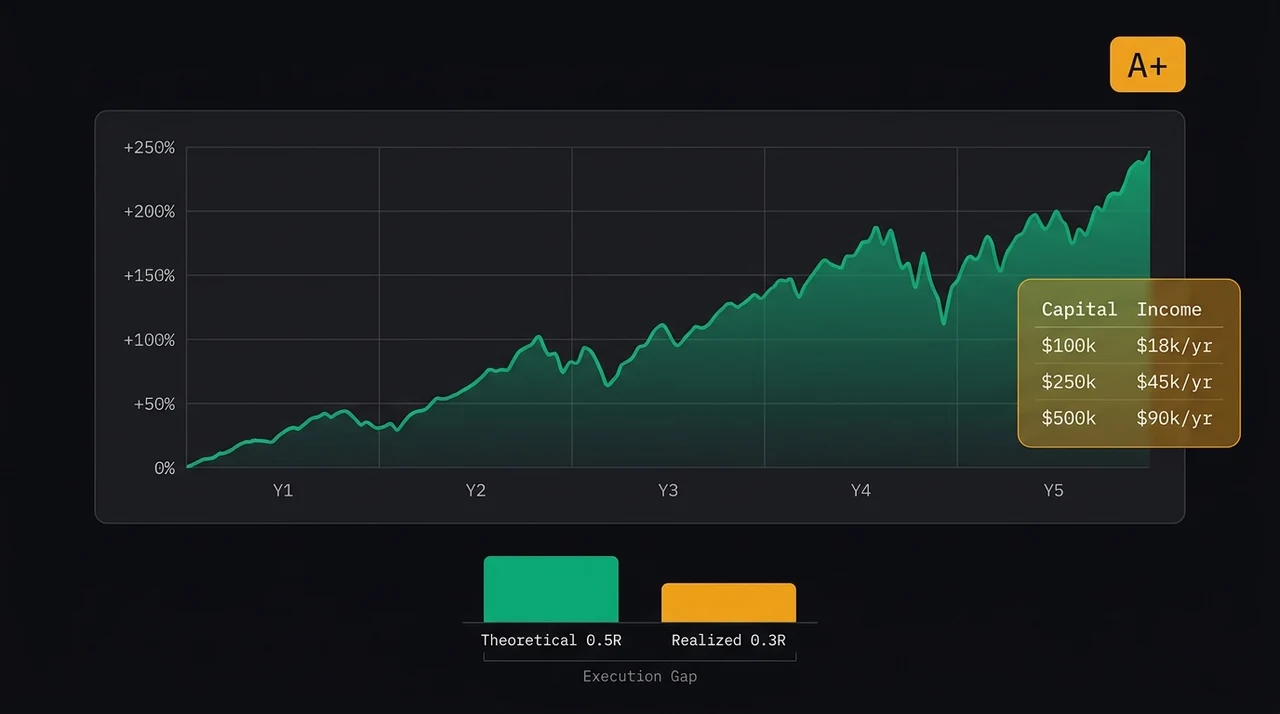
Most swing traders achieve positive expectancy in their strategy rules but fail to capture it in their actual results. The gap between theoretical and realized returns — typically 30–50% — is the behavioral execution problem, not a strategy problem. Solving it requires examining where exits deviate from plans, not redesigning the entry criteria.
For a detailed breakdown of how to calculate R-multiples and size each position to a defined risk amount, see position sizing with R-multiples.
Why Execution Erodes Theoretical Returns
Odean (Journal of Finance, 1998) analyzed 10,000 household brokerage accounts and documented what he called the disposition effect: traders sold winning positions at a statistically higher rate than losing ones, even when tax and portfolio considerations pointed to the opposite behavior. The disposition effect is the primary mechanism by which traders underperform their own strategies.
Kahneman and Tversky's prospect theory (Econometrica, 1979) explains the mechanism: losses register approximately twice as painfully as equivalent gains. A position moving $0.50 against a trader produces more psychological discomfort than the equivalent $0.50 move in their favor produces satisfaction. That asymmetry causes two systematic behaviors — cutting winners short to "lock in the gain" and holding losers past the stop to avoid realizing the loss — both of which destroy positive expectancy over time.
Over 150 trades per year, even small deviations compound significantly. Exiting winners 0.4R early reduces average wins from 2.0R to 1.6R. Widening stops on losers by 0.5R increases average losses from 1.0R to 1.5R. Together, those two behaviors convert a 0.5R theoretical expectancy into approximately 0.05R realized — a functional edge that barely covers transaction costs.
Three structural fixes that prevent execution drift:
- Pre-written trade plans: Document the entry trigger, stop level, Target 1, and Target 2 before placing any order. In-session decisions become binary rule checks, not real-time judgment calls.
- Formula-driven position sizing: Risk no more than 1% of account equity per trade, regardless of conviction level. The formula eliminates the oversizing that creates disproportionate emotional stakes on individual positions.
- Stop orders placed at entry: When an entry triggers, the corresponding stop goes in simultaneously. The exit decision is made before emotional pressure exists. For stop placement mechanics using structurally valid levels, see swing trading stop-loss placement.
The Role of Market Regime in Income Stability
The 12% excess return documented by Jegadeesh and Titman (1993) carries a qualifier: it is observed under favorable market conditions. In trending environments, the momentum edge is robust. In choppy or declining markets — characterized by narrow breadth, a declining advance-decline ratio, and elevated volatility — the same strategy applied without adaptation produces negative excess returns.
For swing traders targeting consistent income, regime awareness is not optional. A systematic trader who runs the same strategy through all market environments without adjustment experiences large drawdown periods that make income planning unreliable. A trader who reduces position size, tightens quality thresholds, and shifts to lower-risk setups in adverse regimes preserves capital through drawdowns and compounds faster in subsequent favorable environments.
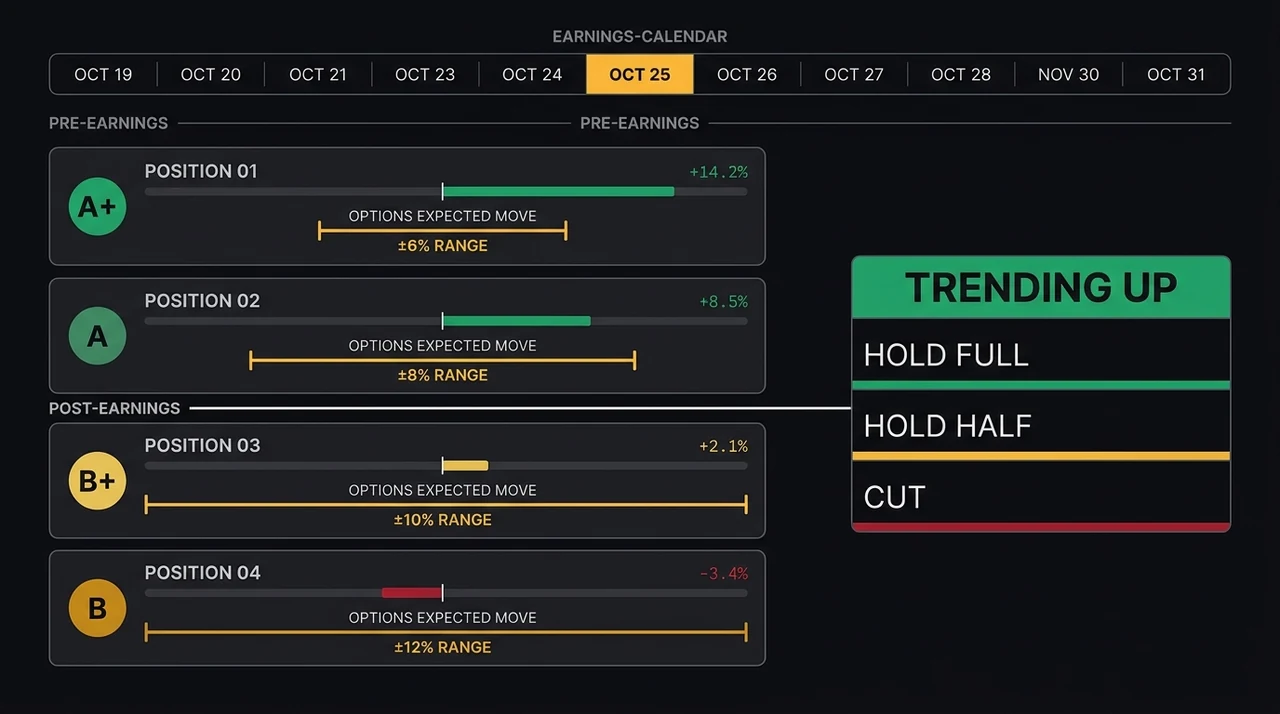
EasySwing's five-state regime classification — Trending Up, Trending Down, Ranging, High Volatility, and Transitioning — automatically adjusts setup availability by market state. When the market shifts into a Transitioning regime, the gate raises its quality floor — only top-grade setups pass, and only strategies validated for uptrends stay eligible. In the other adverse states, setups from strategies not validated for that regime are filtered out entirely. Fewer trades in bad conditions is how a systematic approach reduces drawdown volatility over a full market cycle. For a breakdown of how regime states affect strategy selection, see market regime: bull, bear, and choppy markets.
The Swing Trading Income Checklist
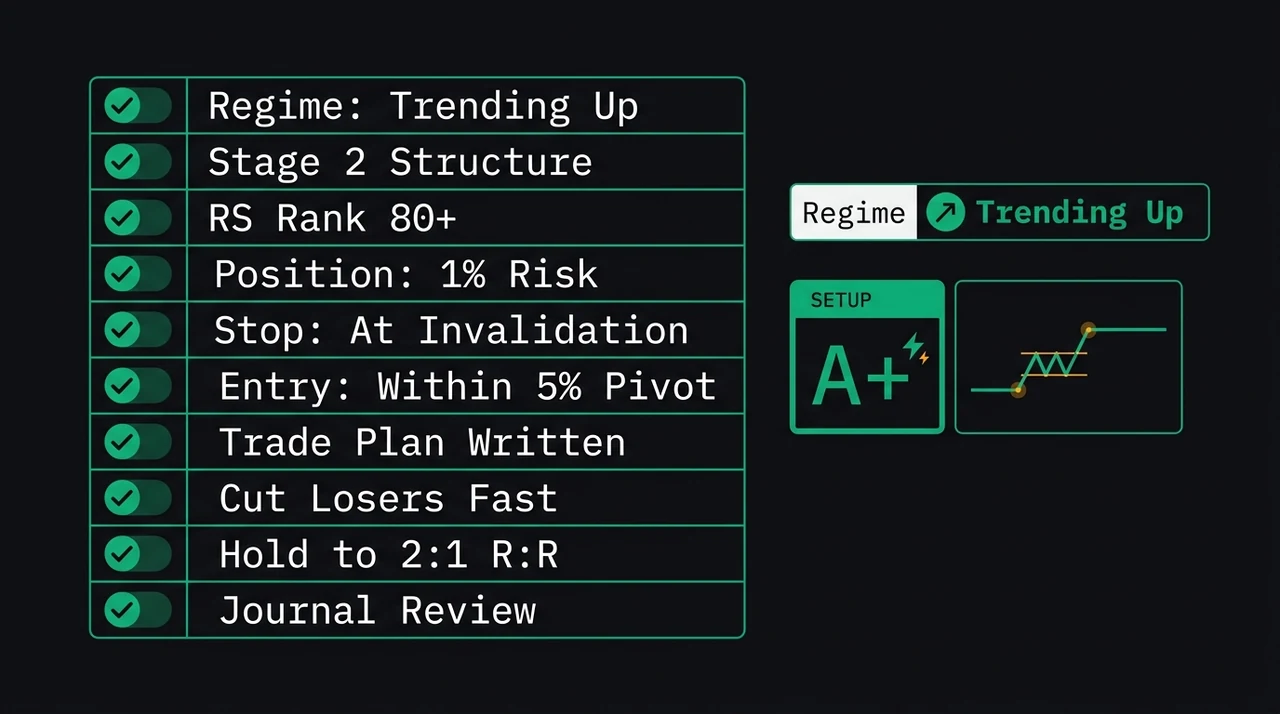
Before deciding to target full-time income from swing trading, assess each of the following honestly.
Capital and financial readiness:
- ✅Trading capital is at minimum $150,000, held separately from living expense reserves
- ✅Twelve months of living expenses are in cash, not in trading capital
- ✅Profits will not be withdrawn as income until a 24-month consistent performance record exists
- ✅Tax payments on trading gains are accounted for before projecting net income
Edge verification:
- ✅At least 30 completed trades have entry, exit, stop, and plan deviation logged in a journal
- ✅Win rate and average R-multiple produce a theoretical expectancy above 0.3R per trade
- ✅Actual realized returns over the past 12 months are within 30% of theoretical expectancy
- ✅Performance has been evaluated across at least one Trending Down or High Volatility regime
Behavioral requirements:
- ✅Stops have not been moved after entry in the past 30 trades
- ✅All positions are sized with the 1% rule, regardless of conviction
- ✅A documented process exists for logging and reviewing deviations from the trade plan
Red flags — delay the full-time attempt:
- ❌Trading capital is less than 12 months of living expenses
- ❌Actual returns are more than 40% below theoretical expectancy
- ❌No trades have been completed through a meaningful market drawdown
- ❌The plan is to start withdrawing income immediately upon going full-time
For the psychological discipline that separates consistent executors from theoretically sound traders, see swing trading psychology: rules over reactions.
EasySwing.trading screens for swing trading setups automatically across 2,000+ US equities each session, grading each result A+ to C against a five-state market regime gate — entry levels, stops, and targets are pre-calculated before the market opens. For the foundational mechanics of trading income, read about position sizing with R-multiples and the market regime gate. Scan results are for informational purposes only. See our Risk Disclaimer.
Frequently Asked Questions
How much capital do I need to make a living swing trading?
The practical benchmark for full-time income is $300,000–$500,000 in trading capital, assuming 15–20% annual returns and withdrawing gains as income. With $100,000 at 15% returns, you generate $15,000 per year — supplemental income, not a primary living. The capital requirement is more binding than the strategy requirement: most traders who attempt to live off swing trading underestimate how much starting capital is needed, not how difficult the trading itself is.
What annual return rate is realistic for swing traders?
For a systematic swing trader in year three or beyond with documented methodology, 12–20% annually is achievable. Jegadeesh and Titman (1993) documented 12% excess returns for top-decile momentum strategies in favorable conditions — that is above-market, not total returns. Returns above 25% are possible in strong trending markets but are not reliable year over year. Year-one and year-two targets should focus on capital preservation and rule-following, not income generation.
Can you swing trade part-time while working a full-time job?
Yes, and most successful systematic swing traders do exactly that for the first 3–5 years. Swing trading requires roughly 30–60 minutes daily for pre-market screening, order entry, and open position monitoring. That time commitment is compatible with most working schedules. Many traders build capital and refine methodology part-time, then consider full-time status only after 24+ months of consistent performance history and adequate capital accumulation.
What percentage of swing traders achieve consistent profitability?
The exact figure for swing traders is not publicly documented, but Barber and Odean's 2000 study (The Journal of Finance) found that the median active retail trader marginally underperformed a passive buy-and-hold strategy after costs. The most active quintile underperformed by 6.5% annually. The distinguishing factors in consistently profitable traders — across multiple research studies — are systematic entry and exit rules, defined position sizing, and regime-aware selection, not prediction accuracy or market timing.
How long does it take to become consistently profitable at swing trading?
Brett Steenbarger's work on trading psychology emphasizes that rule-following becomes reflexive only through repeated deliberate practice paired with explicit post-trade review — not through a fixed number of trades, but through sustained, reviewed repetition. For a trader completing 2–3 trades per week with consistent journaling, building that fluency typically takes 2–4 years. Most consistently profitable swing traders report 3–5 years from starting to developing a reliable documented edge. Progress is not linear — it typically involves periods of improvement followed by regression in new market regimes before restoring at a higher level.
Disclaimer: This article is for educational purposes only and does not constitute investment advice. EasySwing is a stock screening tool, not a registered investment advisor. All trading involves risk. Read our full disclaimer →