How to Choose a Reliable Swing Trading Signal Service
A reliable swing trading signal service shows a dated, verifiable track record that includes its losers, publishes the rules behind each signal, attaches a stop and target to every alert, and costs less than a few percent of the account it serves. Few services pass all four. Barber and Odean (2000) found that the most active household traders earned 11.4% a year while the market returned 17.9%, so a signal feed that drives extra trading has to clear a high bar.
The market for trading signals is crowded and mostly unregulated in practice, which puts the vetting work on you. The sections below turn that work into five tests you can run in about an hour, using only public information and a free trial.
Start With the Track Record, Not the Marketing
A trustworthy track record is dated, timestamped before the outcome was known, and includes every signal the service issued, losers included. Screenshots of winning trades prove nothing. A full signal history with entry date, stop, and result lets you compute win rate, average loss, and drawdown yourself.
Ask three questions of any record you are shown. Were the signals logged when they were issued, or reconstructed afterward? Does the list include the failed ones? And does it cover a losing stretch, not only a bull run?
Survivorship bias is the quiet distortion here. Elton, Gruber, and Blake (1996) estimated that dropping funds that closed overstated mutual fund returns by roughly 0.9 percentage points a year. A signal service that quietly deletes retired strategies or old losing calls does the same thing to its own history, and the effect is usually larger because the sample is smaller.
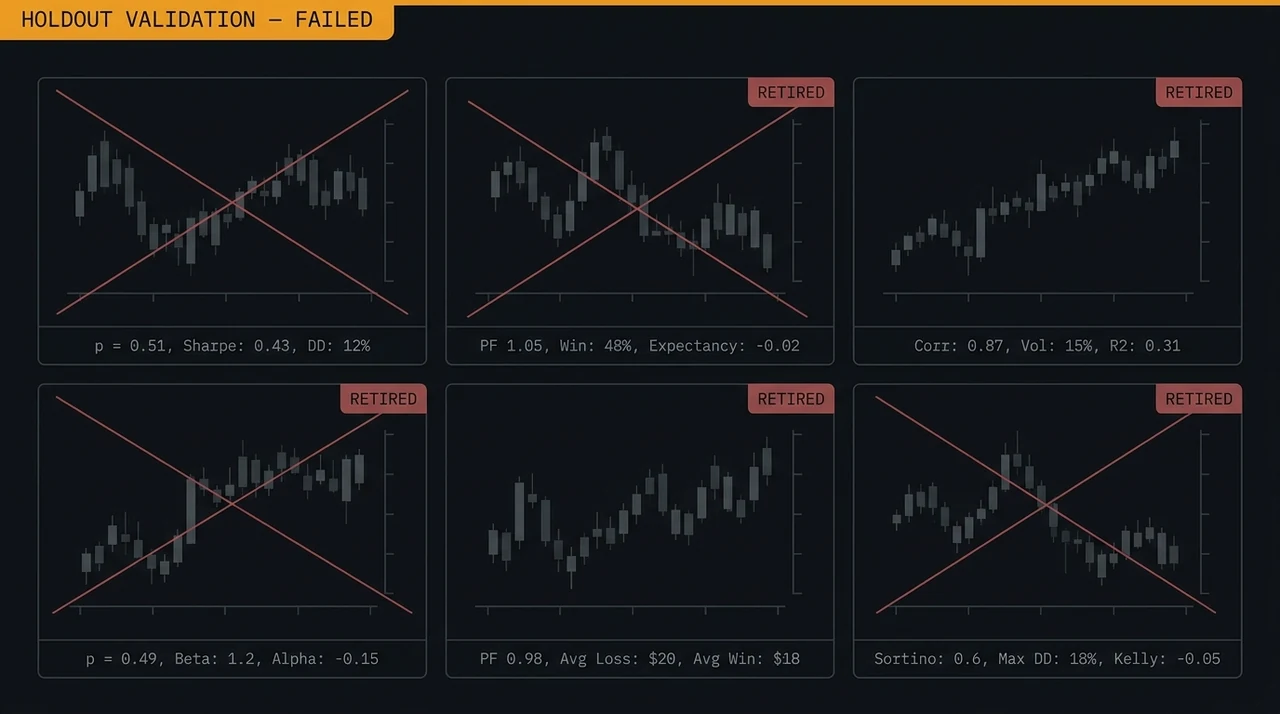
Look for services that publish what they stopped using. A visible list of abandoned strategies is a stronger credibility signal than a spotless win rate, because it shows someone is testing claims and acting on the results. We publish ours in the strategy graveyard post.
Demand to See the Rules Behind Each Signal
A reliable service can state, in plain language, what conditions must be true before a signal fires. If the answer is "proprietary algorithm" and nothing more, you cannot tell a durable edge from a lucky stretch, and you cannot tell when the edge has stopped working.
Rule transparency matters because it lets you check a signal against a chart in thirty seconds. A breakout signal should name the pivot, the volume condition, and the trend filter. A pullback signal should name the moving average and the depth. If you cannot reproduce the logic by eye on a single chart, you are trusting a black box with your capital.
Marcos López de Prado and his co-authors (Bailey, Borwein, López de Prado, and Zhu, 2014) showed that trying enough parameter combinations on the same history will always produce an impressive backtest, and that the required evidence grows with every combination tried. The practical question for a service is how many variations it tested before choosing the one it sells. Services that cannot answer are often selling the best of many random results.
Harvey, Liu, and Zhu (2016) argued that new factor claims should clear a t-statistic of about 3.0 rather than the traditional 2.0, because so many researchers test so many ideas. Apply the same skepticism to any signal service quoting a backtest with no mention of out-of-sample or holdout testing.
Check That Every Signal Carries Its Own Risk
A reliable signal is incomplete without an entry zone, a stop level, and at least one target. Those three fields let you compute reward-to-risk before acting and size the position so a loss stays small. A signal that says only "buy XYZ" hands you the decision that matters most and gives you no data to make it.
Stops are not a formality. Van Tharp's R-multiple framework, covered in our position sizing guide, expresses every outcome as a multiple of the initial risk, which only works when the stop is defined up front. A service that adjusts the stop after the fact makes every result look better than it was.
Look at the geometry of the signals too:
- Stop distance. Stops set 1-2 ATR below entry on a trending stock are workable. Stops set 15% away on a volatile name are not.
- Reward-to-risk. Targets that give at least 2:1 leave room for a win rate under 50%.
- Expiry. A signal should say how long it stays valid. A breakout alert that is five days old is a different trade.
Our swing trading signals guide walks through each of these fields on a real signal card.
Match the Service to Your Style and Time Frame
A swing trading signal service should issue signals for holds of two days to several weeks, on stocks liquid enough to enter and exit without moving the price. A feed that fires fifty intraday alerts a day is built for a different trader, however it is labelled.
Check these fit factors before paying:
- Hold period. Stated holds should match the time you can give the charts. A service that expects intraday management does not suit someone who checks once a day.
- Volume of signals. More alerts is not better. If you cannot size and monitor every signal, the extra ones are noise. Selective services that issue a handful a week fit a part-time schedule.
- Universe. Thinly traded stocks widen the gap between the signal price and the price you get. Look for stated liquidity filters.
- Market conditions. Strategies that work in uptrends fail in corrections. The best services publish how signals change when the market does.
That last point deserves attention. A momentum-breakout feed that keeps firing during a market downtrend is not reading the market. Our market regime guide explains why a regime filter is among the most useful safeguards a signal system can have.
Price the Service Against Your Account Size
A signal service is a fixed cost that comes straight out of your returns, so its monthly price should be a small fraction of the capital it helps you manage. As a rough test, a service costing 1% of your account per year needs to improve your result by more than 1% just to break even.
Run the arithmetic honestly. At $50 a month, the annual cost is $600. On a $10,000 account, that is a 6% hurdle before the signals add a cent. On a $100,000 account, it is 0.6%. The same service can be a bargain for one trader and a drag for another.
Other cost signals to weigh:
- Free trial or refund window. Services confident in their output let you watch live signals before paying.
- Lock-in. Multi-year prepaid plans transfer the risk to you.
- Upsells. A base price that rises through "VIP" tiers, private groups, or coaching add-ons suggests the signals are the lead-in to a different business.
Watch for the Red Flags That Predict Disappointment
The most reliable warning signs are guaranteed returns, screenshots with no dates, pressure to buy before a deadline, and testimonials in place of data. Any one of these should end the evaluation. Several together are the profile of a service selling hope rather than a process.
The regulatory side matters too. General signals sent identically to every subscriber sit in a different legal category from personalized advice, and undisclosed paid promotion of a stock is a separate problem. Our guide to whether stock signals are legal covers how to check a provider before you pay.
Common red flags, in rough order of severity:
- Guaranteed or "risk-free" returns of any size
- A win rate above 90% with no stated average loss
- Results shown only as screenshots or percentages with no dates
- Alerts for thinly traded or low-priced stocks that can be pushed around
- No stated stop on the signals
- Anonymous operators with no named team or published methodology
- Pressure tactics: countdown timers, "last spots," bonus offers
A win rate means nothing without the average win and average loss that go with it. A service that wins 90% of the time but loses ten times as much on each loser as it gains on each winner loses money. Always ask for expectancy, not win rate alone.
Run a Four-Week Test Before You Commit
The safest way to judge a signal service is to paper-track its signals for four weeks, logging each entry, stop, and result in a spreadsheet, before risking any capital. A month will not prove an edge, but it will quickly expose missing stops, late alerts, and signals that do not match the stated rules.
A simple test protocol:
- Record every signal the moment it arrives, with the time stamp.
- Note whether the stop and target were included.
- Check the stated entry against the chart. Was the price still in the zone when you saw it?
- Track each signal to its stop, target, or expiry.
- Compute the average R-multiple and the maximum losing streak.
Four weeks is a screening step, not a verdict. A positive month can be luck and a negative month can be a poor market for the strategy. What the test reliably catches is process failure: alerts that arrive after the move, vague rules, or an absent stop. Keep a swing trading journal once you go live so you can compare real results against the paper test.
How EasySwing.trading Approaches These Tests
EasySwing.trading screens a universe of roughly 2,000 U.S. stocks and surfaces setups from its active strategies, each graded A+, A, B+, B, or C, with an entry, stop, and targets on every signal. The rules for each strategy are documented, and retired strategies are published rather than deleted.
Applied to the five tests above:
- Track record. Each strategy is validated on a holdout window it was not tuned on, and strategies that fail are retired and documented in The Strategy Graveyard. Those are historical-test results, so judge them with the same scrutiny you would apply to any backtest. Separately, the outcomes of the live daily picks are published on the track record page, whichever way they go.
- Rules. Each strategy has stated conditions. Trend Pullback, for example, requires an EMA9 > EMA20 > SMA50 stack, a relative strength floor, and declining volume on the pullback.
- Risk fields. Every signal carries a stop and targets, so reward-to-risk is visible before you size anything.
- Market regime. Signals are filtered by the current market regime so breakout setups do not fire in a downtrend.
- Sameness. The same signal goes to every subscriber, so it is general screening output rather than personal advice.
You can see how a signal card is laid out in the stock screener guide. Whatever service you choose, run it through the same checklist. These tests screen for process quality, not outcomes. No service, this one included, can promise that its signals will be profitable.
Signal Service Vetting Checklist
Use this list before you pay for any swing trading signal service:
- ✅ Full signal history with dates, entries, stops, and results, including losers
- ✅ Signals logged when issued, not reconstructed afterward
- ✅ Rules for each signal stated clearly enough to check on a chart
- ✅ Entry zone, stop, and target on every alert
- ✅ Hold periods and signal volume that fit your schedule
- ✅ Annual cost small relative to your account size
- ✅ Trial or refund window so you can paper-track first
- ❌ Guaranteed returns or "risk-free" language
- ❌ Win rate quoted without average win and average loss
- ❌ Screenshots with no dates or timestamps
- ❌ Countdown timers, "last spots," or pressure to buy now
- ❌ Anonymous team with no published methodology
EasySwing screens for swing trading setups automatically and publishes the same graded signals to every subscriber. For how those signals are built, see the swing trading signals guide, and for the legal test that separates general signals from personalized advice, see are stock signals legal. Scan results are for informational purposes only. See our Risk Disclaimer.
Frequently Asked Questions
How do I know if a swing trading signal service is reliable?
Check four things: a dated track record that includes losing signals, stated rules behind each signal, a stop and target on every alert, and a cost that is small relative to your account. Then paper-track the signals for four weeks before risking capital. A service that fails any of the first three is not worth testing further.
What win rate should a good signal service have?
Win rate alone says little. Swing strategies often win 40-60% of the time and still profit because winners are larger than losers. Ask for the average win, the average loss, and the resulting expectancy in R-multiples. A quoted win rate above 90% with no average loss is a warning sign, not a credential.
Are free swing trading signals worth following?
Free signals can be useful if you vet them with the same tests as paid ones: dated history, stated rules, and defined stops. Be aware that free channels are often marketing for a paid tier, and some promote thinly traded stocks. Price is not the filter. Transparency and risk fields are.
How long should I test a signal service before paying?
Four weeks of paper-tracking is a sensible screening step. It will not prove an edge, but it reveals late alerts, missing stops, and signals that do not match the stated rules. If the service offers a free trial or refund window, use it for exactly this test.
Does EasySwing.trading give personalized trade advice?
No. EasySwing.trading publishes general screening results, with the same graded signal, stop, and targets shown to every subscriber watching a strategy. It does not manage accounts or tailor signals to an individual portfolio. Scan results are for informational purposes only.
Disclaimer: This article is for educational purposes only and does not constitute investment advice. EasySwing is a stock screening tool, not a registered investment advisor. All trading involves risk. Read our full disclaimer →