The Strategy Graveyard: 6 Strategies We Killed, and Why
We Killed 6 of Our Own Strategies. Here's the Receipt.
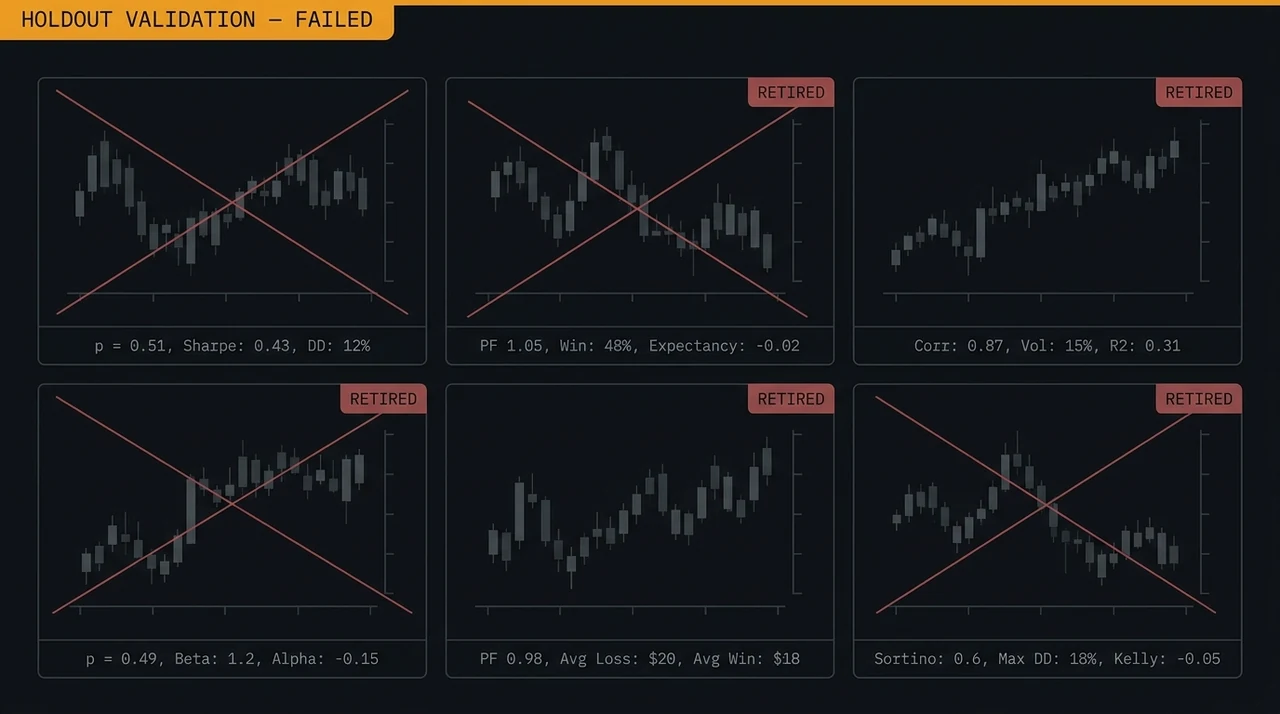
Most trading platforms only publish what works. EasySwing.trading runs an autoresearch pipeline that tests every strategy candidate on a holdout window it never touched during tuning, then runs a permutation test asking whether the strategy's selection filter beats picking randomly from its own candidate pool. Of 23 strategies evaluated in the 2026-07 sweep, 6 failed and were formally retired: rsi-reversion, bear-flag, rsi-overbought, swing-condor, atr-stretch-reversion, and frog-in-the-pan.
This post is the record of why. A system that never kills anything is not more accurate — it just has not looked hard enough yet.
Why an Honest Graveyard Matters
A backtesting process with zero retired strategies has not been tested honestly. Curve-fit systems tune parameters until every candidate looks profitable on the same data used to build it, so nothing ever fails. A validation pipeline that separates a holdout window, shuffles returns to test for selection skill, and requires the result to survive both — will retire strategies. That is the mechanism working, not a flaw in the strategies.
EasySwing's pipeline applies four gates to every candidate: a holdout split (the last 12 months are never touched during tuning), a parameter-robustness check across a ±10-20% neighborhood, a shuffle-returns permutation test (200 shuffles) that asks whether the RS/grade filter picks winners better than random selection from the same pool, and a Sharpe ratio with a multiple-testing haircut. A strategy that fails any gate on holdout does not ship. Full methodology: /methodology. Aggregate live results: /performance.
What "Dead" Actually Means Here
Dead means the strategy's selection filter showed no statistically credible edge on data it never saw during tuning — not that the underlying idea is theoretically wrong, and not that a single bad trade sank it. The verdict comes from a documented decision function (isStrategyDead() in the strategy engine) that live pick surfaces check before a setup is ever shown to a user. A dead strategy cannot appear as a graded setup.
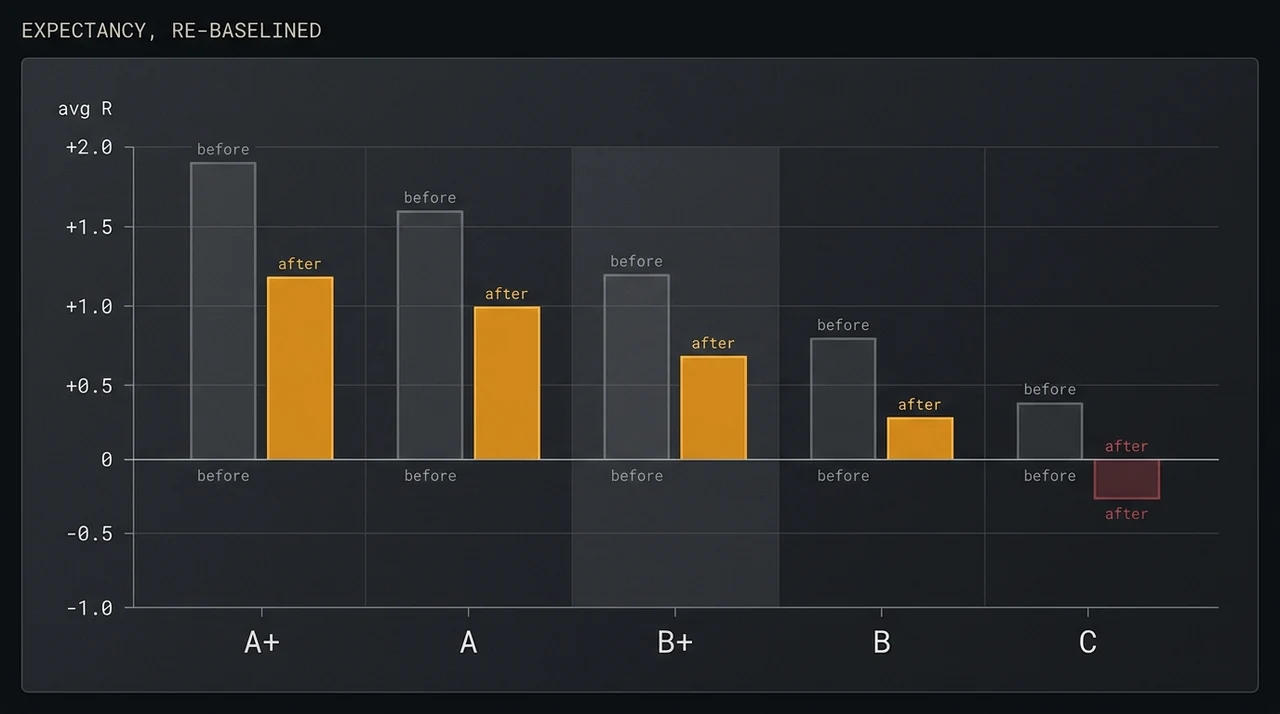
Two structural findings carried across the 2026-07 re-baseline. First, every one of the six dead strategies sits at a permutation p-value above 0.5 — meaning the filter is statistically indistinguishable from picking candidates at random. Second, this is a re-baseline: the platform re-ran validation after fixing a risk-floor calibration bug (see the companion post on the risk-floor correction), and several strategies that looked marginal before the fix did not survive after it.
The Six
rsi-reversion — Connors-style mean reversion, single-name shape
RSI(2) dip-buy triggered on a strict four-way confirmation. On the 2026-07-03 cold re-baseline: holdout net profit factor 1.17 on 738 trades, permutation p=0.522, haircut Sharpe 0.17. The strict trigger pre-selects roughly 77% of its own candidate pool before the RS/grade filter ever runs, so the filter has almost nothing left to discriminate — the permutation test degenerates toward noise. The lesson carried forward: a mean-reversion edge does exist in this codebase, but only when the hard gate stays broad and RS-based grading does the actual selection work. That inverted shape shipped as two different, currently-tuned strategies — rsi2-leader-dip and snapback-zscore — discussed below.
bear-flag — short-side breakdown continuation
Short entries on distribution-stage breakdowns. Holdout net profit factor 0.47 on 284 trades, permutation p=1.000, robustness score 0.00, haircut Sharpe −0.90. Short setups in this universe get squeezed on holdout with enough regularity that the edge does not survive — a known, structural finding, not a one-off bad window.
rsi-overbought — extended-stock short fade
Fade entries on RSI overbought readings, tested with a tightened exit. Holdout net profit factor 1.42 on 512 trades, robustness 0.85, haircut Sharpe 0.40, permutation p=1.000. Positive profit factor, zero selection skill — the RS/grade filter contributes nothing beyond what a random draw from the same pool would produce.
swing-condor — range-bound reduced-risk setup
A wider-channel range strategy. Held dead on policy: an inconclusive re-run (net profit factor 1.65 on 40 trades, p=0.912) did not overturn the same-day falsification, and under the adoption policy an inconclusive result does not resurrect a dead verdict on its own. Range strategies broadly need range-bound regimes that are rare across a 12-month holdout window — a sample-size problem as much as a signal problem.
atr-stretch-reversion — ATR-based snapback on a mid-RS band
Holdout net profit factor 1.31 on 1,693 trades, robustness 1.00, haircut Sharpe 0.15, permutation p=0.996. Depth-of-stretch alone, without an independent discrimination signal layered on top, carries no selection edge in this test.
frog-in-the-pan — information-discreteness momentum, extreme-leader band
Held dead on the resurrection policy: a single 88-trade tuned-provisional read (net profit factor 1.79, p=0.344) does not meet the bar for reversing two same-day dead verdicts, one of which showed p=0.692 on a 202-trade cold sample. The policy requires a stable credential across multiple sweeps, not one favorable snapshot.
The Table
| Strategy | Holdout trades | Permutation p | Verdict basis |
|---|---|---|---|
| rsi-reversion | 738 | 0.522 | Strict trigger pre-filters own pool; degenerate permutation |
| bear-flag | 284 | 1.000 | Short-side squeeze risk; negative haircut Sharpe |
| rsi-overbought | 512 | 1.000 | Positive PF, zero selection skill |
| swing-condor | 40 | 0.912 | Held dead on policy; range regime too rare in holdout |
| atr-stretch-reversion | 1,693 | 0.996 | Stretch depth alone has no discrimination power |
| frog-in-the-pan | 88 / 202 | 0.344 / 0.692 | Single favorable snapshot doesn't meet resurrection bar |
Selection Skill, Not Profitability
The permutation test does not ask "did this strategy make money" — it asks "did the RS/grade filter pick better winners than a random draw from the same candidate pool." This distinction is the single biggest source of confusion in reading these results, and it cuts both ways: a strategy can show a positive profit factor and still be ruled dead (rsi-overbought, above), and a strategy with a modest profit factor can clear the bar if its filter does real selection work.
Two of the currently-live strategies illustrate the inverse case directly. rsi2-leader-dip clears at permutation p=0.000 with 1,124 holdout trades; snapback-zscore clears at p=0.010 with 3,216 holdout trades. Both are mean-reversion strategies — the same family as the retired rsi-reversion — but built with a broad hard gate and a grade filter that does the discrimination work instead of a strict multi-way trigger doing it upfront. Structure determines survival more reliably than the underlying trading idea.
What Survives the Same Bar
Of the 23 strategies tested in the 2026-07 sweep, the honest count is 12 carrying the strict "tuned" verdict, 1 tuned-provisional, 4 inconclusive, and the 6 above marked dead. That is not "13 alpha setups" — the platform's own validation record shows only 3 of 23 strategies clearing a strict permutation threshold (p ≤ 0.05) on the primary 2026-07-03 snapshot, rising to 4 of 23 on a confirmatory cold re-run. The two highest-volume strategies — rsi2-leader-dip and snapback-zscore — stay rock-solid across both snapshots and account for roughly 4,300 of the platform's ~6,900 annual signals.
The honest framing: this is disciplined selection and risk management layered on a validated core, with a small number of strategies carrying the statistical weight and daily trade volume, plus a longer provisional tail that has not yet cleared the strict bar in either direction. The breadth is real but narrower than a strategy count alone implies.
What This Should and Shouldn't Change About How You Use It
- Do treat a strategy tag on a graded setup as meaning it survived holdout + permutation testing, not that it is guaranteed to keep working.
- Do expect the roster to shift over time — a strategy can be re-tested and revert to dead, or a currently-inconclusive strategy can clear the bar on a later sweep.
- Don't read "13 strategies" as 13 independently validated alpha sources — the statistically strongest, highest-volume core is a smaller number.
- Don't assume a dead verdict means the underlying trading idea (mean reversion, short breakdowns, range trading) is worthless — it means this specific implementation, tested this way, did not clear the bar. The rsi-reversion → rsi2-leader-dip / snapback-zscore case shows the same family can be re-shaped and pass.
- Don't expect a static list. The graveyard, like the roster, is a record of ongoing testing, not a finished document.
FAQ
See below for frequently asked questions about how this validation process works.
EasySwing.trading screens for setups drawn from strategies that survive holdout and permutation testing, and retires the ones that don't. Read the methodology and current performance record for the full validation process, and see the companion post on correcting a risk-floor bug in backtest expectancy. Scan results are for informational purposes only and do not constitute investment advice. See our Risk Disclaimer.
Frequently Asked Questions
What does it mean when EasySwing marks a strategy "dead"?
It means the strategy failed holdout and permutation testing — the RS/grade selection filter showed no statistically credible edge over random selection from the same candidate pool, evaluated on a 12-month window the tuning process never touched. A documented decision function drops dead strategies from every live pick surface before a user ever sees them.
Why would a strategy with a positive profit factor still be marked dead?
The permutation test measures selection skill, not raw profitability. rsi-overbought showed a holdout profit factor of 1.42 but a permutation p-value of 1.000 — meaning the RS/grade filter contributed nothing beyond what a random draw from the same candidate pool would have produced. A positive profit factor without selection skill does not clear the bar.
Can a dead strategy come back?
Yes, under a resurrection policy that requires a stable credential across multiple sweeps, not one favorable snapshot. frog-in-the-pan and swing-condor both showed marginal favorable reads in later re-runs but were held dead because a single inconclusive or tuned-provisional result does not overturn a same-day falsification on its own.
How many of EasySwing's strategies are statistically validated at the strict level?
As of the 2026-07 validation record, 12 of 23 tested strategies carry a strict "tuned" verdict, with only 3-4 clearing a permutation p-value of 0.05 or below depending on the sweep snapshot. Two strategies — rsi2-leader-dip and snapback-zscore — clear that bar consistently and carry the majority of daily signal volume.
Why does EasySwing publish which strategies failed instead of only the ones that worked?
A validation pipeline with zero retired strategies has not been tested honestly — curve-fit systems tune until everything looks profitable on the same data used to build them. Publishing the graveyard is the visible proof that the holdout and permutation gates are real constraints, not a formality.
Disclaimer: This article is for educational purposes only and does not constitute investment advice. EasySwing is a stock screening tool, not a registered investment advisor. All trading involves risk. Read our full disclaimer →