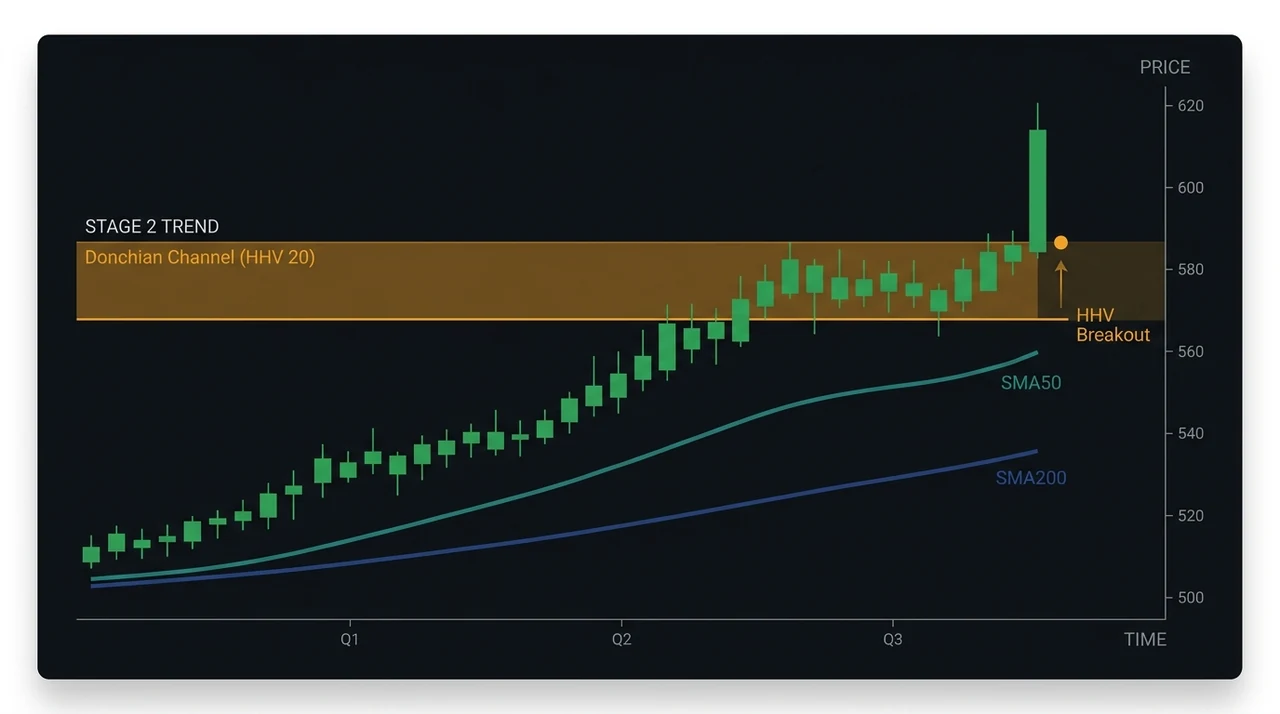
HHV Breakout: How the Donchian Channel Captures Trend-Following Leaders
Jegadeesh & Titman (1993, Journal of Finance) documented that top-decile 12-month return stocks outperformed the bottom decile by 12.01% annually. Richard Dennis built a $200 million career on a simpler version of that observation: stocks closing above their 20-day high tend to keep moving.
The Highest-High Value (HHV) Breakout — also called the Donchian Channel breakout — captures this exact moment. EasySwing's implementation requires a Stage 2 uptrend, RS rank leadership, and a 3-month momentum gate before the channel breakout qualifies, then surfaces only Grade A+ setups. The validated configuration returned a 2.76 profit factor across 1,075 holdout trades in Trending Up conditions.
What Is the HHV Breakout Strategy
The HHV Breakout detects stocks whose daily close exceeds their 20-day highest high for the first time in Stage 2 uptrend conditions with RS rank leadership. EasySwing gates the signal with a 3-month momentum requirement and surfaces only Grade A+ setups. The 2026 tuned configuration returned a 2.76 profit factor across 1,075 holdout trades — with a 52% win rate and +0.63R expectancy per trade.
The "highest high value" of a 20-day window is simply the maximum closing high across the prior 20 sessions excluding today. Richard Donchian developed the channel concept at Futures Inc. in the 1960s, publishing his mechanical trading rules publicly. When price closes above that ceiling, it signals that buyers have cleared the most recent resistance — that the supply that existed at every prior high has been absorbed.
The underlying mechanism differs from pattern-based strategies. A VCP Breakout requires a multi-week contraction pattern. The HHV Breakout requires only one bar: a confirmed close above the prior channel high. The Stage 2 and RS rank gates substitute for the structural quality checks that the VCP base provides visually.
The Channel Breakout Edge: Practitioner History and Academic Evidence
Richard Donchian's mechanical channel rules attracted little attention until Richard Dennis and William Eckhardt operationalized the 20-day breakout as the entry trigger for their 1983 Turtle Experiment. Dennis recruited 23 novice traders — no trading experience required — and trained them on systematic channel breakout rules with strict position sizing. Jack Schwager documented the results in Market Wizards (1989): the Turtle traders generated substantial profits over five years, proving that systematic breakout trading could be taught and replicated.
Dennis summarized the insight: "I always say that you could publish my trading rules in the newspaper and no one would follow them. The key is consistency and discipline." The rules themselves were simple. The discipline to execute them mechanically — including the regime-gating that cuts activity in choppy environments — was the real variable.
Academic literature confirms the channel breakout premium is robust. Jegadeesh & Titman (1993) established that 12-month return momentum earned 12.01% annually in US equities. Asness, Moskowitz & Pedersen (2013, Journal of Finance) extended the finding across 48 countries and four asset classes, confirming trend-following breakout rules captured a cross-sectional return premium independent of market. Faber (2010, Journal of Wealth Management) documented that a simple trend-following rule — holding positions only when above a 10-month moving average — reduced maximum drawdown by over 50% versus buy-and-hold across five asset classes.
The EasySwing HHV Breakout applies this practitioner and academic heritage to a filtered universe of Stage 2 uptrend leaders, not raw channel breaks across all equities. The distinction is load-bearing: applying a 20-day high rule to all 2,000+ covered stocks without the RS and Stage 2 gates produces many false breakouts from downtrends. The filters concentrate entries on names where the breakout is more likely to represent genuine institutional conviction.
The Four Entry Conditions EasySwing Checks
EasySwing scans a universe of liquid US equities at each market close, applying four hard gates in sequence before grading qualifying setups A through A+.
- Close > 20-day highest high. Today's close must exceed the maximum high of the prior 20 sessions, excluding today. This is the breakout trigger — a confirmed close, not an intraday spike. Price printed above the channel ceiling and held it into the close.
- Stage 2 uptrend confirmed. The close is above the 50-day simple moving average, and the 50-day SMA is above the 200-day SMA. Stan Weinstein's (Secrets for Profiting in Bull and Bear Markets, 1988) stage framework filters out breakouts in Stage 3 distribution tops and Stage 4 downtrends — environments where the same channel break signals exhaustion or a failed rally rather than a new leadership leg.
- 3-month return ≥ +5%. The stock must have gained at least 5% over the prior 63 sessions. This momentum gate concentrates the strategy on names already in institutional motion — leaders with measurable buy-side participation — where channel breakout follow-through is empirically stronger than names just starting to move.
- RS Rank leadership. EasySwing's Relative Strength Rank measures six-month price performance versus the tracked universe. The hard gate is RS ≥ 40. The A+ grade concentrates on names at RS ≥ 81 — the top quintile of relative performance. Stocks below RS 40 often represent sector-rotation plays or short-covering bounces, not sustained institutional accumulation.
Two additional gates run above the four. EasySwing surfaces only Grade A+ HHV Breakout setups in the pick feed — the highest composite quality tier. The market regime gate restricts the strategy to TRENDING_UP conditions only. In Ranging, Trending Down, or High Volatility regimes, EasySwing does not surface HHV Breakout picks — consistent with the academic consensus that channel breakout strategies earn their premium in trending environments and erode it in choppy ones.
EasySwing's HHV Breakout Backtest Results
EasySwing validated the HHV Breakout using a walk-forward methodology: parameters were tuned on a training window (November 2022–March 2025), then performance was measured on a holdout window (May 2025–April 2026) the tuning procedure never touched.
Holdout period results (TRENDING_UP, Grade A+):
| Metric | Holdout |
|---|---|
| Holdout period | May 2025 – Apr 2026 |
| Trades | 1,075 |
| Profit factor (net of fees) | 2.76 |
| Win rate | 52% |
| Average expectancy | +0.63R per trade |
| Robustness score | 1.00 |
| Permutation p-value | 0.000 |
The HHV Breakout strategy produced a 2.76 profit factor net of fees ($1.50/trade) and 5 bps slippage across 1,075 holdout trades. A 52% win rate with +0.63R expectancy means more than half of trades close profitable, with the average winner substantially exceeding the average loser — a healthier profile than pure momentum strategies that win less often but cut losers tightly.
A robustness score of 1.00 — the maximum — means the edge persists across every parameter variation tested. In none of the 250 shuffle permutations did a random baseline match the observed holdout performance (p-value of 0.000), indicating the signal-selection edge is genuine rather than data-mining noise. The training window produced a 1.60 profit factor over 2,565 trades, a deliberately conservative tuning that avoids parameter overfitting; the holdout improvement to 2.76 suggests the filters hold up on new data.
Trade Structure: Entry, Stop, and Exit
EasySwing's HHV Breakout uses a three-level structure calibrated to the strategy's tuned parameters.
Entry: Placed 0.1% above the 20-day high (entry ≈ HHV × 1.001), taken on a confirmed bullish close. Setups meeting all gates but closing lower print as WATCH until a bullish close confirms the channel break held.
Stop: The higher of two references — 2.28× ATR14 below the entry, or 1% below the 50-day SMA. The structural SMA50 reference prevents the stop from sitting unreasonably far below price in low-volatility stocks; the ATR reference controls absolute risk in higher-volatility names. Size the position so the stop-to-entry distance equals ≤ 1% of total account equity.
Targets (R = per-share risk: entry minus stop):
- T1: Entry + 2.96R — partial exit at close to 3R gain
- T2: Entry + 5.17R — full exit, capturing the extended momentum leg
Maximum hold is 23 sessions. If price has not reached T1 within 23 trading days, EasySwing closes the position — the breakout has failed to follow through on its expected schedule.
HHV Breakout vs VCP Breakout: Two Approaches to the Same Move
Both strategies buy at a breakout point. The underlying conditions differ substantially.
| Dimension | HHV Breakout | VCP Breakout |
|---|---|---|
| Breakout reference | 20-day highest high | Pivot above contracting base |
| Pattern requirement | Single-bar channel break | Multi-week VCP contraction |
| Entry conditions | 4 mechanical gates | Pattern + volume confirmation |
| Win rate (holdout) | 52% | Strategy-specific |
| Expectancy (holdout) | +0.63R | Strategy-specific |
| Grade requirement | A+ only | A+ or A |
| Max hold | 23 days | Strategy-specific |
The VCP Breakout requires a visible contraction pattern — tightening price ranges over successive legs — before the breakout trigger. The HHV Breakout is purely mechanical: the only pattern required is today's bar closing above the channel high with the four gates passing. This makes it faster to identify and less dependent on chart-reading judgment, but it relies entirely on the Stage 2, RS, and momentum gates to filter quality.
Practitioners often use both together: VCP when a contraction pattern is clearly visible, HHV Breakout when a high-RS trending leader simply closes above its 20-day range without forming a tight base.
HHV Breakout Trading Checklist
Run this checklist before acting on any HHV Breakout setup EasySwing surfaces:
- ✅Close above 20-day highest high confirmed on today's final bar
- ✅Stage 2: Close > SMA50 > SMA200, both moving averages rising
- ✅3-month return ≥ +5% (momentum gate active)
- ✅RS Rank ≥ 81 (Grade A+ tier)
- ✅Market regime is TRENDING_UP
- ✅Grade A+ confirmed — composite quality at highest tier
- ✅Stop placed at the higher of SMA50 × 0.99 or entry − 2.28×ATR
- ✅Position sized so stop-to-entry distance ≤ 1% of account equity
- ❌Enter during Ranging, Trending Down, or High Volatility regimes
- ❌Chase entries significantly above HHV × 1.001 — use a limit order
- ❌Hold past 23 sessions if T1 has not been reached
- ❌Treat a WATCH signal as a buy — wait for the bullish close confirmation
Frequently Asked Questions
What is a Donchian Channel in trading?
A Donchian Channel plots the N-day highest high and N-day lowest low as two bands around price. A close above the upper band signals a breakout. Richard Donchian developed the concept at Futures Inc. in the 1960s; the 20-day version became the entry rule for the 1983 Turtle Experiment. EasySwing's HHV Breakout uses the upper channel only — filtered by Stage 2, RS leadership, and 3-month momentum.
Why does the HHV Breakout require a Stage 2 uptrend?
Without the Stage 2 filter — close > SMA50 > SMA200 — a raw 20-day high signal fires on stocks in any phase, including Stage 3 distribution tops where a breakout above the channel often marks the final push before institutional selling begins. Weinstein's (1988) stage framework confines the signal to the advancing phase where breakout follow-through is historically strongest.
How is HHV Breakout different from a simple 20-day high alert?
EasySwing adds three filters above the raw channel break: Stage 2 confirmation, 3-month return ≥ +5%, and RS Rank ≥ 81. A raw 20-day high fires on any stock clearing its recent range — including laggards, shorts covering, and sector rotation plays. The filtered version targets only market leaders already in institutional uptrends. The 1,075-trade holdout dataset was achieved on this filtered population, not the raw signal.
Does the HHV Breakout work in bear markets?
No. The market regime gate restricts HHV Breakout to TRENDING_UP conditions only. Channel breakouts in Ranging or Trending Down regimes are characterized by high failure rates — price breaks above the channel on low institutional conviction and reverts. EasySwing's regime detection, derived from S&P 500 trend, breadth, and volatility indicators, gates the strategy to the environment where the 1,075-trade holdout was validated.
How do I set alerts for HHV Breakout in EasySwing?
In the Alerts panel, create an alert targeting the HHV Breakout strategy at Grade A+. EasySwing evaluates the full universe at each market close and sends a notification — email, push, or Telegram — when a qualifying setup fires. See the swing trading alerts guide for the step-by-step process. The alert fires only when regime is TRENDING_UP; you will not receive false alerts during choppy or declining market phases.
EasySwing.trading automatically detects HHV Breakout setups — stocks closing above their 20-day highest high in Stage 2 uptrends with RS leadership — at each market close. For a broader view of trend-following momentum strategies, see the ROC Breakout strategy guide and the Qullamaggie Breakout continuation setup. Scan results are for informational purposes only. See our Risk Disclaimer.
Disclaimer: This article is for educational purposes only and does not constitute investment advice. EasySwing is a stock screening tool, not a registered investment advisor. All trading involves risk. Read our full disclaimer →