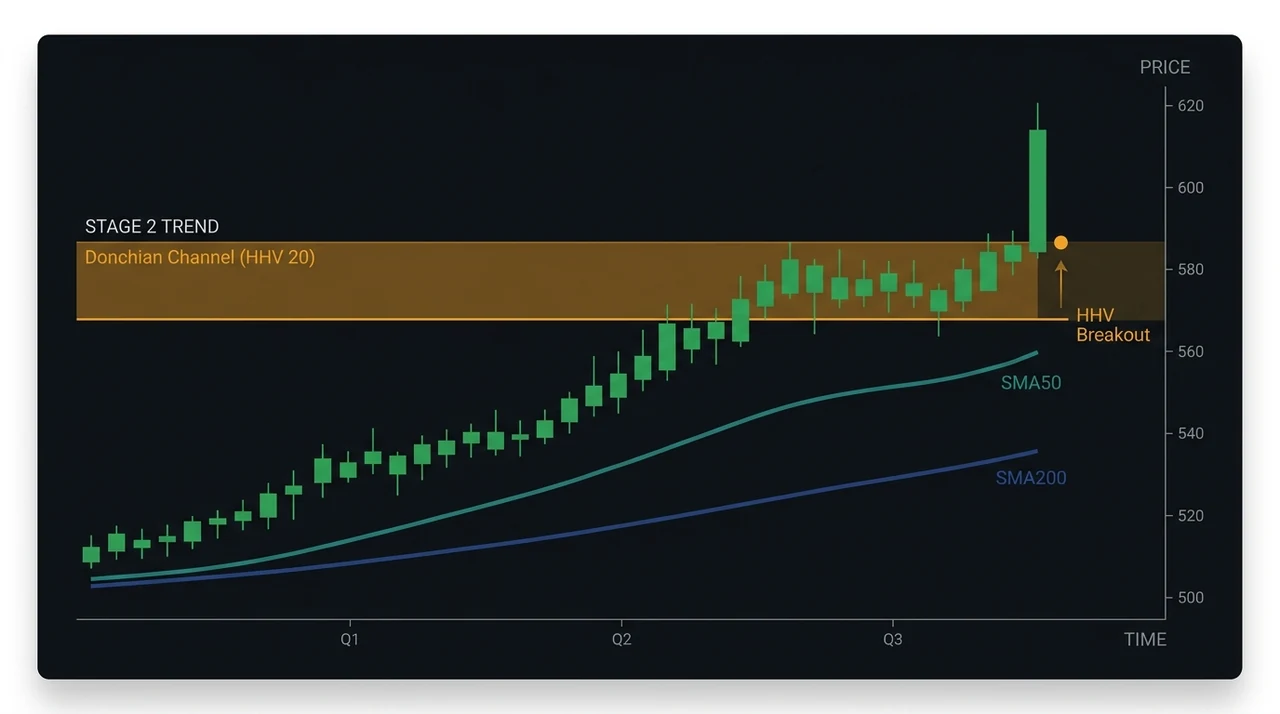
Qullamaggie Breakout: The Continuation Setup After a Momentum Leg
Kristjan Kullamägi — known online as Qullamaggie — has published his discretionary trade log on Kinfo since 2019. The verified results put him among the most consistent retail swing traders of the last decade. He trades three setups: Breakout Continuations, Episodic Pivots, and Parabolic Shorts. This guide covers the first one — the Breakout Continuation — and explains how it works as a rule-based, screenable setup rather than a vibe.
This is NOT the Episodic Pivot
The two setups get conflated constantly. They are different patterns.
- Episodic Pivot (EP) is a gap-up on a catalyst — usually an earnings beat or news event. The trader enters intraday once the opening range resolves. The thesis is that the catalyst has shifted the stock's distribution; expect follow-through over the next 1–10 days. EP is a discretionary, catalyst-driven setup.
- Breakout Continuation is a base trade. The stock has already had a sharp leg up — at least +25% in the last 60 days. It then consolidates tightly, drifts toward its 20-day EMA, and breaks above the 20-day high. The thesis is institutional accumulation in a leader; expect the next leg of the trend.
If you remember one difference: EP is a catalyst trade entered on the gap. Breakout Continuation is a base trade entered when a leader clears the consolidation high. The rest of this guide is about the Breakout Continuation.
The Three Rules
Qullamaggie's Breakout Continuation reduces to three measurable conditions, each of which has to hold for the setup to qualify.
Rule 1 — A prior +25% leg in the last 60 days
This is the gate that makes the strategy a continuation trade rather than a fresh breakout. The stock has to have already done something. The numerical test is the trailing 60-day total return — close today divided by close 60 sessions ago, minus one, has to be at least 0.25.
Why this matters: it filters out the universe down to names that institutions are already in. A breakout from a quiet stock has no proof of momentum behind it. A breakout from a stock that has already advanced 25% over the prior quarter is a continuation of a flow that is already there. Most of the broad US universe will fail this gate every day — that is the point.
Note on the threshold: Qullamaggie's original discretionary writeups cite a +30% prior-60d leg. EasySwing relaxes this to +25% so the screener returns enough signals per session to be useful in a daily workflow — a strict +30% gate cleared too few names per day on the US universe to produce a workable shortlist. The looser gate trades a small amount of leadership concentration for sample density. The other six conditions still have to hold.
Rule 2 — Tight consolidation within 10% of EMA20
After the leg, the stock has to pause. The pause is measured two ways. First, the range over the last 20 sessions — the highest high minus the lowest low — has to be no more than 20% of the current close. Second, the close has to sit within 10% of the 20-day exponential moving average. The first condition rules out wide, choppy bases that look like a top instead of a pause. The second condition rules out bases that are extended too far above the moving averages — a stock that has run 40% above its EMA20 is overextended and will mean-revert before it continues.
A clean Qullamaggie base looks boring on the chart. Tight range, low volume, price hugging the EMA20. That is the constructive sign.
Rule 3 — Break the 20-day high on volume
The trigger is a close above the highest high of the prior 20 sessions, on volume at least 1.4 times the 50-day average. The 20-day high is the resistance level the consolidation built; clearing it on expansion volume is the signal that buyers have re-engaged.
The volume condition is non-negotiable. A close above the 20-day high on declining volume is a weak signal — it suggests there was not enough demand to absorb the supply at that level. EasySwing distinguishes a BUY trigger (close above pivot AND volume confirmation) from a WATCH state (consolidation looks right but volume has not arrived yet).
Stop Placement and Trade Management
Once the breakout fires, the entry zone is anchored at the pivot — the 20-day high. The protective stop sits 1.5 ATR below entry. ATR is the 14-day average true range, a standard volatility measure. On a $100 stock with an ATR of $2.50, the stop is at $96.25.
After the trade is live, the management rule is a trailing EMA20 close break. As long as the stock holds above its 20-day EMA on a closing basis, the position stays open. The first close below the EMA20 closes the position. There is also a hard time stop at 60 bars — roughly three months — that exits any position that has not made progress.
Targets are bonus profit-taking points: scale 50% off at 2R (twice the initial risk), and 50% off at 4R. With the $3.75 risk per share from the example above, T1 sits at $107.50 and T2 at $115.
Why It Works (Honestly)
The mechanical answer is momentum persistence. Jegadeesh and Titman's 1993 paper, replicated in dozens of follow-ups, found that stocks ranked in the top decile by 6–12 month returns continue to outperform over the next 3–12 months. The +25% prior-60d gate is a strict version of the same idea: filter for momentum that has already proven itself.
The behavioral answer is institutional accumulation. Funds with multi-billion-dollar mandates cannot enter a position in a single afternoon. They build positions over weeks. A consolidation in a stock that just ran +25% or more is what that building looks like on the chart: tight, low volume, near the moving average. The eventual breakout is the resumption of the same buying.
Neither answer is unique to Qullamaggie — the same logic underwrites VCP Breakouts, Cup and Handle setups, and most pattern-based momentum strategies. What is specific to Qullamaggie is the strict prior-leg requirement. He will not trade a breakout from a stock that has not already moved.
How EasySwing Detects It
EasySwing screens for Qullamaggie Breakouts every day after the close. The screener applies the rules: RS rank ≥ 80 (the proxy for leadership), close above SMA200, prior 60-day return ≥ +25% (relaxed from Qullamaggie's discretionary +30% for sample density), 6-month return ≥ +20%, 20-bar range ≤ 20% of close, close within 10% of EMA20. When a stock crosses the pivot the next morning on volume confirmation, the setup grades up from WATCH to BUY.
Like every other strategy on the platform, the setup is regime-gated. If the broader market is in Trending Down or High Volatility regime, the setup is suppressed — Qullamaggie's own walk-forward showed the strategy is structurally adversarial in deep bear markets, and there is no point firing signals into conditions where the edge is negative.
How It Differs from VCP and Cup & Handle
EasySwing already had two long-side breakout strategies — VCP and Cup & Handle. Qullamaggie's Breakout Continuation is distinct from both:
- vs VCP: VCP requires 2–6 progressively tighter contractions inside the base. Qullamaggie does not — any 20-bar base that fits the range and EMA20 distance tests qualifies. More importantly, VCP does not gate on the prior leg. A Qullamaggie setup is a continuation trade; a VCP can sometimes fire from a stock that has only just entered Stage 2.
- vs Cup and Handle: Cup and Handle requires the U-shape — a deeper, 12–35% base over 3–6 weeks with a handle. Qullamaggie's base is shallower (≤ 20%) and shorter (20 bars), with no shape requirement. Same family of trade, different cadence.
The +25%-in-60d prior-leg gate is what makes the Qullamaggie Breakout its own strategy rather than a parameter variation of the others.
Honest Caveat — Bear Markets
Qullamaggie's own backtest (24 years, walk-forward across five folds) had one consistently failing window: the 2007–2010 fold spanning the Global Financial Crisis. Sharpe in that fold was −3.59. Breakout strategies are structurally adversarial in deep bear regimes — every long breakout in a rolling top is a trade into the next leg down.
VIX-scaled position sizing helps but does not solve it. The honest production handling is to use this strategy as one sleeve in a diversified book rather than standalone, and to scale down or halt new entries when the regime turns. EasySwing's regime-invalidation handles the latter: the strategy is hard-exited if the market flips to Trending Down or High Volatility.
If you trade this strategy through a 2008-style year without a portfolio hedge or a regime stop, you will give back multiple years of returns. There is no version of this setup that survives that on its own.
Practical Checklist
Before entering a Qullamaggie Breakout, confirm:
- ✅ Stock is above SMA200 (long-term uptrend)
- ✅ Trailing 60-day return is at least +25%
- ✅ Trailing 6-month return is at least +20%
- ✅ The last 20 sessions' range is no more than 20% of the current close
- ✅ Close sits within 10% of the EMA20
- ✅ RS rank is at least 80 — and ideally 90+ for higher-conviction setups
- ✅ Today's close prints above the 20-day high
- ✅ Today's volume is at least 1.4× the 50-day average
Stop at entry minus 1.5 ATR. Trail on the EMA20 close break. Time stop at 60 bars. Scale 50% at 2R, 50% at 4R.
Setup grade and regime gating handled by EasySwing. For the full strategy catalog see the swing trading strategies guide.
Frequently Asked Questions
What is the Qullamaggie Breakout setup?
The Qullamaggie Breakout — also called the Breakout Continuation — is a momentum-continuation pattern from Kristjan Kullamägi's discretionary playbook. The setup requires a leader that has already run at least +25% in the prior 60 days (EasySwing's relaxed threshold; Qullamaggie's original cites +30%) to form a tight consolidation: a 20-bar base with range no more than 20% of close, held within 10% of the 20-day EMA, above SMA200, with RS rank at least 80. The trigger is a close above the 20-day high on volume at least 1.4× the 50-day average. Stop is 1.5 ATR below entry; the position is trailed on the EMA20 close break with a hard time stop at 60 bars.
Is this the same as the Episodic Pivot?
No. The Episodic Pivot is a gap-up-on-catalyst setup — typically an earnings beat or news event — entered intraday on the opening range. The Breakout Continuation is a base trade — a leader pauses after a momentum leg, then breaks the 20-day high on volume. Both are Qullamaggie setups but the entry mechanics and edge sources are different. EasySwing currently implements the Breakout Continuation; the Episodic Pivot is a separate setup.
How does EasySwing screen for Qullamaggie setups?
EasySwing scans the full US equity universe (≈ 2,000 stocks) end-of-day. The Qullamaggie Breakout filter applies seven gates in order: RS rank ≥ 80, close above SMA200, prior 60-day return ≥ +25% (relaxed from Qullamaggie's +30% for sample density), 6-month return ≥ +20%, 20-bar consolidation range ≤ 20% of close, close within 10% of EMA20, and a close above the 20-day high on volume ≥ 1.4× the 50-day average for the BUY trigger. Setups that satisfy the structural gates but not the trigger appear as WATCH. Confluence scoring (0–6) grades stronger setups higher — for example a 60-day leg of +50% or a 6-month return of +50% pushes the grade upward beyond the minimum.
What is the win rate of Qullamaggie's strategy?
The honest answer is that EasySwing's own live aggregate is not yet published — the strategy is new on the platform, and live numbers will appear on the /performance page once enough signals have fired through the autoresearch sweep and grading. The 24-year imported backtest exists in our research notes, but it was produced on a different universe (yfinance top-50 momentum rebalance) and a different sizing model (VIX-scaled) than EasySwing's runtime, so its headline numbers should not be read as a forecast for the live aggregate. The point of the platform is to compute results on our universe with our cost assumptions and surface them transparently — not to inherit somebody else's headline figure.
Can this strategy be used in a bear market?
Not standalone. Qullamaggie's own walk-forward analysis found the 2007–2010 GFC window produced a Sharpe of −3.59. Breakout continuations are structurally adversarial in deep bear regimes — every long breakout in a rolling top is a trade into the next leg down. EasySwing's regime gating hard-exits the strategy when the market flips to Trending Down or High Volatility. Production users running this strategy through a 2008-style year should also pair it with a hedge or a short-bias sleeve and scale down on portfolio drawdown. There is no version of a pure long breakout strategy that survives a deep bear market unhedged.
Disclaimer: This article is for educational purposes only and does not constitute investment advice. EasySwing is a stock screening tool, not a registered investment advisor. All trading involves risk. Read our full disclaimer →