AI Stock Screener for Swing Traders: Automated Setup Detection With Market Regime Filtering
In their landmark 1993 Journal of Finance study, Jegadeesh and Titman documented that a strategy buying recent winners and selling recent losers earned a 12.01% compounded excess return per year over their 1965–1989 sample. The edge exists in the data. The problem is detection: across 2,000+ U.S. equities, an AI stock screener identifies qualifying setups every session in seconds — manual filter maintenance at that scale is not a realistic alternative.
This guide explains what separates AI-powered stock screening from conventional filter-based tools, how EasySwing's automated detection engine works, and what to evaluate before choosing any systematic screener.
What an AI Stock Screener Does Differently
An AI stock screener replaces discretionary filter maintenance with automated, validated setup detection — surfacing stocks that satisfy a complete named pattern definition, a quality grade, and a live market regime check before anything reaches your feed.
Traditional screeners (Finviz, TC2000, ThinkorSwim's Stock Hacker) put the burden on the trader: translate your edge into discrete filter combinations — "RSI under 30, close above SMA50, volume ratio above 1.5" — and the screener returns every stock that clears those thresholds. Whether those thresholds represent a real edge is left entirely to the trader's judgment. An automated setup-detection engine asks a different question: does this stock today match the complete definition of a named, historically validated setup?
The difference matters most over a full market cycle. Manual thresholds drift with recency bias — traders tighten RSI gates after missing an oversold bounce, loosen volume requirements after missing a low-volume breakout. Walk-forward validated parameter sets do not drift.
Mark Minervini, a two-time U.S. Investing Championship winner, makes the same argument throughout Trade Like a Stock Market Wizard (2013): a clear, repeatable process matters more than any single trade or indicator.
Validated Parameters vs User-Defined Thresholds
The core difference between an automated screener and a conventional filter tool comes down to one question: where did the parameters come from?
Standard screeners apply user-defined rules against today's data. Validated setup detection applies research-confirmed rules — derived from systematic backtesting, walk-forward testing, and out-of-sample holdout analysis — against every trading session.
This produces two practical advantages:
Parameter confidence. EasySwing's 13 named strategies are each backed by systematic out-of-sample testing, and the ones that cleared the selection-edge bar carry a published holdout profit factor, robustness score (0–1), and permutation p-value. The HHV Breakout runs with parameters that survived a full out-of-sample holdout: holdout PF 2.76 across 1,075 trades, robustness score 1.0, p=0.000. When you use an active EasySwing strategy, you are running entry conditions that passed rigorous testing — not a guess at what might work.
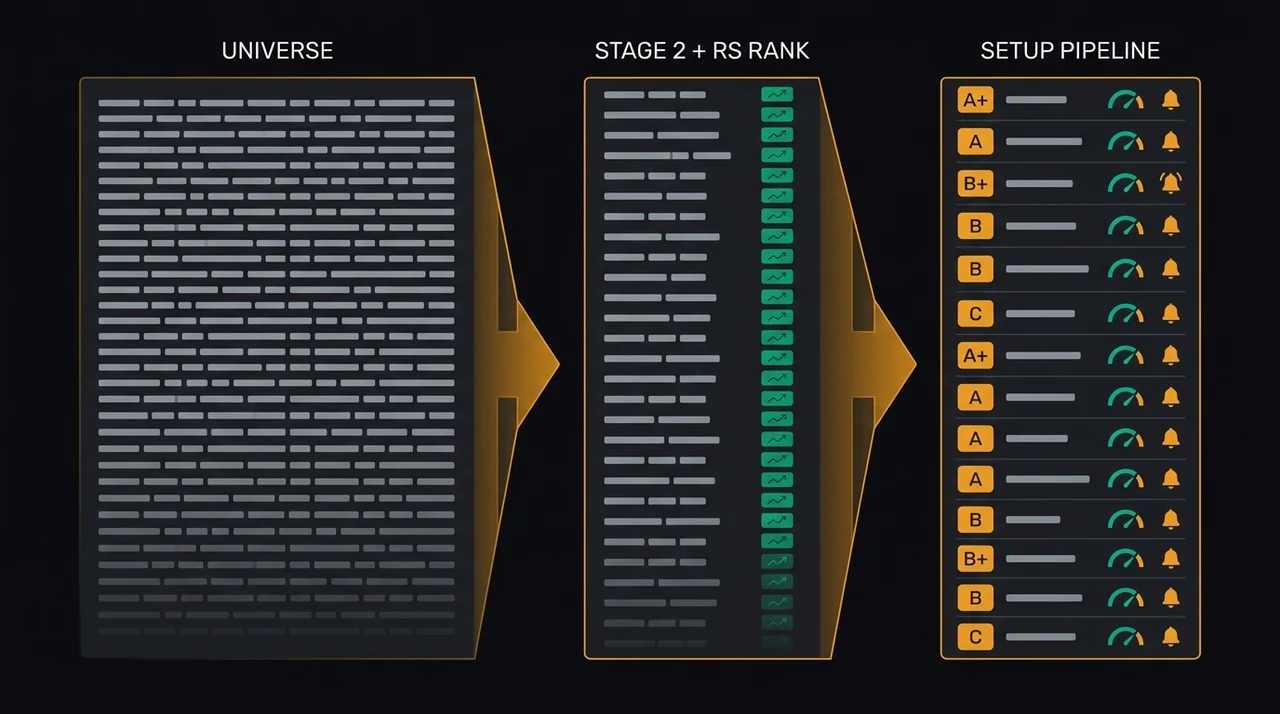
Setup-level grades. Each detected setup receives an A+, A, B+, B, or C quality grade based on pattern-specific metrics: contraction tightness for VCP, handle depth for Cup and Handle, up-day vs down-day volume ratio for trend pullbacks. The grade quantifies how closely the current pattern matches the highest-win-rate form of that setup. No filter checkbox recreates that judgment.
For the full breakdown of each strategy's parameters and historical statistics, see the swing trading strategies guide.
How EasySwing's Automated Detection Engine Works
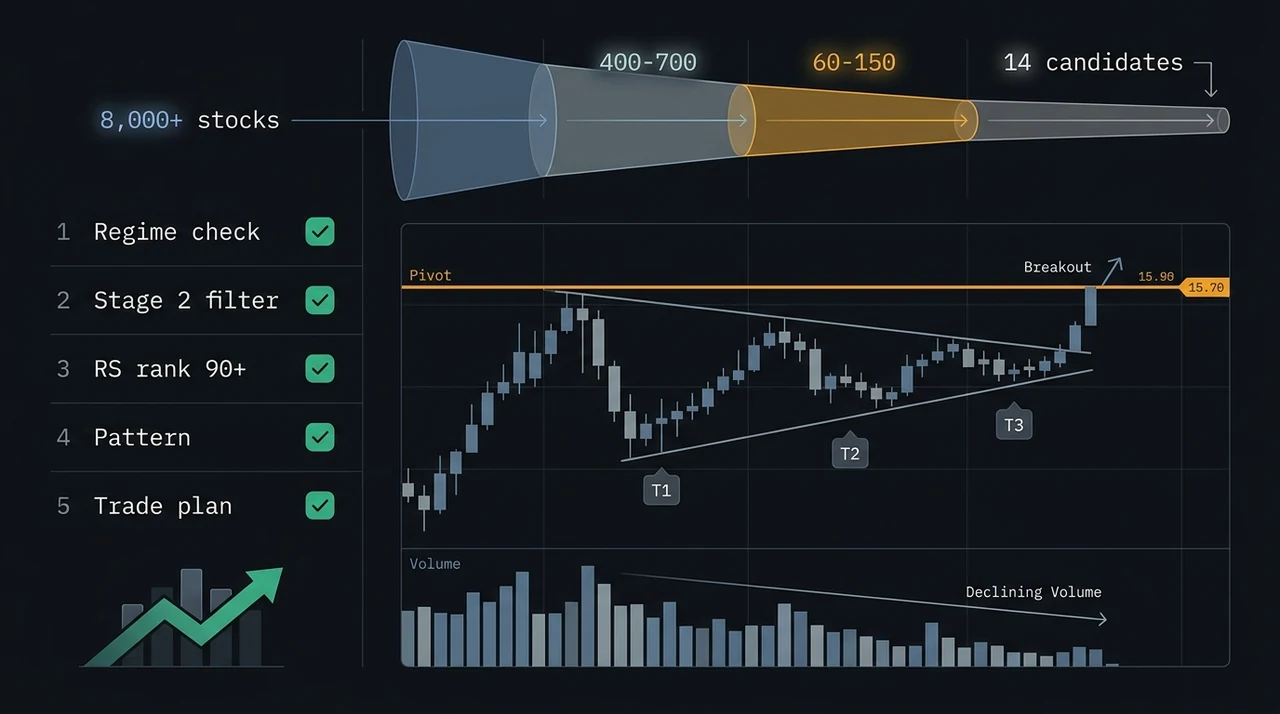
EasySwing runs three sequential gates before any setup appears in your feed:
Gate 1 — Pattern match. Each strategy's detection signal runs against end-of-day OHLCV data for the full equity universe each session. A stock either satisfies the complete multi-condition definition or it does not. Partial matches are excluded; no approximations are surfaced.
Gate 2 — Grade filter. The detected setup receives a quality grade (A+ through C), and each strategy carries its own validated minimum-grade floor — some setups only surface at A or A+, where their historical edge was confirmed. A pattern match below its strategy's floor never reaches the feed.
Gate 3 — Market regime gate. Every strategy carries an allowed-regime list derived from its historical win rate across market conditions. A VCP Breakout is allowed in Trending Up regimes but suppressed in Ranging and Trending Down regimes, where its historical win rate drops below breakeven. The market regime is assessed automatically from SPY trend structure, market breadth, and volatility data.
On a strong trending session, the combined feed may show 20–40 qualifying setups across the 2,000+ stock universe. During a choppy week, it may show 8 or fewer. The screener surfaces fewer signals and means more by each one. For how regime detection works mechanically, see the market regime guide.
Soren: AI-Assisted Interpretation and Custom Screen Building
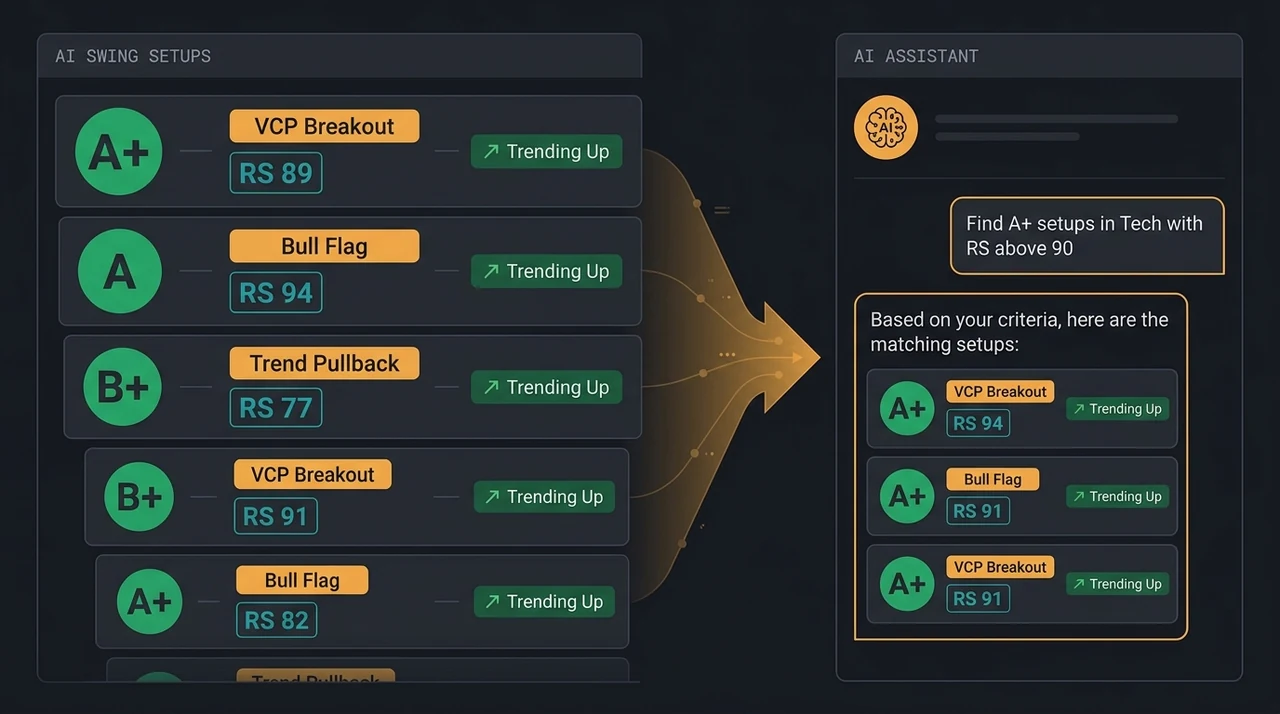
Beyond automated scanning, EasySwing includes Soren, an AI trading assistant built specifically for swing traders. Soren adds two capabilities that systematic scanning alone cannot provide.
Setup interpretation. For any detected setup, Soren explains why the pattern qualifies, what the historical win rate is in the current regime, where the optimal stop-loss sits relative to the pattern structure, and what the trade management rules look like — in plain English, with the pattern and regime context behind the signal. You receive not just the signal but the reasoning behind it.
Custom screen building. Ask Soren to build a custom screen using natural language: "Show me A+ grade setups in Technology with RS rank above 85." Soren translates that request into structured screener parameters and returns the matching setup list. No filter syntax required, no documentation lookup needed.
This approach narrows the gap between what systematic traders can screen for and how long it takes to configure those screens. Experienced traders move faster; newer traders avoid the parameter-guessing phase entirely.
The Grade System: A+/A/B+/B/C as Finished Judgment
Five-tier grading converts raw setup detection into a practical decision layer.
| Grade | What It Reflects |
|---|---|
| A+ | Top-decile pattern quality — tightest contraction, cleanest structure, strongest volume signature |
| A | Strong quality, above-average historical win rate for this setup type |
| B+ | Good quality, moderate win rate uplift over the baseline |
| B | Adequate quality, near-baseline win rate |
| C | Pattern conditions met but quality metrics below threshold |
Whether a given grade reaches the feed depends on the strategy: each carries its own validated minimum-grade floor, so a B-grade pullback may surface while a B-grade breakout from a stricter strategy does not.
The grade is not a simple filter applied after detection — it is pattern-specific. An A+ VCP has tighter successive contractions, lower inside-day volume, and a more precise pivot structure than a C VCP. The system quantifies that distinction the same way each session, across every stock in the universe simultaneously. No analyst team works at that scale.
Regime-Aware Screening: Same Setup, Different Odds
An automated screener without regime awareness is a detection engine without a filter for relevance.
The same VCP Breakout setup is, by design, a Trending Up strategy — its edge depends on institutional buying pressure that a Ranging market doesn't supply, so it's suppressed outside that regime. Live, tracked win rate is on the performance page rather than a headline backtest figure. A screener that runs the same logic regardless of market conditions will surface setups during periods when the expected value is negative. More signals in a choppy market is not a feature; it is noise.
EasySwing's regime gate is always active. When the market transitions from Trending Up to Ranging or Trending Down conditions, strategies whose historical performance does not clear the baseline in those environments are automatically removed from the feed. Traders do not need to manually adjust their screening criteria when market conditions shift.
This is the functional difference between an opinionated AI stock screener and a neutral filter tool. Neutral tools show you everything and leave context to you. An opinionated screener pre-filters for regimes in which each specific strategy has a documented edge.
AI Stock Screener Checklist
Before subscribing to any automated screening tool, verify these points:
- ✅Scans the full U.S. equity universe each session, not just a curated watchlist
- ✅Uses out-of-sample validated parameters, not in-sample tuned settings
- ✅Grades each setup on pattern quality, not just binary pass/fail detection
- ✅Applies a live market regime filter before surfacing any setup
- ✅Documents each strategy by name so you know exactly what you are trading
- ✅Publishes holdout performance statistics for each strategy in the engine
- ✅Includes an AI assistant to interpret signals and answer questions in context
- ✅Delivers signals via alerts so you can respond without monitoring the platform constantly
- ❌Avoid tools that require you to maintain manual RSI thresholds or crossover rules to replicate a known strategy
- ❌Avoid screeners that surface raw data without regime context or quality grades
- ❌Avoid any platform that cannot name the strategies its engine detects or publish their performance statistics
For configuring delivery so signals reach you automatically, see the swing trading alerts guide.
Frequently Asked Questions
What makes a stock screener "AI-powered"?
An AI-powered stock screener combines automated setup detection — systematic rules validated against historical data, running every session across the full equity universe — with an AI assistant that interprets signals, explains reasoning, and builds custom screens from natural language input. The key distinction: the detection logic is documented and its edge is verifiable against holdout data.
Does EasySwing use machine learning to identify setups?
EasySwing's strategy detection engine runs validated, rule-based signals derived from systematic walk-forward backtesting — not machine learning model inference. Rule-based systems are auditable, parameters are documented, and the edge is verifiable against out-of-sample holdout data. Soren, EasySwing's AI trading assistant, uses a large language model to interpret setups, answer trader questions, and build custom screens from natural language input.
Can I build my own screening criteria using the AI assistant?
Yes. With Soren's screen-building capability, describe a screening idea in plain English and Soren converts it to structured parameters. For example: "Find B+ or better VCP Breakout setups with RS rank above 90 in Technology." Soren returns a filtered setup list matching those criteria — no filter entry or documentation lookup required.
How does an AI screener differ from Finviz or TC2000?
Traditional screeners like Finviz require manually defined filter conditions — RSI levels, price ranges, volume minimums — and return raw lists of stocks that pass. AI-powered screeners detect named, validated setups automatically, grade each result on pattern quality, and filter for market regime before anything appears in the feed. You receive a shorter list with more context, not a longer list of raw data.
What is the best AI stock screener for swing traders using momentum strategies?
The best AI stock screener for momentum-style swing traders combines three elements: automatic detection of named momentum setups (such as VCP Breakout, Qullamaggie Breakout, and HHV Breakout) with out-of-sample validated parameters; quality grading on each detected setup; and a live regime filter that suppresses momentum setups during Bear or Choppy market conditions when momentum strategies historically underperform. EasySwing's strategies hub lists all 13 named setups with published holdout statistics — start there to confirm the strategy set matches your approach.
EasySwing.trading automatically detects 13 named swing trading setups across 2,000+ US equities each session, grades each setup A+ through C on pattern quality, and applies a live market regime filter before delivering results via the web app and Telegram alerts. See the swing trading strategies guide and market regime guide for how the detection and regime filtering work. Scan results are for informational purposes only. See our Risk Disclaimer.
Disclaimer: This article is for educational purposes only and does not constitute investment advice. EasySwing is a stock screening tool, not a registered investment advisor. All trading involves risk. Read our full disclaimer →